

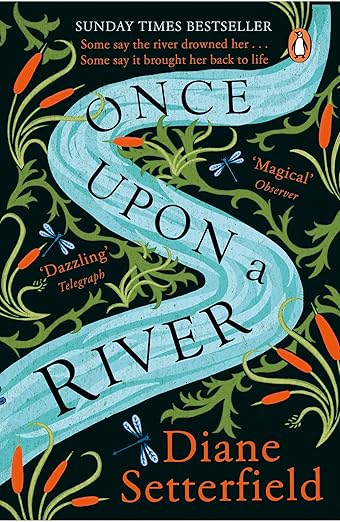
About Once Upon a River by Diane Setterfield – A Haunting Historical Mystery of Storytelling, Family, Science and the River Thames
Once Upon a River by Diane Setterfield is a rich historical mystery set beside the River Thames in the nineteenth century. The story begins on a dark winter night at the Swan, an old riverside inn where people gather to drink, talk, and tell stories. The regular evening changes when a badly injured stranger enters carrying the body of a small girl who appears to be dead. Hours later, the child breathes again.
No one knows who she is, where she came from, or how she survived. Because the girl cannot explain her past, other people begin to create answers for her. Soon, three different families believe she may belong to them.
From this strange event, Setterfield builds a story about grief, hope, identity, parenthood, love, folklore, and the need to make sense of things we do not understand. The book mixes mystery with historical fiction and a touch of the uncanny. It asks whether every mystery needs one clear answer, or whether people sometimes live between fact, belief, memory, and story.
A winter night at the Swan changes everything
The Swan is more than a pub. It is a place where stories are shared, changed, remembered, and passed from one person to another. People come because they enjoy listening as much as talking.
On the night the novel begins, the regulars expect another evening of familiar tales. Instead, a stranger enters badly hurt. He carries a small child who seems lifeless.
The shock is immediate. The people at the inn stop being storytellers and become witnesses to something they cannot explain. Then the girl begins to breathe.
That moment gives the novel its central mystery. Was the child truly dead? Did the cold river make her appear dead? Was her return a miracle? Is there a scientific answer? Or has the river done something no one can understand?
Setterfield does not force the reader to choose too quickly. The mystery stays open long enough for both reason and wonder to matter.
The unknown girl becomes the center of many lives
Because the girl does not speak, she cannot tell anyone her name. This silence creates a space that other people quickly fill.
One family believes she may be Amelia Vaughan, a child who was kidnapped years earlier. Another family sees a possible connection to their own missing child. A third claim also appears, giving the mystery more emotional weight.
Each family has a reason to hope. Each has suffered loss. That means identifying the girl is not simply a matter of solving a puzzle. The answer could change several lives.
This is where the book becomes more than a strange river mystery. It becomes a story about what grief can make people believe and what hope can make people risk.
Readers are asked to look at each claim with sympathy while also asking what the evidence truly shows.
Science and folklore flow beside each other
One of the most interesting parts of Once Upon a River is the way science and old stories exist side by side.
The nineteenth century was a time of growing scientific curiosity. New ideas about the body, nature, medicine, and human life were challenging older ways of understanding the world.
Rita Sunday, a nurse, represents careful observation and practical knowledge. She wants to understand what happened to the girl through evidence and the body.
Other people are more willing to believe in miracles, river spirits, old tales, or forces that cannot be measured.
The novel does not treat one side as foolish and the other as cold. Instead, it shows why people need both explanation and meaning.
The river feels alive without becoming a simple fantasy
The River Thames is one of the most important presences in the novel.
People work beside it, travel on it, fear it, respect it, and tell stories about it. The river connects different homes and communities, but it can also separate people.
Water carries objects, secrets, bodies, memories, and rumors. Its movement gives the book a natural shape. Stories travel like water, changing as they move from one person to another.
Setterfield makes the river feel powerful without turning it into a simple magical creature. It remains real water with real danger, but it also gathers symbolic meaning.
This is one reason the novel feels so atmospheric. The setting is not only a background. The river shapes the lives of the characters and the way the story itself moves.
Readers who enjoy books where place matters as much as plot may find this especially satisfying.
Storytelling is not just decoration here
Once Upon a River is deeply interested in why people tell stories.
At the Swan, stories are entertainment, memory, community, and sometimes a way to make life easier to understand.
People do not always tell stories exactly as events happened. They select details. They change emphasis. They fill gaps. They sometimes make a tale better for the listener.
The mystery of the girl becomes another story that spreads along the river. Each person hears it slightly differently. Each family brings its own hopes and fears.
The novel asks a simple but important question: when many versions of an event exist, how do we know which one to trust?
Rita Sunday brings calm reason into a strange situation
Rita Sunday is one of the most grounded characters in the novel.
She is practical, skilled, and interested in evidence. When the child appears dead and later breathes again, Rita does not immediately accept a supernatural explanation. She watches, thinks, and asks what the body may have done.
Her presence gives the novel a strong balance. The story can explore folklore and mystery while still respecting science.
Rita is also emotionally complex. She is not only a medical mind. She has her own fears, hopes, and relationships.
Through Rita, Setterfield shows that reason and emotion do not need to fight each other. A person can want evidence and still feel wonder. A person can understand medicine and still be moved by mystery.
Family love gives the mystery its emotional force
The question of the girl's identity matters because several people are carrying deep pain.
Parents who have lost a child do not experience the mystery as an interesting problem. For them, it may be a chance to recover someone they have never stopped missing.
This gives every new clue emotional weight.
Hope can become dangerous when someone wants an answer too badly. Setterfield handles this carefully. The families are not only plot devices. Their grief, love, guilt, and uncertainty become part of the heart of the book.
Readers who enjoy family-centered mysteries may find this part especially strong.
A historical mystery with a Gothic touch
The novel combines several kinds of reading experience.
There is a mystery to solve, but there is also a strong sense of history. The setting includes old inns, river travel, rural communities, changing science, and social rules of the period.
There is also a Gothic feeling. A child returns from apparent death. The river is full of old stories. Darkness, winter, silence, and uncertainty create an eerie mood.
Yet the novel is not a horror story. Its tension is quieter. Fear grows from not knowing what is true and from understanding how much people stand to lose.
What makes Once Upon a River worth reading
The novel offers many reasons to choose it:
- A strange opening mystery that begins with a child who appears to return from death.
- A richly drawn nineteenth-century setting beside the River Thames.
- Three competing family claims that give the mystery emotional depth.
- A strong mix of folklore, science, history, suspense, and romance.
- Memorable characters with different beliefs and motives.
- Themes of grief, parenthood, identity, truth, memory, and hope.
- A river setting that shapes both the story and the mood.
- A thoughtful look at how stories change as people repeat them.
- A mystery that allows both evidence and wonder to remain important.
- Beautifully layered storytelling for readers who enjoy slow, immersive fiction.
The novel also won the 2019 Historical Writers’ Association Gold Crown Award, adding to its reputation as a strong work of historical fiction.
Who should read Once Upon a River?
This book is a strong choice for readers who enjoy historical fiction, literary mystery, Gothic atmosphere, folklore, family drama, and stories set in old England.
It may especially appeal to readers who liked novels where a place feels alive, where the mystery develops slowly, and where the characters matter as much as the final answer.
Book clubs can find many useful questions here. Was the child’s survival a medical event or something more? Why do different people believe different stories? How does grief change judgment? What makes a family? Can a story be emotionally true even if every detail is not factual?
Readers who enjoy layered stories with patient pacing, emotional questions, and a strong sense of place may find the novel especially rewarding and memorable.
A premium reading copy from Bookish Wonderland
Once Upon a River is a detailed, atmospheric novel that many readers may want to enjoy slowly. Bookish Wonderland offers a reader-friendly copy with premium eye-soothing cream paper, crystal-clear print, and high-quality stitched plus glue binding for better longevity.
The cream paper helps make longer reading sessions comfortable, while the clear printing keeps the text easy to follow. The durable binding is designed for regular reading and long-term collection.
For readers comparing the Book price in Bangladesh for Once Upon a River by Diane Setterfield, Bookish Wonderland offers a convenient local option for ordering this atmospheric historical mystery.
Nationwide delivery is available across Bangladesh, including inside and outside Dhaka. Cash on delivery is available, and fast or urgent delivery options may also be available in Dhaka.
A mystery that asks what truth really means
The deeper strength of Once Upon a River is that the book does not only ask who the girl is.
It asks how people decide what to believe.
Evidence matters. Memory matters. Love matters. Fear matters. Stories matter. Sometimes these things point in the same direction, and sometimes they do not.
The characters must live with uncertainty while still making choices. Setterfield uses the mystery to show that truth can be something we search for carefully, but meaning is also shaped by the stories we tell about what happened.
Let the river carry you into the mystery
Once Upon a River by Diane Setterfield begins with one impossible-looking event and grows into a wide story about families, loss, identity, science, folklore, and the power of storytelling.
The novel takes its time, but that slow movement is part of its charm. Characters enter gradually. Stories cross. Clues appear. The river keeps moving while people try to decide what is true.
If you enjoy books that mix mystery with atmosphere and emotional depth, this is an excellent title to choose. It gives you a historical setting, a memorable cast, and a central question strong enough to pull the whole novel forward.
Order Once Upon a River by Diane Setterfield from Bookish Wonderland and discover a spellbinding Thames mystery where science, folklore, family love, and storytelling meet around one silent child and one unforgettable winter night.
If you require any customization or have any questions, please inbox us via FB or Insta.
| Primary Specification | |
| Author | Laura Levatino |
| Narrator | Juliet Stevenson |
| Genre | Historical Fiction, Literary Fiction, Gothic Fiction, Historical Fantasy, Mystery |
| ISBN-13/ISSN | 978-0743298087 |
| ISBN-10 | 074329808X |
| Publisher | Atria/Emily Bestler Books |
| Publishing Date | July 2, 2019 |
| Language | English |
| Reading Age | 18+ |
| Format | Printed book |
| Physical Specification & Quality | |
| Paper Quality | Premium eye-soothing cream paper |
| Binding Quality | High quality stitched and glue binding (for longevity) |
| Print Quality | Crystal-clear print |
| Pages | 496 pages |
| Country | UK |
| Logistics Information | |
| Weight | 516 gm |
| Length | 8.5 inches |
| Width | 5.6 inches |
| Height | 1.3 inch |