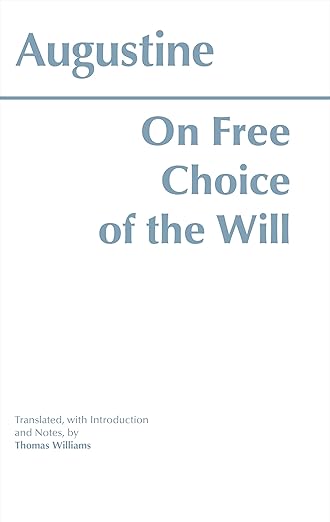
Skip to product information
1 of 1

Bookish Wonderland

On Free Choice of the Will by Saint Augustine

On Free Choice of the Will by Saint Augustine

Regular price Tk 164.00 BDT
Regular price Sale price Tk 164.00 BDT
Sale Sold out
Book cover type
Quantity

On Free Choice of the Will by Saint Augustine is a classic work of philosophy and Christian thought that explores one of the biggest questions in human life: why do people choose to do wrong? Augustine examines the meaning of free will, moral responsibility, evil, justice, truth, and the relationship between human choice and God. Written as a dialogue, the book follows a thoughtful discussion in which difficult questions are asked and carefully examined step by step. Augustine argues that free will is itself a good gift, but people can misuse it by choosing what is wrong instead of what is good. The book also considers whether people can truly be responsible for their actions if God already knows what they will choose. This makes the work important for readers interested in philosophy, theology, ethics, religion, and the history of ideas. On Free Choice of the Will is especially suitable for students, researchers, and thoughtful readers who want to understand freedom, responsibility, and the problem of evil more deeply. Read More

View full details

About On Free Choice of the Will by Saint Augustine – A Powerful Guide to Freedom, Evil, Choice, and Moral Responsibility

Why do people choose what is wrong when they know what is right? If God is good, where does evil come from? Are our choices truly free, or are they already decided by forces beyond us? On Free Choice of the Will by Saint Augustine takes these difficult questions and turns them into a clear philosophical conversation about human choice, responsibility, justice, truth, and the nature of evil. Instead of giving short answers, Augustine carefully examines how the human will works and why freedom matters. The book is written as a dialogue between Augustine and Evodius, which makes the discussion feel like a thoughtful question-and-answer exchange rather than a dry lecture. It is one of Augustine’s important early works and remains valuable for readers interested in philosophy, Christian thought, ethics, theology, free will, and the problem of evil.

A Book Built Around One Big Human Question

Most people have asked some version of the same question: if people can choose between good and bad, why do they often choose badly? Augustine begins from the problem of evil and asks whether God can be blamed for human wrongdoing. His answer develops step by step. He argues that human beings have a will, that the will can choose, and that moral responsibility depends on those choices. In his view, free choice is not bad simply because it can be misused. The power to choose is also what allows a person to act rightly, love what is good, and accept responsibility.

This makes the book more than a religious text. It is also a serious work of moral philosophy. Augustine asks what makes an action wrong, what makes a person responsible, why law matters, how reason should guide desire, and whether knowledge of the future destroys freedom.

When Simple Answers Are Not Enough

Questions about freedom and evil can feel confusing because they touch many ideas at once. A reader may wonder whether an action is truly free if God already knows it will happen. Another person may ask why a good creator would give humans the ability to make harmful choices. Some may struggle with the difference between wanting something and choosing what is actually good.

On Free Choice of the Will gives readers a structured way to think through these problems. Augustine does not simply say that humans are free and end the discussion. He tests the idea through objections, questions, examples, and logical steps. Evodius often raises the kind of doubts a reader might have, and Augustine responds by developing the argument further. This dialogue form helps turn a difficult subject into a sequence of connected questions.

The dialogue format also helps readers follow the movement from one question to the next, making the book practical for close reading, classroom discussion, written assignments, and personal study over time.

What You Will Find Inside the Work

The text is divided into three internal books. In the first part, Augustine and Evodius examine wrongdoing, law, desire, reason, and the human will. The discussion asks whether people sin because they are forced or because they choose wrongly. Augustine develops the idea that a well-ordered person should allow reason to guide lower desires instead of becoming ruled by them.

The second part moves deeper into the value of free will. If free will can lead to sin, Evodius asks, why would God give it to human beings at all? Augustine answers by arguing that free will is needed for right action. A person cannot deserve praise for goodness if goodness is completely forced. The discussion also explores truth, reason, and the idea of a higher and unchanging good.

The third part turns toward difficult questions about divine foreknowledge, necessity, responsibility, suffering, and the origin of evil. Augustine considers whether God’s knowledge of future choices makes those choices unavoidable. He works to separate knowing that something will happen from causing it to happen. This section is especially useful for readers interested in the long debate between free will and determinism.

Why This Book Still Matters

The world has changed greatly since Augustine wrote, but the questions in this book have not disappeared. People still debate whether criminals are fully responsible for their actions, whether biology and environment control behavior, whether freedom can exist in a world governed by cause and effect, and whether suffering can be understood within a belief in a good God.

Augustine’s work gives historical depth to these debates. Many later thinkers in Christian theology and Western philosophy responded to questions that Augustine helped shape. Reading this book lets you see an early and influential form of the debate rather than only reading modern summaries of it.

It is also useful because the book does not treat freedom as simply “doing whatever you want.” Augustine connects freedom with reason, order, goodness, and responsibility.

Easy to Use for Study and Discussion

This title can be valuable for university students, philosophy learners, theology students, teachers, book clubs, and independent readers. It works well when studying topics such as free will, determinism, moral responsibility, the problem of evil, Christian philosophy, late ancient thought, ethics, and the history of ideas.

A student can use it alongside lecture notes or secondary readings. A discussion group can take one argument at a time and ask whether Augustine’s reasoning is convincing. A reader interested in religion can focus on divine justice, sin, and responsibility. A reader interested mainly in philosophy can examine the logical structure of the arguments without needing to agree with every theological assumption.

A Reading Experience Designed for Serious Readers

At Bookish Wonderland, this edition is prepared for readers who want a comfortable physical copy for repeated reading and study. The text is printed clearly so long sections remain easier on the eyes. Premium eye-soothing cream paper gives the pages a softer look than bright white paper, which can help during longer reading sessions. The high-quality stitched and glue binding is designed for better durability, especially for readers who underline, annotate, revisit chapters, or use the book in regular coursework.

The goal is simple: a thoughtful book should come in a format that supports thoughtful reading. You should be able to move through difficult ideas without being distracted by weak print, uncomfortable paper, or a fragile binding.

Key Features of This Edition

  • Crystal-clear print for clean and easy reading.

  • Premium eye-soothing cream paper for a softer page tone.

  • High-quality stitched and glue binding for better longevity.

  • Durable printed format suitable for regular study and rereading.

  • A serious philosophical work focused on free will, evil, justice, and responsibility.

  • Dialogue-based structure that presents questions and answers in a natural flow.

  • Useful for philosophy, theology, ethics, religious studies, and independent learning.

  • Suitable for annotation, class discussion, research, and personal reading.

What Readers Can Gain From It

One major benefit of this book is sharper thinking. Augustine forces the reader to define terms carefully. What is evil? What is freedom? What makes a choice voluntary? Can a person be responsible for an action if that action is known in advance? These questions train the reader to slow down and examine assumptions.

Another benefit is historical understanding. Modern debates about free will did not begin recently. By reading Augustine directly, you can see how major questions about choice and responsibility were framed many centuries ago.

The book can also strengthen discussion skills. Because Augustine’s arguments can be accepted, challenged, or compared with other thinkers, the text gives readers many starting points for essays, classroom debate, research, and personal reflection.

For religious readers, it can provide a deeper look at the relationship between human choice, divine goodness, justice, and sin. For nonreligious readers, it remains important as a work in the history of philosophy and as an example of systematic reasoning about moral responsibility.

Who Should Read On Free Choice of the Will?

This book is a strong choice for readers who enjoy philosophy that asks basic but difficult questions. It is especially suitable for students of philosophy, theology, religious studies, history, ethics, and Western thought. It can also appeal to readers of Augustine’s Confessions, The City of God, or other classic works of Christian philosophy.

You may enjoy this book if you often think about why people make bad choices, whether people can change, whether freedom is real, how responsibility should be judged, or how belief in God can be reconciled with evil and suffering.

It is not a fast entertainment read, and that is part of its value. The book is meant to be considered carefully. Some passages may require rereading, but that slower pace can make the ideas more memorable. Readers who like books that challenge the mind will find much to discuss.

A Useful Addition to a Philosophy or Theology Collection

Classic works become more useful when they are available for repeated reference. On Free Choice of the Will is the kind of title that can be returned to during different stages of study. A first reading may focus on the problem of evil. A later reading may focus on moral responsibility. Another may focus on divine foreknowledge or the meaning of true freedom.

For students building a personal academic library, it can sit naturally beside works on ethics, philosophy of religion, ancient and medieval philosophy, and Christian theology. For general readers, it offers direct access to one of the thinkers who strongly influenced later discussions of the will.

If you are comparing Book price in Bangladesh for On Free Choice of the Will by Saint Augustine, Bookish Wonderland offers a durable reading copy made for study, collection, and long-term use.

Why Order From Bookish Wonderland?

Bookish Wonderland focuses on English books for readers who care about both content and physical quality. This edition combines clear printing, premium cream paper, and durable stitched and glue binding so the book can handle regular reading and study. The store also offers a large collection of premium and durable English books, making it easier to find classics, philosophy, fiction, self-development, academic titles, and other reading choices in one place.

Nationwide delivery is available across Bangladesh, including delivery inside and outside Dhaka. Cash on Delivery is available, which gives customers a simple payment option. Readers in Dhaka can also ask about fast or urgent delivery when they need a book sooner.

Make This Classic Part of Your Reading List

On Free Choice of the Will by Saint Augustine is for readers who want more than a surface-level answer to the question of human freedom. It asks you to think about what makes a choice truly yours, why wrongdoing happens, how reason should guide desire, and whether responsibility can exist alongside divine knowledge.

The book has lasted because these questions are still alive. Whether you are studying Augustine for a course, exploring the problem of evil, comparing theories of free will, or building a serious philosophy collection, this work gives you a direct path into one of the most important debates in the history of thought.

Choose a copy that is comfortable to read and strong enough for repeated use. Order On Free Choice of the Will by Saint Augustine from Bookish Wonderland and add a foundational work on freedom, responsibility, and moral choice to your collection today.

If you require any customization or have any questions, please inbox us via FB or Insta.

Primary Specification
AuthorSaint Augustine of Hippo
TranslatorThomas Williams
EditorDan Kirklin
GenrePhilosophy, Christian Philosophy, Theology, Free Will, Medieval Philosophy
ISBN-13/ISSN‎ 978-0872201880
ISBN-100872201880
PublisherHackett Publishing Company, Inc.
Publishing DateOctober 1, 1993
LanguageEnglish
Reading Age16+ years
FormatPrinted book
Physical Specification & Quality
Paper QualityPremium eye-soothing cream paper
Binding QualityHigh quality stitched and glue binding (for longevity)
Print QualityCrystal-clear print
Pages160 pages
CountryUnited States
Logistics Information
Weight181 gm
Length8.5 inches
Width5.6 inches
Height0.5 inch
What is On Free Choice of the Will by Saint Augustine about?How many books are in the On Free Choice of the Will series by Saint Augustine, and what are they?

On Free Choice of the Will is a philosophical and theological dialogue in which Saint Augustine examines human freedom, moral responsibility, sin, evil, justice, and the goodness of God. The discussion begins with a difficult question: if God is good and created everything, where does evil come from? Augustine argues that wrongdoing should not be blamed on God because human beings possess free choice and can misuse it. The discussion gradually expands into questions about eternal law, reason, happiness, truth, divine foreknowledge, and why free will is still a good gift even though people can use it badly. The book is especially valuable for readers interested in philosophy of religion, Christian thought, ethics, free will, and the historical debate about the problem of evil.

How many books are in the On Free Choice of the Will series by Saint Augustine, and what are they?

There is no numbered On Free Choice of the Will series by Saint Augustine. On Free Choice of the Will, originally titled De libero arbitrio, is one complete standalone philosophical work. However, the work itself is divided internally into three sections called Book One, Book Two, and Book Three. These should not be confused with three separate novels or volumes in a series. Book One mainly examines wrongdoing, desire, law, and moral responsibility; Book Two asks why God gave human beings free choice and discusses the existence and goodness of God; and Book Three considers divine foreknowledge, responsibility, sin, and the origin of the will's movement toward lesser goods. Readers therefore receive the complete argument in a single work rather than needing to purchase additional books to finish the discussion.

Is On Free Choice of the Will difficult for beginners to read?

It can be challenging for a complete beginner because Augustine develops his arguments step by step and often examines an objection from several different directions before reaching a conclusion. Readers discussing the book commonly mention that some sections require slow reading or rereading, especially when Augustine moves into questions about knowledge, the existence of God, divine foreknowledge, the soul, and moral responsibility. However, readers do not need to be professional philosophers to benefit from it. The dialogue format helps because questions are raised and answered through discussion rather than presented only as abstract statements. The Thomas Williams edition is particularly useful for students because it includes an introduction designed to help readers understand Augustine's ideas and philosophical context. Taking one section at a time makes the book much easier to follow.

What does Saint Augustine say about the problem of evil in On Free Choice of the Will?

One of Augustine's central concerns is explaining how evil can exist if God is good. His answer places moral responsibility on the misuse of human freedom rather than making God the author of wrongdoing. Augustine argues that free choice is itself a good thing, but a person can direct the will badly by turning away from higher and lasting goods toward lower or changeable goods in a disordered way. This allows him to distinguish between God giving humans the capacity to choose and humans being responsible for how that capacity is used. The argument became historically important because it shaped later Christian discussions about evil, freedom, responsibility, punishment, and divine justice. Readers interested in the classic philosophical "problem of evil" will therefore find this one of Augustine's most directly relevant works.

How does Augustine explain free will if God already knows what people will choose?

Augustine directly addresses the apparent conflict between divine foreknowledge and human freedom. The basic problem is simple: if God already knows what a person will do tomorrow, some readers wonder whether that person can genuinely choose anything else. Augustine argues that knowing an action beforehand is not the same as causing that action. God's knowledge of a future voluntary choice does not, in Augustine's argument, turn the choice into something performed against the person's will. This part of the book remains highly discussed because the relationship between foreknowledge, necessity, freedom, and responsibility is still an important issue in philosophy of religion. It also makes the work useful beyond purely historical study, since readers can compare Augustine's reasoning with modern arguments about determinism and moral responsibility.

Why is On Free Choice of the Will written as a dialogue, and who is Evodius?

The work is presented largely as a philosophical dialogue involving Augustine and Evodius, a friend and associate of Augustine. Evodius raises questions, doubts, and objections, while Augustine develops answers through reasoning and further questioning. This method gives readers a chance to follow the argument as it develops instead of receiving only a finished conclusion. The three-book dialogue moves through connected problems concerning evil, law, reason, freedom, God, knowledge, and responsibility. For students familiar with classical philosophy, the question-and-answer structure may also feel similar to the philosophical dialogue tradition associated with writers such as Plato. The format is useful because Evodius frequently raises exactly the kinds of objections a reader might have, although some later sections become longer and more demanding as Augustine's philosophical reasoning becomes more detailed.

Is the Thomas Williams translation of On Free Choice of the Will good for students and modern readers?
Yes. The Hackett Classics edition translated by Thomas Williams is widely used as an accessible English edition of Augustine's work. Hackett identifies it as a translation with an introduction by Williams, and academic comments published with the edition particularly praise both the translation and the clarity of the introduction. Williams aims to preserve Augustine's meaning and sequence of thought while presenting the text in readable modern English. This is useful because Augustine's argument contains technical questions about freedom, knowledge, morality, God, and responsibility that can become difficult in less accessible translations. The introductory material also gives readers useful background before entering the dialogue. For university students, philosophy readers, theology students, and independent learners, this edition offers a practical way to study an important historical text without depending entirely on older English wording.
Is On Free Choice of the Will by Saint Augustine a premium edition?
Yes. The copy offered by Bookish Wonderland is prepared with premium reading quality in mind, making it suitable for personal study, university reading, annotation, or building a long-term philosophy and classics collection. Readers receive crystal-clear printing so Augustine's argument and the dialogue can be read without unclear or faded text. The pages use premium eye-soothing cream paper, which gives the book a comfortable appearance during longer reading sessions. The physical construction is also designed to handle regular use rather than feeling like a temporary low-quality print. This is especially useful for a philosophical book such as On Free Choice of the Will, because many readers return to important passages, compare arguments between sections, and reread difficult discussions. Bookish Wonderland focuses on providing a clean, durable, comfortable printed copy for readers in Bangladesh.
What is the paper and print quality of On Free Choice of the Will from Bookish Wonderland?

The book is printed on premium eye-soothing cream paper, selected to provide a smooth and comfortable reading experience. Cream-colored pages are especially suitable for a text-heavy philosophical work because they provide a softer reading surface than harsh bright-white paper during longer study sessions. The printing is crystal-clear, with sharp and easily readable text throughout the pages, helping readers follow Augustine's detailed arguments without struggling with weak or blurred letters. Good page quality also makes the book more pleasant for readers who like to underline passages, make study notes, or repeatedly return to important sections. Bookish Wonderland places particular attention on readable printing and dependable page quality so customers receive a physical book that feels appropriate for serious reading, academic use, personal study, and long-term collection.

How durable is the binding of On Free Choice of the Will, and will the book last with regular reading?

The Bookish Wonderland copy uses high-quality stitched and glue binding for improved strength and longevity. Instead of depending only on a basic adhesive structure, the combined binding method helps keep the pages securely attached when the book is opened and read repeatedly. This matters for On Free Choice of the Will because students and serious readers may frequently reopen particular passages while studying Augustine's arguments about evil, free choice, law, and divine foreknowledge. With normal handling and proper storage, the strong construction is intended to maintain the book's shape and page security over extended use. Keeping the book away from excessive moisture, direct sunlight, and rough folding will further protect it. The durable binding makes this copy suitable for regular study as well as readers who want to keep the title in a personal philosophy or theology collection.

Why is Bookish Wonderland one of the best choices for buying On Free Choice of the Will in Bangladesh?

Bookish Wonderland focuses on providing a large collection of premium and durable English books for readers throughout Bangladesh, with particular attention to the physical reading experience. For On Free Choice of the Will, customers receive premium cream paper, crystal-clear printing, and strong stitched and glue binding rather than having to compromise on readability or durability. This combination is particularly useful for philosophy and academic titles that readers may study closely and keep for years. Customers can also order from both Dhaka and locations outside Dhaka instead of being limited to a particular area. Bookish Wonderland brings book quality, convenient ordering, nationwide delivery options, and a broad English-language collection together in one place, making it a practical choice for students, collectors, philosophy readers, and anyone looking for durable English books.

Does Bookish Wonderland offer Cash on Delivery and nationwide delivery for On Free Choice of the Will?

Yes. Customers can order On Free Choice of the Will by Saint Augustine from Bookish Wonderland with nationwide delivery across Bangladesh, and Cash on Delivery is available throughout the country. Orders can be delivered both inside Dhaka and to locations outside Dhaka, allowing readers in different districts to purchase the book without visiting a physical store. For customers in Dhaka who need the book quickly for study, classes, assignments, exams, or personal reading, a fast or urgent delivery option is also available. These delivery choices make it easier for students and general readers to order English philosophy books regardless of their location. Customers can select the suitable delivery option when ordering and receive a well-printed, strongly bound copy directly at their preferred delivery address.