

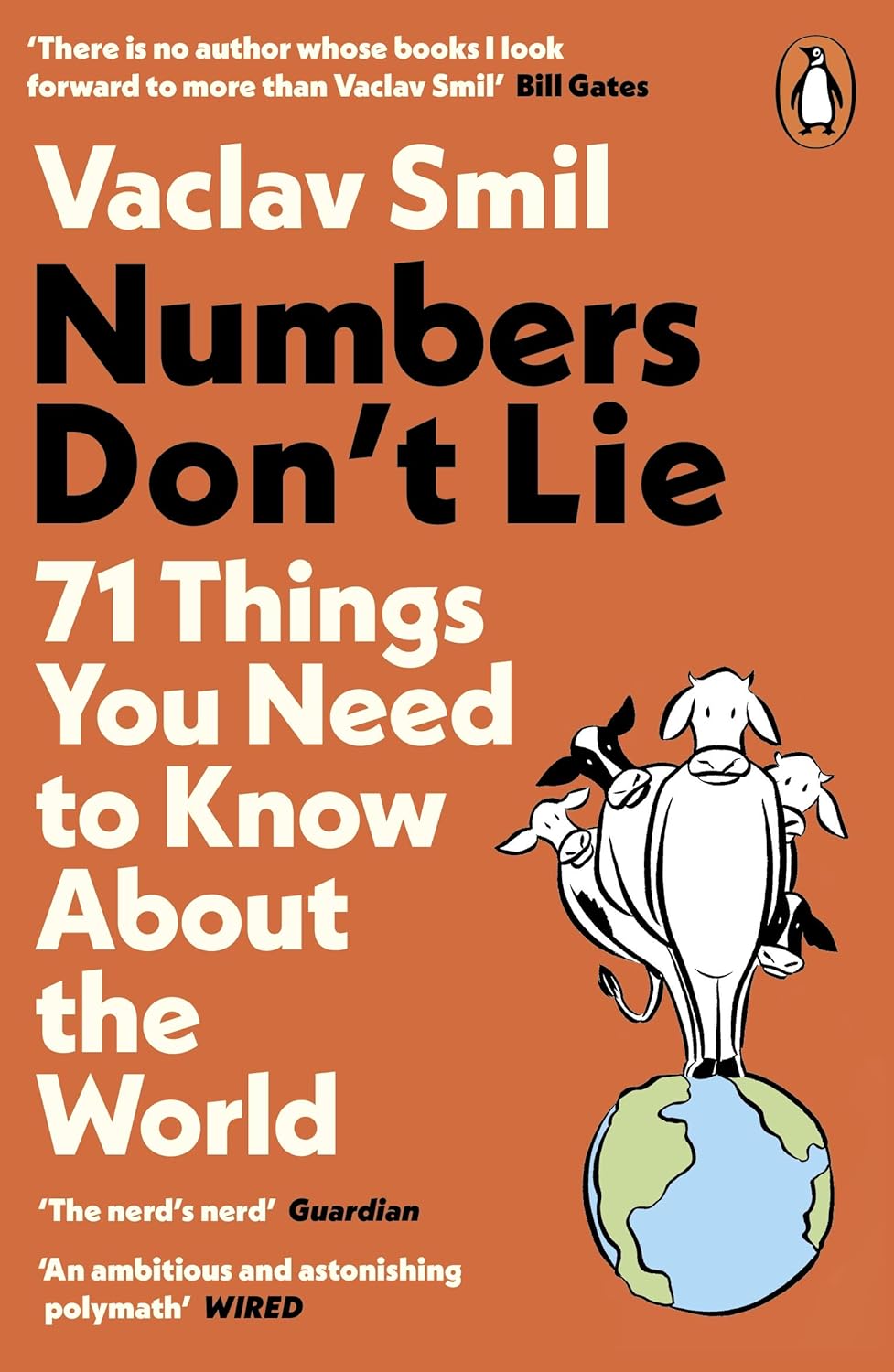
About Numbers Don't Lie by Vaclav Smil – 71 Clear, Data-Driven Lessons About How the Modern World Really Works
Numbers Don't Lie by Vaclav Smil is a wide-ranging nonfiction book that uses statistics, comparisons, and short essays to explain how the modern world works. Instead of asking readers to accept popular claims, headlines, or assumptions, Smil looks at measurable facts and puts them into context. The book covers population, food, energy, technology, transport, machines, the environment, and the ways countries grow and change. Its purpose is not to make readers memorize numbers but to help them understand what those numbers actually mean.
The book is built from 71 short pieces, which makes it easy to read in small sections. You can read one essay at a time or move through the whole book in order. Smil asks practical questions, compares large systems, and shows how everyday life depends on things most people rarely stop to measure. A topic may begin with cows, cars, airplanes, vaccines, smartphones, or electricity and then lead into a larger discussion about resources, efficiency, health, economics, or the environment.
Why this book is useful in a world full of headlines
Modern news moves quickly, and numbers are often used to make a claim sound convincing. A percentage may look impressive without showing the size of the original number. A single year may be used to suggest a trend that does not exist over a longer period. A new technology may be described as revolutionary before anyone has looked carefully at the materials, energy, cost, or infrastructure it requires.
Smil encourages readers to slow down and ask better questions. What exactly is being measured? Compared with what? Over what period? Is the number large because the total population is large, or because the rate is genuinely unusual? Does a change matter at the scale of a person, a city, a country, or the whole planet?
This habit of checking scale and context is one of the book's biggest strengths. It can help readers become more careful when they see statistics in news reports, advertisements, political debates, business presentations, and social media posts.
Seventy-one short essays make difficult topics easier to approach
Numbers Don't Lie covers a large amount of material, but the short chapter format keeps the book manageable. Each essay focuses on one question or comparison and develops it without turning into a long academic chapter. This structure suits readers who like learning in short sessions.
The topics move from population and food to energy, transport, technology, and the environment. Smil often uses one surprising number as a starting point, but he usually connects it to a wider system so the reader understands why the number matters.
The result works both as a continuous read and as a reference.
People and populations look different when you compare the right numbers
One group of essays examines people, population, health, and social change. Smil looks at the size and structure of populations, life expectancy, fertility, disease, and the ways societies change over time. These chapters show why total numbers and rates can tell very different stories.
A country with a large population may have a huge number of births even when the average family size is falling. A nation may become older even while its economy continues to grow. Health improvements can have effects that reach far beyond hospitals because longer lives, lower child mortality, and changing family size can reshape education, work, housing, and public spending.
Smil uses numbers to make these relationships easier to see. Rather than treating population as an abstract topic, he connects demographic change with real questions about how societies function and what governments, businesses, and families may need to prepare for.
Energy is one of the hidden systems behind everyday life
Energy is a major subject in Smil's wider work, and it appears throughout Numbers Don't Lie. Modern life depends on large flows of energy that power homes, factories, transport, farms, data systems, and infrastructure. Many products that seem simple require long chains of extraction, manufacturing, transport, and electricity before they reach the user.
Smil's approach is useful because he asks readers to think beyond the energy they can see directly. Charging a phone looks simple, but the device itself required materials, factories, shipping, data networks, and electricity. Driving an electric car removes tailpipe emissions, but the full environmental picture also includes battery production, electricity generation, vehicle manufacturing, and the source of raw materials.
The book does not ask readers to reject new technology. It asks them to measure the complete system before making simple claims. That is a useful lesson for anyone interested in climate, energy policy, engineering, sustainability, or technology.
Food becomes more interesting when you follow the full system
Food is another area where the numbers can be surprising. The book looks at agriculture, meat, crops, nutrition, and the enormous systems needed to feed billions of people. A meal may seem ordinary, but producing it can involve land, water, fertilizers, machinery, energy, transport, refrigeration, processing, and waste.
Smil often compares foods by scale and efficiency, helping readers see why certain changes in diet can have large effects when they happen across millions of people. He also examines how agriculture has changed with technology and why food production cannot be understood only by looking at what appears on a supermarket shelf.
These chapters show how food choices connect with wider systems and why agriculture remains central to modern life.
Transport is about more than speed and convenience
Cars, airplanes, ships, and other forms of transport have changed where people can live, work, trade, and travel. Smil looks at transportation through questions of scale, risk, efficiency, fuel, and infrastructure. The numbers often challenge everyday impressions.
People may fear one type of travel because accidents receive major news coverage while underestimating risks that are more common but less dramatic. A transport system may appear efficient when judged only by travel time but look different when fuel use, construction, maintenance, and total passenger movement are considered.
This is where Smil's method becomes especially useful. He does not rely on one number when several are needed. He compares rates, totals, trends, and physical limits, showing that a fair comparison depends on choosing the right measure.
Machines and inventions are judged by what they actually achieve
The book also examines machines, technologies, and inventions that changed modern life. Smil is interested in how quickly technologies spread, how much energy they use, what they improve, and whether their real impact matches the excitement around them.
Some innovations transform life, while others improve only one part of a larger system. Smil looks at evidence before deciding how important a technology really is.
The lesson applies beyond the specific examples in the book. When a new device, app, vehicle, energy source, or industrial process is described as world-changing, readers can use Smil's approach and ask what it replaces, how widely it can scale, what resources it needs, and what measurable improvement it creates.
The environment needs numbers as well as good intentions
Environmental questions are often emotional because they involve climate, pollution, land, resources, and the future. Smil does not argue that emotion should disappear, but he shows why environmental decisions need accurate measurement.
A technology may reduce one kind of pollution while increasing demand for another resource. A product may look clean during use but require energy-intensive manufacturing. A policy may create a large effect in one country but only a small change globally. Without numbers, it is easy to focus on the most visible part of a problem while missing the larger system.
Numbers Don't Lie helps readers think in terms of totals, rates, lifetimes, and trade-offs. This does not automatically give one correct policy answer, but it makes the discussion more realistic. For students, researchers, business readers, and environmentally conscious readers, that habit can be more valuable than memorizing any single statistic.
Why the book does not require advanced mathematics
Despite the title, this is not a mathematics textbook. Readers do not need advanced algebra, calculus, or statistics to understand the main arguments. Smil uses numbers as evidence, but the explanations are written for general readers.
The important skill is curiosity. Readers should be willing to compare quantities, think about scale, and question assumptions. Graphs and statistics support the essays, but the book's main purpose is interpretation rather than calculation.
This makes it suitable for readers who want to become more comfortable with data without taking a technical course. It also shows why numerical literacy matters across science, health, business, politics, and everyday decisions for work, study, and everyday decision making.
Who should read Numbers Don't Lie by Vaclav Smil?
The book is a strong choice for readers interested in science, economics, energy, technology, environment, food, transport, population, and global development. It can also suit students, teachers, researchers, business professionals, policy readers, and anyone who regularly encounters statistics and wants to judge them more carefully.
Readers who enjoy short essays may especially like the format and its flexible pace.
It is also useful for people who normally find large nonfiction books intimidating. The topics are serious, but the structure breaks them into smaller questions, allowing readers to build understanding gradually instead of facing one long technical argument.
Premium reading quality from Bookish Wonderland
Bookish Wonderland offers this edition for readers who want a comfortable physical copy for regular reading, study, or long-term reference. The book uses premium eye-soothing cream paper, giving the pages a softer appearance during longer reading sessions. Crystal-clear printing helps keep graphs, numbers, headings, and text easy to follow, while high-quality stitched and glue binding supports the pages through repeated use.
These features are useful for a nonfiction book that readers may highlight, annotate, revisit, or keep near a study desk. The focus is on practical reading comfort, clear presentation, and durable construction rather than unnecessary extras.
Numbers Don't Lie by Vaclav Smil Book price in Bangladesh
Readers searching for Numbers Don't Lie by Vaclav Smil Book price in Bangladesh can order the title from Bookish Wonderland with convenient delivery options. Cash on Delivery is available across Bangladesh, allowing customers to place an order and pay when the parcel arrives.
Delivery is available inside and outside Dhaka, while customers in Dhaka can also ask about fast or urgent delivery when they need the book sooner. The title is suitable for students, professionals, science readers, business readers, teachers, researchers, and anyone building a personal collection of informative nonfiction.
Bookish Wonderland also carries a large collection of premium English books across science, economics, history, business, psychology, literature, technology, and many other subjects, making it easier to order several useful titles from one place.
Why this book is worth keeping on your shelf
The most useful lesson in Numbers Don't Lie is not one specific statistic. Numbers change as populations grow, technologies improve, prices move, and new data becomes available. The lasting value comes from learning how to ask better questions about the numbers you see.
Smil encourages readers to check scale, context, trends, physical limits, and trade-offs before accepting a simple conclusion. That habit can improve the way you read news, compare products, think about climate claims, judge business forecasts, or understand changes in society.
Numbers Don't Lie by Vaclav Smil is therefore a good choice for curious readers who want a clearer picture of the modern world without reading a highly technical textbook. Order your copy from Bookish Wonderland and enjoy nationwide delivery, Cash on Delivery, premium cream paper, crystal-clear printing, and durable stitched and glue binding.
If you require any customization or have any questions, please inbox us via FB or Insta.
| Primary Specification | |
| Author | Vaclav Smil |
| Narrator | Ben Prendergast |
| Genre | Nonfiction, Popular Science, Statistics, Economics, History, Environment & Public Policy |
| ISBN-13/ISSN | 978-0143136224 |
| ISBN-10 | 0143136224 |
| Publisher | Penguin Books |
| Publishing Date | May 4, 2021 |
| Language | English |
| Reading Age | 14+ |
| Format | Printed Book |
| Physical Specification & Quality | |
| Paper Quality | Premium eye-soothing cream paper |
| Binding Quality | High quality stitched and glue binding (for longevity) |
| Print Quality | Crystal-clear print |
| Pages | 368 pages |
| Country | UK |
| Logistics Information | |
| Weight | 889 gm |
| Length | 8.5 inches |
| Width | 5.6 inches |
| Height | 0.78 inch |