

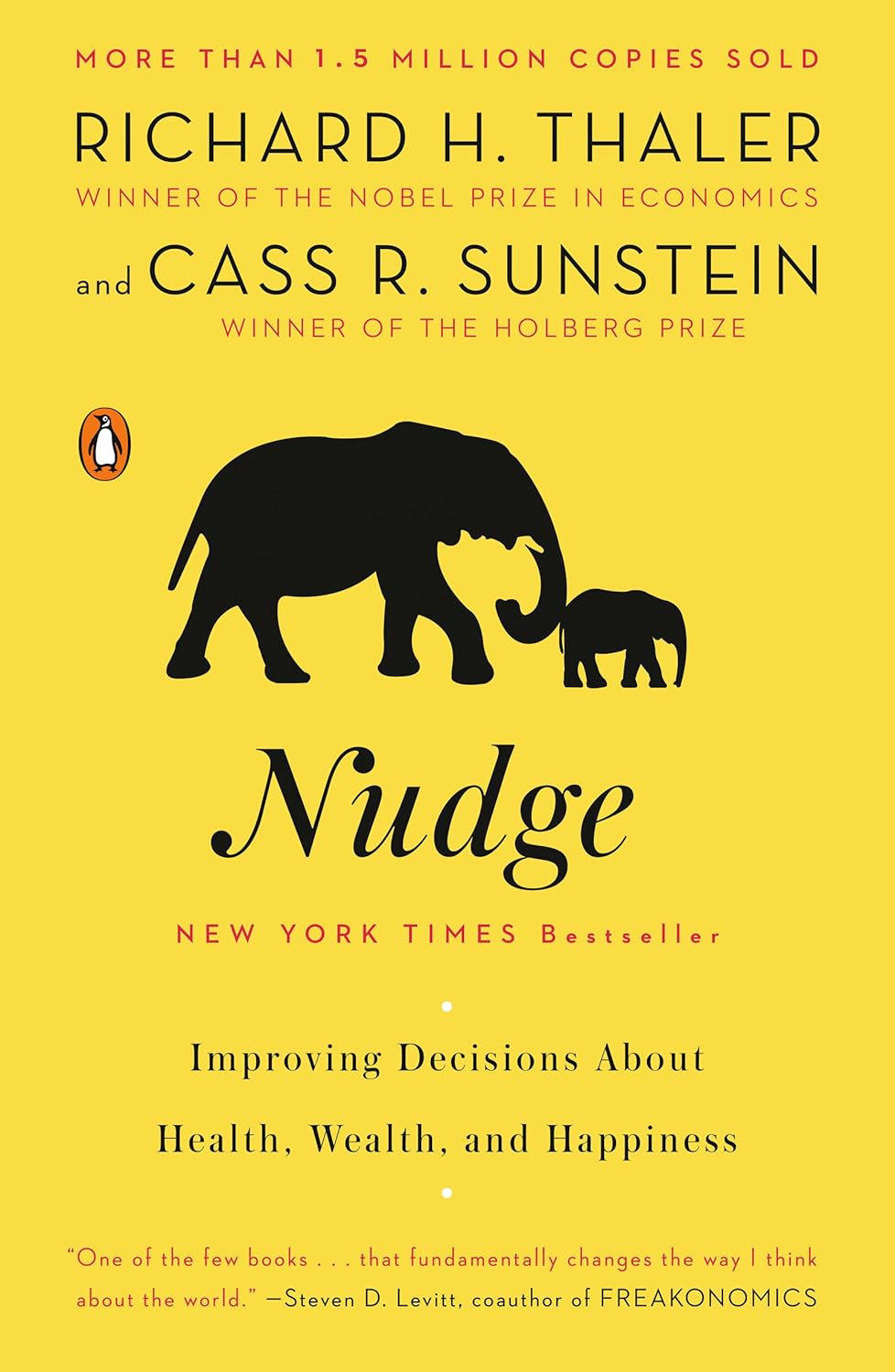
About Nudge by Richard H. Thaler and Cass R. Sunstein: Small Changes That Help People Make Better Choices
Nudge by Richard H. Thaler and Cass R. Sunstein explains why smart people can still make poor choices. We forget, delay, follow the crowd, and choose what feels easy now. The authors show how the way choices are set up can gently guide us toward better results while leaving us free to choose.
Written by Nobel laureate Richard H. Thaler and Harvard professor Cass R. Sunstein, this book joins economics, psychology, public policy, and daily life. It explores money, health, retirement, debt, organ donation, and the environment. Its key idea is simple: small changes in a form, message, menu, or default can shape what people do.
Why good plans often fail
Most of us know what we should do. We may want to save more, eat better, finish a form, take medicine on time, or choose a good plan. Still, the useful action may feel hard. There may be too many choices, too much small print, or no clear next step. We put it off and later wish we had acted.
Thaler and Sunstein offer a practical answer. Improve the setting so that the helpful choice is easier to see and easier to take. People keep the right to say no or choose another path. The change simply helps attention, timing, and action work together.
What is Nudge about?
Nudge is about choice architecture, which means the way choices are arranged and shown. Every choice has a setting. A school decides where food sits in a lunch line. A company decides whether a worker must join a savings plan or is added to it unless the worker says no. A website decides which box is already selected.
These details may look small, yet they can shape behavior. There is no fully neutral design because something must appear first, some words must explain the choice, and some result must happen when a person does nothing. The person who builds that setting is a choice architect.
A nudge keeps the door open
A nudge changes behavior in a predictable way without banning an option or making the money cost much higher or lower. Putting fruit where it is easy to see may be a nudge. Removing all other food is a ban. Giving a reminder before a payment date may be a nudge. Giving a large fine is a stronger tool.
This line matters because the book is about gentle guidance with freedom. The authors call their view libertarian paternalism. The words sound hard, but the basic point is easy: try to help people reach better results while keeping their power to choose.
Real people do not choose like perfect machines
Old economic models often picture people as calm thinkers who know every fact and always choose what serves them best. Daily life looks different. We use short cuts. We fear a loss more than we enjoy a similar gain. We may stay with a familiar option, copy other people, or value today more than next year.
The book helps readers notice these common patterns without shame. Once we know where choice can go wrong, we can add a reminder, a clear label, a better order, or a safer starting point. Design can support human limits instead of acting as if those limits do not exist.
Defaults have quiet power
A default is what happens when a person takes no action. It can be the plan already chosen, the box already marked, or the setting already turned on. Many people stay with a default because changing it takes time, effort, or confidence.
The lesson is not that every default must force one answer. It is that the starting point should be chosen with care, explained in plain words, and made easy to change. This idea can help anyone who builds an app, form, service, school system, or workplace plan.
Better paths for money and saving
Money choices are a major part of the book. Saving for later can be hard because the reward feels far away, while today’s needs feel close. Forms may be long, plans may use hard words, and the fear of choosing badly can lead to no choice at all.
The authors explore ways to make saving easier. Automatic entry can give people a useful start. A plan that raises saving when pay rises can reduce the pain of giving up money today. Clear comparison tools can help people see fees, risks, and likely results.
Health choices need clear help
Health decisions can be hard because the facts are complex and the cost of error may be high. People may need to compare care plans, remember medicine, choose food, or decide about organ donation. Stress can make a confusing choice even harder.
Nudge looks at how clear information, thoughtful defaults, reminders, and well-timed questions can help. A message sent before a visit may reduce missed care. A simple label may make a fact easier to use. Asking people to make an active choice may work better than letting an important question disappear.
Small design can support a cleaner world
Environmental problems are large, so a small nudge cannot solve them alone. Laws, prices, public work, and new tools may all be needed. Still, choice design can help people use less energy, waste less, and understand the effect of daily action.
A clear energy report can compare current use with earlier use. A well-timed note can remind a home to switch off a wasteful setting. A good default can make a cleaner option easier while allowing another choice.
The Final Edition adds today’s problems
Nudge first appeared in 2008. The authors later rewrote and updated it as Nudge: The Final Edition. That version uses newer research and adds modern examples involving health, COVID-19, credit card debt, home loans, climate change, and other parts of life.
It also gives more attention to sludge. Sludge is the needless trouble that makes a useful action hard. Long forms, repeated questions, hidden buttons, slow approval, and unclear rules can drain time and hope. Sometimes the best nudge is to remove this burden.
The edition sold by a shop may be the original, a later edition, or The Final Edition. The central ideas remain closely linked, but examples and page counts can differ. Ask Bookish Wonderland which edition is in stock if this detail matters for your class or collection.
Ideas that deserve careful questions
The book is persuasive, but a wise reader should also test its claims. A nudge can serve the person choosing, the group building the system, or both. Those goals do not always match. A company may place a costly option first because it earns more, not because it helps the buyer.
Good choice architecture should be open about its goal. Important facts should be easy to find. Leaving a default should be simple. Results should be checked, including results for people with less money, less time, or less skill with forms and technology.
These questions make the book stronger as a study tool. Readers do not have to accept every example. They can compare freedom, care, fairness, and proof. That turns a famous idea into a useful way to judge real systems.
What makes this book easy to use
- One strong idea connects many parts of daily life.
- Simple examples make behavioral economics easier to understand.
- Money, health, public policy, and the environment show wide use.
- Choice architecture helps readers notice how settings shape action.
- Defaults, feedback, reminders, and clear labels become practical tools.
- Humor and familiar stories keep a serious topic lively.
- Ethical questions encourage care, fairness, and open design.
- Updated editions add newer research, sludge, and present-day cases.
The book gives readers a set of clear lenses. After learning them, a person may notice the order of a menu, the wording of a form, or the setting on a phone. Ordinary details begin to reveal how much design guides daily life.
What you may gain from reading it
First, you may make better personal choices. The book can help you build useful defaults, reduce small barriers, and set reminders before a busy moment. It does not promise perfect control. It shows how to make a good action more likely.
Also, you may become a more careful buyer and citizen. You can ask who built a choice, what goal the design serves, and how easy it is to refuse. This skill helps you spot both helpful nudges and tricks that use the same ideas for private gain.
Who should read Nudge?
This book suits students of economics, business, psychology, law, government, public health, and design. It is also useful for founders, managers, teachers, doctors, policy workers, app builders, parents, and curious general readers.
A class can use one chapter to discuss a real policy. A work team can map each step in a customer journey and remove needless trouble. A reading group can debate when guidance is fair. An individual can study one personal choice, such as saving or food, and build a small change around it.
No high level of math is needed. Some policy examples are detailed, and some claims may lead to debate. Readers who enjoy practical ideas, human behavior, and real-world systems are likely to get the most value.
A reader-friendly copy for steady study
Bookish Wonderland offers a comfortable copy made for reading, notes, and later review.
- Premium eye-soothing cream paper gives each page a soft look.
- Crystal-clear printing keeps examples and key terms easy to follow.
- High-quality stitched and glue binding supports regular use.
- A durable finish helps protect the book on a desk or shelf.
The copy works well for a student, professional, home library, office shelf, book club, or thoughtful gift. Its practical ideas invite readers to mark useful parts and return when they need to improve a choice.
Easy ordering from Bookish Wonderland
When comparing the Book price in Bangladesh for Nudge by Richard H. Thaler and Cass R. Sunstein, consider paper comfort, print clarity, binding strength, and delivery service along with the cost. A book full of useful ideas should remain easy to read and strong enough for repeat study.
Cash on Delivery is available nationwide, with delivery inside and outside Dhaka. Fast or urgent delivery is available in Dhaka when you need the book soon. Contact Bookish Wonderland through Facebook or Instagram for the current price, stock, edition, delivery time, or customization help.
Give your next choice a better start
Every day brings choices about money, health, work, family, and the future. Willpower alone cannot make every choice easy. Nudge shows how a small change in the setting can help a good plan survive a busy day.
Read it to understand why people delay, follow defaults, and miss useful facts. Keep it to improve forms, messages, plans, and habits. Share it with someone who wants to make systems kinder, clearer, and easier to use.
Order Nudge by Richard H. Thaler and Cass R. Sunstein from Bookish Wonderland today. Bring home a modern classic that can change how you see every menu, form, reminder, and choice around you.
If you require any customization or have any questions, please inbox us via FB or Insta.
| Primary Specification | |
| Author | Richard H. Thaler, Cass R. Sunstein |
| Narrator | Sean Pratt |
| Genre | Behavioral Economics, Psychology, Economics, Public Policy, Decision-Making |
| ISBN-13/ISSN | 978-0143115267 |
| ISBN-10 | 0143115267 |
| Publisher | Penguin Books |
| Publishing Date | February 24, 2009 |
| Language | English |
| Reading Age | 16+ |
| Format | Printed Book |
| Physical Specification & Quality | |
| Paper Quality | Premium eye-soothing cream paper |
| Binding Quality | High quality stitched and glue binding (for longevity) |
| Print Quality | Crystal-clear print |
| Pages | 312 pages |
| Country | USA |
| Logistics Information | |
| Weight | 335 gm |
| Length | 8.5 inches |
| Width | 5.6 inches |
| Height | 0.8 inch |