

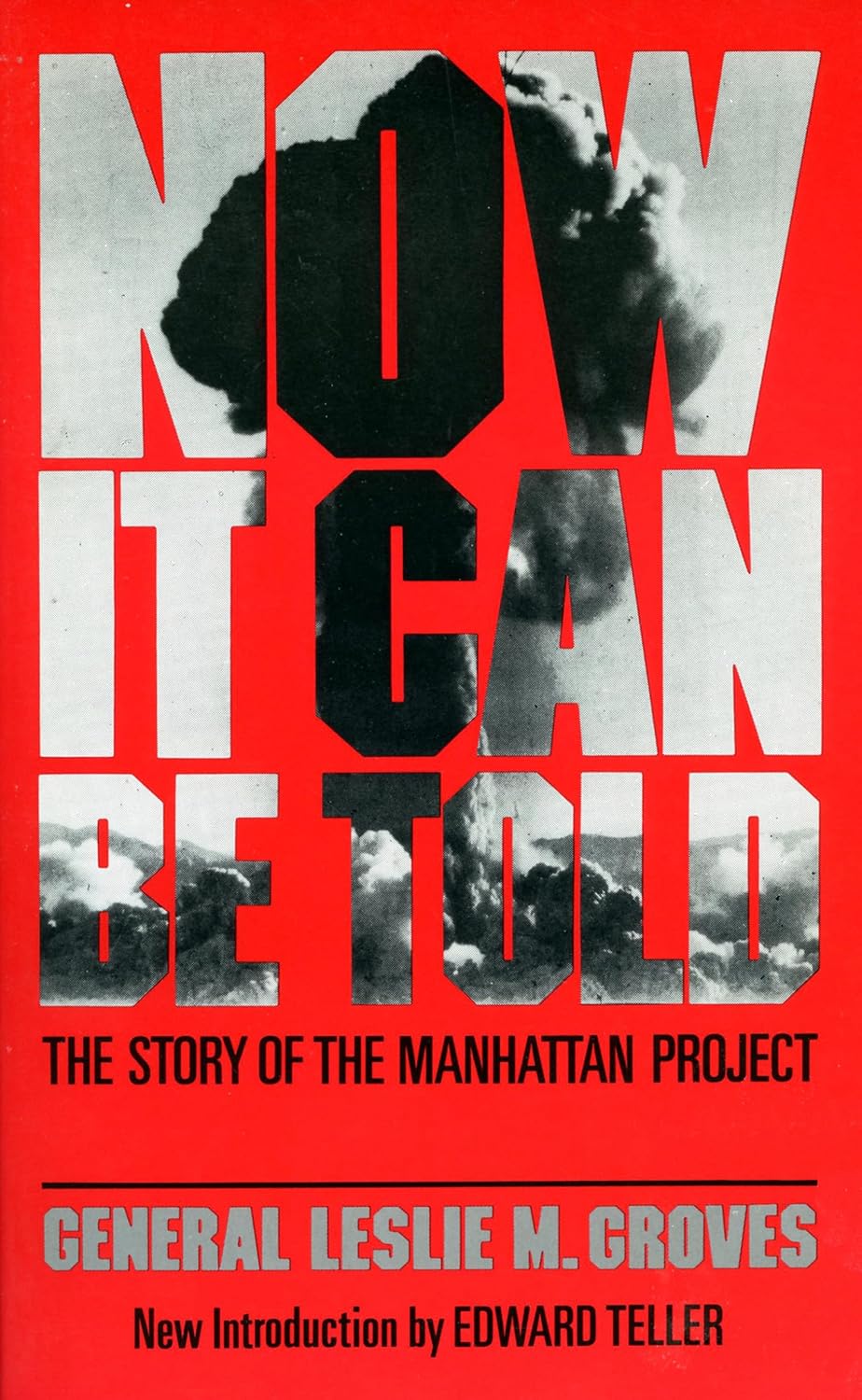
About Now It Can Be Told by Leslie R. Groves – The Inside Story of the Manhattan Project, Wartime Science, and Leadership
Now It Can Be Told by Leslie R. Groves is a first-person account of one of the largest secret projects of the Second World War. Groves was the United States Army officer placed in charge of the Manhattan Project, the program that developed the first atomic bombs. In this book, he explains how scientists, engineers, military officers, companies, and government leaders worked under extreme pressure to turn an uncertain scientific idea into a working weapon.
J. Robert Oppenheimer is also central to the story. Groves explains why he selected Oppenheimer to lead the scientific work at Los Alamos and how their very different personalities worked together. For readers interested in Oppenheimer, nuclear history, World War II, engineering, leadership, or the history of science, this book offers a rare view from inside the project.
A First-Hand View of a Project Hidden From the World
Many books explain the Manhattan Project after the fact. This one is different because Groves was not watching from outside. He was the senior military leader responsible for organizing the work. He had to turn broad goals into real factories, laboratories, schedules, contracts, security systems, and decisions.
That makes the book useful for readers who want to understand how the project actually functioned. The Manhattan Project was not only a group of physicists working in a laboratory. It required enormous industrial plants, new towns, rail links, construction crews, military security, scientific teams, and supply chains spread across different locations.
Groves describes the pressure to move quickly while keeping the work secret. The United States was at war, and there was fear that Nazi Germany might also be trying to build an atomic weapon. Every delay mattered. At the same time, many technical questions had no proven answer when the work began.
The book shows how managers and scientists had to make choices before they had complete information. That mix of urgency, uncertainty, and secrecy is one of the most important reasons the story remains interesting.
The Human Side of the Manhattan Project
The Manhattan Project is often remembered through famous names such as Oppenheimer, Enrico Fermi, Niels Bohr, and Edward Teller. Groves brings another side into view: the people who had to connect scientific work with military goals and industrial production.
He writes about disagreements, difficult personalities, security worries, and the challenge of deciding who could be trusted with sensitive information. He also describes how scientific freedom sometimes came into conflict with military secrecy.
Groves and Oppenheimer were very different men. Groves was direct, practical, and focused on schedules and results. Oppenheimer was an academic physicist who could bring many leading scientists together. Their partnership was unlikely, but it became essential to Los Alamos.
Reading Groves’s own account helps readers see how he understood that partnership. It also gives a useful contrast to books and films that tell the story mainly from Oppenheimer’s point of view.
Why Oak Ridge, Hanford, and Los Alamos Matter
The Manhattan Project did not happen in one laboratory. Groves had to oversee work at several major sites, each with a different role.
Oak Ridge in Tennessee became a major center for producing enriched uranium. Hanford in Washington became the site for large reactors and plutonium production. Los Alamos in New Mexico was where scientists designed and assembled the bombs.
These places required huge amounts of land, electricity, water, labor, equipment, and money. In many cases, facilities were built before anyone could be fully certain that the chosen process would work at industrial scale.
Groves explains how these choices were made and why several technical approaches were pursued at the same time. That may sound inefficient, but it reduced the risk that one failed method would stop the whole program.
For readers interested in engineering or project management, this part of the story can be as interesting as the nuclear physics. It shows what happens when a government attempts something that has never been done before and cannot afford to wait for perfect certainty.
A Book About Leadership Under Extreme Pressure
Now It Can Be Told is also a book about management. Groves had to coordinate people who came from very different worlds. Scientists valued open discussion and careful proof. Military leaders valued security, clear authority, and deadlines. Industrial companies had their own methods, costs, and limits.
Groves had to make these groups work toward one goal.
His style could be demanding and controversial, but the book lets readers see the logic behind many of his decisions. He was responsible for a project whose cost, size, secrecy, and technical risk were extraordinary.
This makes the book useful beyond military history. Readers interested in leadership can study how Groves handled uncertain information, selected people, divided responsibility, pushed schedules, and solved problems when there was no simple model to follow.
The book does not mean every decision should be copied. Instead, it gives a real case study that readers can judge for themselves.
The Race Against Time
One of the strongest parts of the book is the constant sense of urgency. The project was taking place during a global war. Leaders did not know exactly how far German nuclear research had gone, and they could not assume there would be unlimited time.
That pressure influenced almost every major choice. Construction began quickly. Different scientific paths were tested at once. Materials and workers were moved on a huge scale. Security rules were strict because even a small leak could reveal important information.
Groves explains how the project moved from early research toward production and testing. The story eventually reaches the Trinity test in New Mexico and the use of atomic bombs against Hiroshima and Nagasaki.
These events are among the most serious and debated moments in modern history. Groves writes from the viewpoint of the military leader who helped make the weapon possible, so readers should understand that this is one important perspective, not the only perspective.
Why This Book Still Matters
The Manhattan Project changed science, war, politics, and international relations. Nuclear weapons shaped the Cold War and continue to affect global security today.
Now It Can Be Told helps readers understand how that change happened from inside the organization that built the first bombs. It records practical details that can disappear when history is reduced to a few famous photographs or names.
The book is especially valuable when read beside other accounts. Groves had his own views, loyalties, and judgments. A first-person memoir can reveal details that an outside historian cannot, but it can also reflect the author’s personal position.
That is part of what makes the book useful. Readers can compare Groves’s account with later historical research, biographies of Oppenheimer, records from scientists, and studies of Hiroshima, Nagasaki, and nuclear policy.
Who Should Read Now It Can Be Told?
This book is a strong choice for readers interested in World War II, military history, the Manhattan Project, nuclear science, engineering history, Oppenheimer, government decision-making, or large-scale project management.
It can also appeal to readers who enjoyed the film Oppenheimer and want to understand the same period from the viewpoint of the military officer who chose Oppenheimer and directed the broader project.
The writing is detailed and practical. Some sections focus heavily on organization, construction, security, production, and administration. Readers looking only for personal drama may find these sections slower. Readers who want to know how the project worked will likely find those same details valuable.
The book is best suited to older teen and adult readers because the subject involves war, atomic weapons, mass death, military strategy, and complex historical questions.
A Useful Book for Students and Researchers
Students studying the Second World War or the history of science can use this book as a primary-source-style account from a major participant. It gives direct insight into how Groves remembered events and explained his decisions.
It can support research on the relationship between science and government, wartime secrecy, industrial mobilization, nuclear policy, leadership, and the development of atomic weapons.
Because Groves was deeply involved, readers should still compare his account with other sources. Historical research becomes stronger when different viewpoints are placed beside one another.
Teachers and book clubs can also use the text to ask difficult questions. How should leaders act when time is short? How much secrecy is acceptable in wartime? What responsibility do scientists and military leaders have for the later use of what they create? How should we judge decisions made under conditions very different from our own?
Those questions give the book value long after its original publication.
A Comfortable Edition for Long Reading Sessions
Bookish Wonderland offers this title as a premium reading copy made for readers who want clear text and durable construction. The copy uses premium eye-soothing cream paper, which gives the pages a softer appearance during long reading sessions.
Crystal-clear printing keeps names, dates, and detailed passages easy to follow. That is useful in a history book where readers may want to pay close attention to people, places, technical terms, and sequences of events.
The book also uses high-quality stitched and glue binding for better longevity. This gives the pages stronger support during normal reading, study, note-taking, or repeated reference.
The aim is simple: to provide a copy that feels comfortable enough for serious reading and strong enough to remain useful on a history shelf.
Now It Can Be Told by Leslie R. Groves Price and Ordering in Bangladesh
Readers comparing the Book price in Bangladesh for Now It Can Be Told by Leslie R. Groves may also want to consider the quality of the physical copy and the ease of ordering it.
Bookish Wonderland offers nationwide delivery across Bangladesh, including addresses inside and outside Dhaka. Cash on Delivery is available across the country, giving customers a convenient payment option. Readers in Dhaka can also ask about fast or urgent delivery when they need the book sooner.
This makes the title suitable for personal reading, academic study, history collections, research shelves, or gifts for readers interested in World War II and the history of science.
Read the Manhattan Project From the Man Who Directed It
There are many ways to learn about the atomic bomb. Now It Can Be Told gives readers one of the most important first-person viewpoints: the account of the Army officer who had to organize the people, money, sites, security, construction, and deadlines behind the Manhattan Project.
Groves explains the project as he saw it. His account is detailed, confident, and shaped by his own role, which is exactly why it is valuable to read critically.
For readers who want more than a short summary of Oppenheimer or the atomic bomb, this book opens the door to the enormous organization behind the science. It shows how laboratories, factories, military planning, industrial skill, and individual decisions came together during wartime.
Order Now It Can Be Told by Leslie R. Groves from Bookish Wonderland for nationwide delivery across Bangladesh. Cash on Delivery is available throughout the country, and customers in Dhaka can ask about fast or urgent delivery. If you need book customization or have questions before ordering, contact Bookish Wonderland through Facebook or Instagram and add this major firsthand account of the Manhattan Project to your history collection.
If you require any customization or have any questions, please inbox us via FB or Insta.
| Primary Specification | |
| Author | Leslie R. Groves |
| Narrator | Scott R. Pollak |
| Genre | Military History, World War II History, Nuclear History, Science & Technology History |
| ISBN-13/ISSN | 978-0306801891 |
| ISBN-10 | 9780306801891 |
| Publisher | Grand Central Publishing |
| Publishing Date | March 22, 1983 |
| Language | English |
| Reading Age | 18+ years |
| Format | Printed book |
| Physical Specification & Quality | |
| Paper Quality | Premium eye-soothing cream paper |
| Binding Quality | High quality stitched and glue binding (for longevity) |
| Print Quality | Crystal-clear print |
| Pages | 496 pages |
| Country | USA |
| Logistics Information | |
| Weight | 501g |
| Length | 8.5 inches |
| Width | 5.6 inches |
| Height | 1.3 inches |