

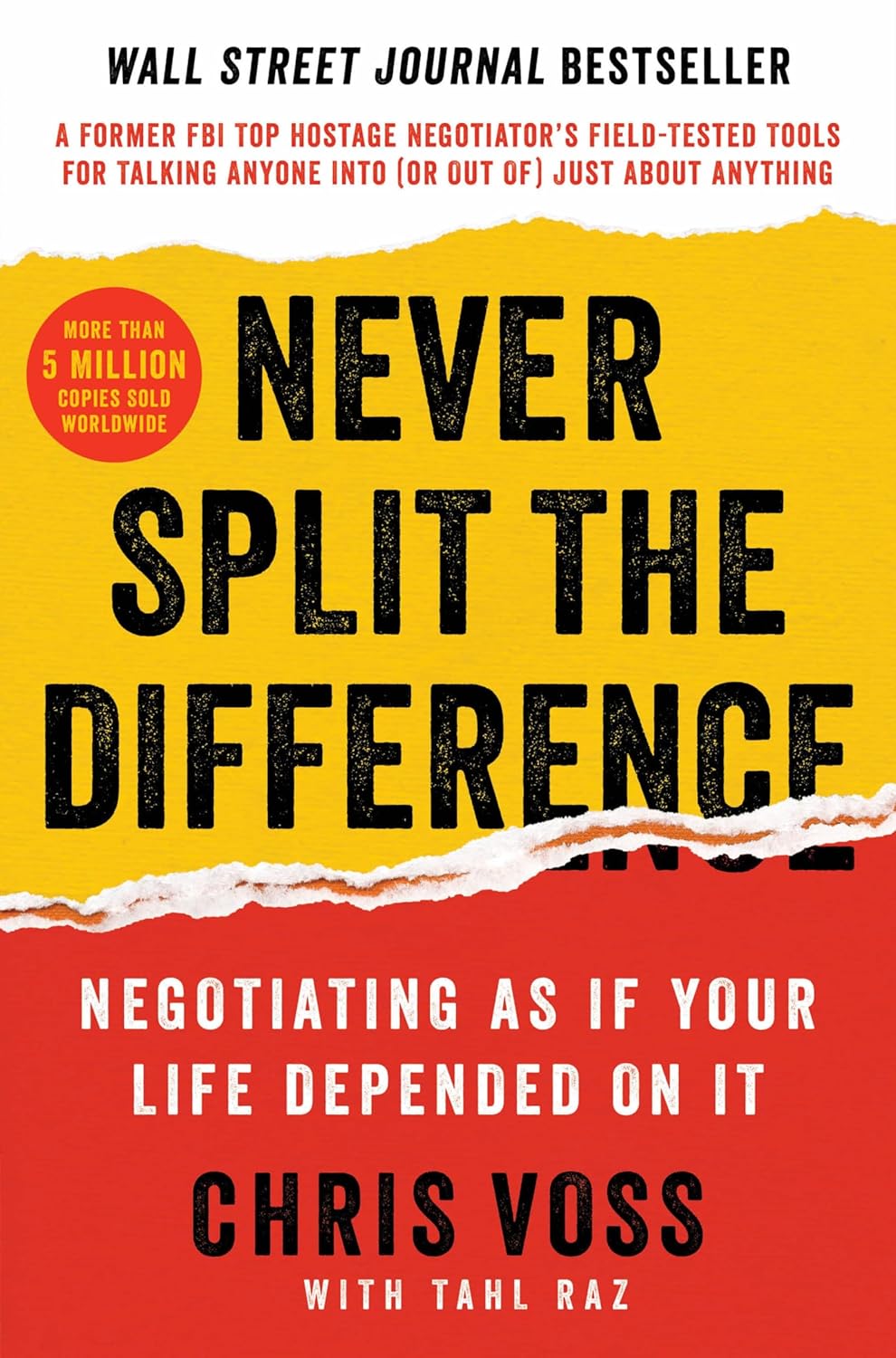
About Never Split the Difference: Negotiating as if Your Life Depended on It by Chris Voss and Tahl Raz – Master Negotiation Skills and Handle Difficult Conversations With Confidence
Imagine asking your boss for a salary increase, trying to get a better price on a car, or discussing an important business deal. You know what you want, but the other person disagrees. What should you say next? Should you argue, accept their offer, or meet them halfway?
Never Split the Difference: Negotiating as if Your Life Depended on It by Chris Voss and Tahl Raz introduces a different approach. It shows how careful listening, thoughtful questions, and an understanding of emotions can help you handle difficult conversations.
Chris Voss spent 24 years working for the FBI and became its lead international kidnapping negotiator. Drawing on his experience, he explains negotiation methods developed and used in high-pressure situations. Together with writer Tahl Raz, he presents these ideas in a practical business and self-help book.
The book explores how to understand another person's needs, recognise hidden concerns, and find better ways to discuss disagreements.
You do not need to work in sales or manage a large company to understand its lessons. The ideas apply to many situations involving communication, money, responsibilities, and important decisions.
Whether you are an entrepreneur, employee, manager, student, or simply someone who wants to communicate more effectively, this book offers an interesting way to rethink how you negotiate.
Why Do So Many Negotiations Go Wrong?
Most people begin negotiating by thinking about their own position. They prepare arguments, collect facts, and try to prove that their offer is reasonable.
But what happens when the other person refuses to agree?
Voss explains that people do not always make decisions through logic alone. Fear, pride, anger, and uncertainty can influence their responses.
Instead of arguing harder, he encourages readers to slow down and understand what is happening.
The book shows how asking thoughtful questions and recognising concerns can reveal information that a direct argument might miss.
This approach can help you prepare for difficult conversations without treating every disagreement as a battle.
Discover Why Listening Is Your First Advantage
When someone speaks, do you really listen, or are you already preparing your next reply?
Voss teaches readers to make listening an active part of negotiation.
Rather than rushing to offer a solution, pay attention to the person's words, tone, and concerns. Give them space to explain what matters.
The book also introduces a calm speaking style that Voss calls the late-night FM DJ voice.
A steady tone may help reduce tension during a difficult discussion.
You can practise this when speaking with customers, colleagues, or family members.
The goal is to understand the problem before deciding how to respond.
Make People Feel Heard With Tactical Empathy
Imagine that a customer is angry because an order arrived late.
You could defend your business immediately, but the customer may become even more frustrated.
Another approach is to recognise their concern before explaining what happened.
This is an example of tactical empathy, one of the book's main ideas.
It means trying to understand another person's feelings and showing that you recognise their position.
Empathy does not mean agreeing with an unreasonable demand.
You can understand why someone is disappointed while still being honest about what your business can offer.
This method encourages communication based on understanding rather than immediate confrontation.
Learn Mirroring and Encourage Others to Explain More
Sometimes, a few repeated words can encourage someone to continue speaking.
Voss calls this mirroring.
The technique involves repeating a short, important part of another person's statement and allowing them time to explain.
For example, a supplier might tell you that a shipment cannot arrive before Friday.
Instead of arguing immediately, you could repeat the key part of their statement with a curious tone.
The supplier might then explain the actual problem, such as a transport delay or missing stock.
That information could help both sides consider alternatives.
Mirroring is not meant to sound like a trick. It works best when paired with genuine curiosity.
Understand Feelings Through Labelling
A conversation can become difficult when someone feels worried but does not explain why.
Labelling is a technique that involves carefully naming a possible emotion or concern.
Imagine that your colleague seems uncomfortable about taking on a new project.
You might say that it sounds as though the deadline is worrying them.
They may agree, correct your understanding, or explain another concern.
Each response gives you useful information.
The book encourages readers to identify emotions without pretending to know exactly what someone else is thinking.
By making space for feelings, you may discover the real issue behind a disagreement.
This can be especially useful during workplace and customer discussions.
Why Hearing No Can Help a Conversation Move Forward
Most people enter a negotiation hoping to hear yes.
However, Voss explains that agreement does not always mean genuine commitment.
Someone might say yes because they feel uncomfortable, want to end the conversation, or have not understood the request.
A no can sometimes reveal an important concern.
In a voluntary negotiation, you can respectfully ask what makes the proposal unsuitable and explore whether another option exists.
But the book's techniques should never be used to disregard someone's clear boundaries or consent.
The practical lesson is that an honest answer provides more useful information than an agreement that nobody intends to follow.
Ask Questions That Help Solve Difficult Problems
Imagine that your manager asks you to finish a large project within an impossible deadline.
You could become upset or agree without knowing how to complete the work.
Voss offers another method called calibrated questions.
These questions usually begin with words such as how or what.
You might ask what tasks need to be completed first or how the team could meet the deadline with its current resources.
Questions like these encourage the other person to consider the practical problem.
They can also help reveal information that was missing from the original request.
The technique is useful because it encourages discussion rather than simply exchanging demands.
Discover Why Meeting Halfway Is Not Always Fair
The title raises an interesting question: why shouldn't people simply split the difference?
Imagine that a customer wants a product for Tk 500, while the seller needs Tk 900 to cover costs and earn a reasonable profit.
Agreeing on Tk 700 might look fair because both sides have moved halfway.
But what if that price would create a loss for the seller?
Voss argues that a compromise based only on the middle point may fail to address the real needs of either side.
The book encourages readers to understand the reasons behind different positions before choosing an agreement.
Compromise can still be sensible when the resulting terms actually work.
Learn How to Discuss Prices With More Confidence
Negotiating a price can feel stressful, especially when you are worried about losing a deal.
The book introduces the Ackerman bargaining model, a structured approach to making offers.
Instead of changing your price randomly, the method encourages you to prepare a target and plan how your offers will develop.
Voss also discusses the effect of carefully chosen numbers and other terms during bargaining.
These ideas may be useful when buying products, selling services, or discussing business contracts.
However, no bargaining technique guarantees a better price.
You still need to understand market prices, your costs, and the conditions of the deal before making a financial commitment.
Find the Hidden Information That Could Change Everything
Sometimes, a negotiation becomes difficult because important information is missing.
A buyer may have an urgent deadline. A supplier might be dealing with an unexpected shortage. An employer may need approval before changing a salary offer.
Voss uses the term Black Swan for unexpected information that can change how a negotiation develops.
Finding such information requires careful listening and curiosity.
Instead of assuming you understand every part of the situation, ask questions and remain open to new details.
The book encourages readers to discover what lies behind a person's first demand.
A small piece of information might help explain a problem that previously seemed impossible to solve.
Make Sure Agreements Lead to Real Action
Reaching an agreement is exciting, but what happens when someone fails to follow it?
A customer may promise to pay next week. A colleague might agree to finish a task. A supplier may accept an important delivery date.
Without clear responsibilities, these agreements can create new problems.
Voss explores how to check whether a proposed agreement can actually be carried out.
You can apply this lesson by confirming deadlines, responsibilities, payment terms, and the next steps.
For important business arrangements, written agreements and qualified professional advice remain essential.
The goal is to move beyond a positive conversation and develop a practical plan that everyone understands.
Prepare Before Your Next Important Negotiation
Walking into a difficult meeting without preparation can leave you feeling uncertain.
The book includes a negotiation preparation sheet in its appendix.
It encourages readers to organise their goals, understand available information, anticipate possible concerns, and prepare useful questions.
Before discussing a salary, for example, you could research suitable pay ranges and document your achievements.
Before meeting a supplier, you might review prices, delivery needs, and the terms you can realistically accept.
Preparation cannot predict every response.
However, knowing your priorities and limits can help you make thoughtful decisions when a conversation takes an unexpected turn.
Use These Skills in Your Professional Life
Negotiation is part of many jobs.
A sales professional may discuss prices. A manager may need to resolve a disagreement between employees. An entrepreneur may negotiate with investors, suppliers, or customers.
Even a job interview can involve discussing responsibilities, working conditions, and compensation.
The book provides ideas that can help you prepare for these situations.
Understanding another person's concerns can make it easier to explain your own position clearly.
Asking better questions may also help you discover options you had not considered.
These skills do not guarantee a successful outcome, but they can support clearer communication and more informed decisions.
Who Should Read This Negotiation Book?
This book is suitable for adult readers interested in business, communication, leadership, sales, and personal development.
It may appeal to entrepreneurs who negotiate with clients, employees preparing for salary discussions, and managers who regularly handle difficult conversations.
Freelancers can also explore its ideas when discussing fees and project requirements.
Business students may find the real negotiation experiences particularly interesting.
You do not need previous training to understand the main lessons.
The book uses stories and practical explanations rather than presenting negotiation only as a technical subject.
Readers looking for academic research may wish to explore additional sources alongside Voss's experience-based approach.
Meet Chris Voss and Tahl Raz
Chris Voss is a former FBI hostage negotiator and the founder of the Black Swan Group, a negotiation training and consulting company.
Tahl Raz is a journalist and business writer known for exploring ideas about communication and professional development.
Their book combines Voss's experiences with accessible explanations intended for everyday readers.
The original HarperBusiness edition was published in 2016.
It contains ten main chapters covering listening, empathy, questions, bargaining, agreement, and unexpected information.
An appendix also provides a preparation tool for readers who want to apply the lessons.
Enjoy a Premium Edition From Bookish Wonderland
Bookish Wonderland offers this practical business guide in a premium reading edition.
The book features:
-
Premium eye-soothing cream paper: Soft-coloured pages designed for comfortable reading.
-
Crystal-clear printing: Sharp, clean text that makes the explanations easy to follow.
-
High-quality stitched and glue binding: Designed to support repeated reading and help keep the pages together with proper care.
These features make the edition suitable for readers who want to keep a useful reference book in their personal collection.
You can return to important chapters whenever you need to prepare for a difficult conversation.
Check the Current Price and Delivery Options
To check the Book price in Bangladesh for this title, visit the product listing at Bookish Wonderland.
We offer nationwide delivery, including locations inside and outside Dhaka.
Cash on Delivery is available across the country, and customers in Dhaka can ask about our fast or urgent delivery option.
If you want to confirm availability, ask about customization, or discuss delivery arrangements, contact us through Facebook or Instagram.
Check the current price and select the delivery option that suits your needs before placing your order.
Make Your Next Conversation More Meaningful
You cannot control everything another person says or does. However, you can improve how you prepare, listen, ask questions, and explain your own position.
This book introduces practical methods that encourage readers to understand disagreements instead of reacting immediately.
Whether you want to negotiate a business deal, discuss your salary, or communicate more clearly at work, its lessons offer useful ideas to explore.
Choose your copy from Bookish Wonderland and begin learning how thoughtful communication can change the way you approach important conversations.
Order today and add this negotiation guide to your personal development collection.
If you require any customization or have any questions, please inbox us via FB or Insta.
| Primary Specification | |
| Author | Chris Voss, Tahl Raz |
| Narrator | Michael Kramer |
| Genre | Business, Negotiation, Psychology, Self-Help |
| ISBN-13/ISSN | 978-0062407801 |
| ISBN-10 | 0062407805 |
| Publisher | Harper Business |
| Publishing Date | May 17, 2016 |
| Edition | 1st |
| Language | English |
| Reading Age | 18+ |
| Format | Printed Book |
| Physical Specification & Quality | |
| Paper Quality | Premium eye-soothing cream paper |
| Binding Quality | High quality stitched and glue binding (for longevity) |
| Print Quality | Crystal-clear print |
| Pages | 288 pages |
| Country | USA |
| Logistics Information | |
| Weight | 308 gm |
| Length | 8.5 inches |
| Width | 5.6 inches |
| Height | 0.64 inch |