

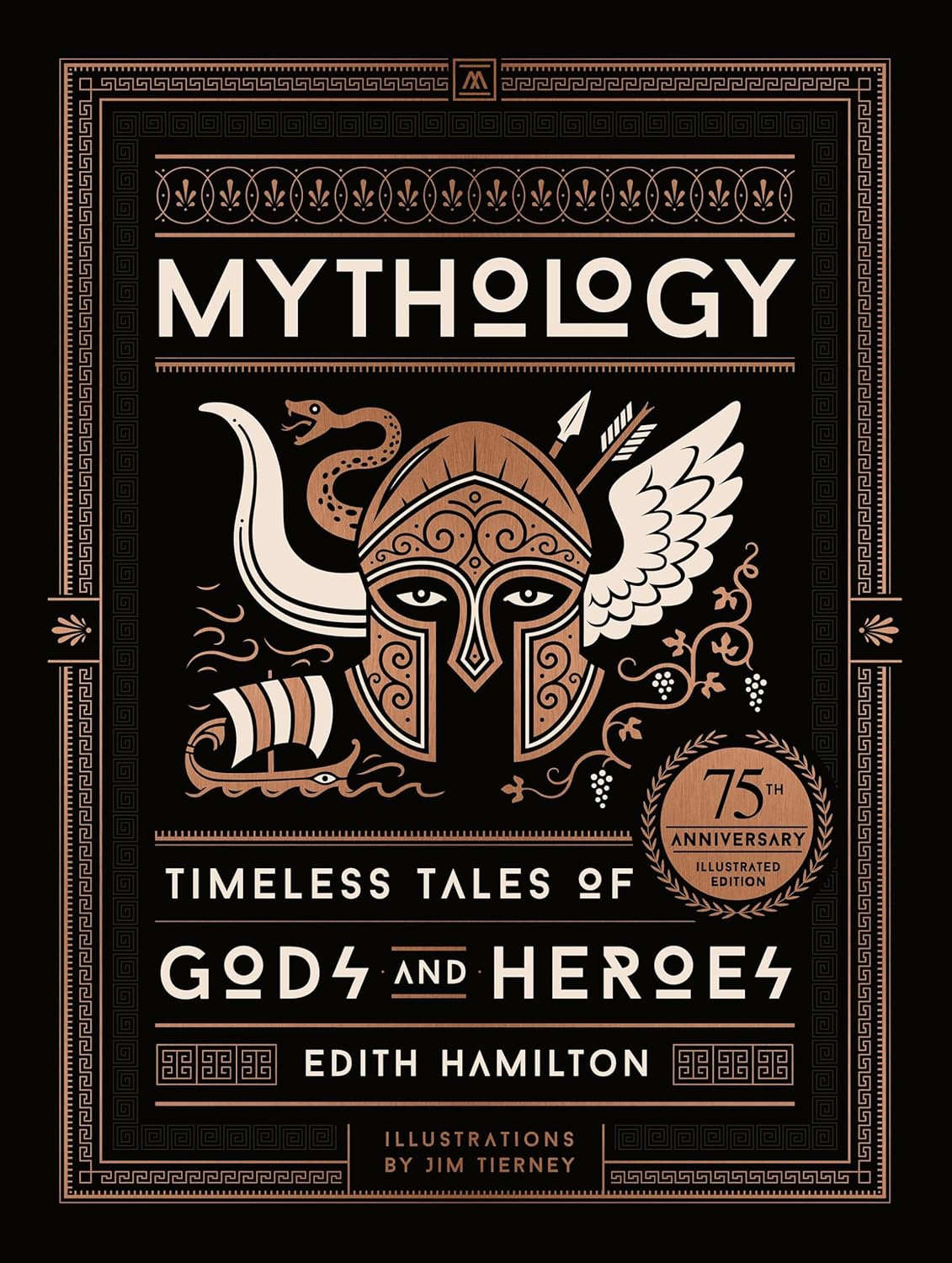
About Mythology: Timeless Tales of Gods and Heroes by Edith Hamilton—A Clear Journey Through Greek, Roman, and Norse Legends
Mythology: Timeless Tales of Gods and Heroes by Edith Hamilton brings the ancient world to life through stories of gods, brave heroes, monsters, wars, love, loss, and fate. First published in 1942 and still read, the book gathers major Greek and Roman myths and ends with a shorter section on Norse mythology. It can be read for pleasure, used for study, or kept nearby as a helpful guide.
Readers meet Zeus, Hera, Athena, Apollo, Aphrodite, Poseidon, Hades, and many other gods. They follow Perseus against Medusa, Theseus into the maze, Hercules through his labours, Jason in search of the Golden Fleece, and Odysseus on his long road home. They also enter the Trojan War, the royal houses of Thebes and Atreus, and the final world of Odin, Thor, Loki, and Ragnarok.
Hamilton tells these old tales in clear English while respecting their ancient sources. She shows that mythology is more than a list of names. It is a way people once tried to explain nature, duty, love, pride, suffering, and the unknown. The result is a classic introduction that can make difficult legends feel connected and alive.
When mythology feels like a maze of names
Greek and Roman myths can be hard to enter. One god may have two names. Families are large, heroes travel between many places, and the same tale may appear in different forms. A new reader can quickly mix up Zeus and Jupiter, Aphrodite and Venus, or the people connected to the Trojan War.
Hamilton gives readers a clear path. She introduces the main gods, explains their Roman names, and groups related tales together. Instead of making the reader jump between random facts, she builds a world step by step. The early chapters prepare you for the adventures, wars, and family stories that follow.
What is Mythology by Edith Hamilton about?
The book retells myths from ancient Greece and Rome, then introduces key Norse tales. Its main focus is the gods and heroes who shaped Western art and literature. Hamilton gathers material linked to ancient writers such as Homer, Hesiod, Ovid, Virgil, and the Greek playwrights, then presents it in a form modern readers can follow.
The book begins with the Greek idea of the gods and the creation of the world. It then moves through stories of love and adventure, heroes before the Trojan War, the war itself, the journeys that follow, famous royal families, smaller myths, and Norse gods. This order helps readers understand how characters, places, and family lines connect.
Meet the gods of Olympus
The first part introduces the Olympian gods and the older powers who came before them. Zeus rules the sky, Poseidon controls the sea, and Hades governs the world of the dead. Hera protects marriage, Athena joins wisdom with war, Apollo is linked with light and music, and Artemis moves through the wild.
These gods are powerful, but they are not perfect. They can be jealous, proud, loving, unfair, wise, or easily angered. Their human-like faults create many of the book’s conflicts. A promise, insult, secret love, or contest can change the life of a whole family.
Love can bring wonder and pain
The love stories are not simple fairy tales. Cupid and Psyche face doubt, separation, hard tasks, and a love that must survive fear. Pyramus and Thisbe become part of a tragic tale of secret love and a terrible mistake. Orpheus travels toward the world of the dead because he cannot accept losing Eurydice.
Other stories show how desire can become selfish or dangerous. Gods chase mortals, people break promises, and families pay for choices they did not make. The myths often ask whether love is a gift, a test, a trap, or all three at once.
Adventure begins with impossible tasks
Jason’s search for the Golden Fleece brings together a famous group of heroes called the Argonauts. Their voyage includes danger, strange lands, tests of courage, and help that comes at a heavy cost. The adventure feels large, but Hamilton keeps the main path clear.
Perseus must face Medusa, whose gaze can turn a person to stone. Theseus enters the maze to fight the Minotaur. Hercules completes a series of labours that test strength, patience, and endurance. Atalanta proves that courage and speed do not belong only to male heroes.
Enter the battle for Troy
The Trojan War begins with choices made by gods and people, then grows into a long conflict between Greece and Troy. Readers meet Achilles, Hector, Paris, Helen, Agamemnon, and many other figures whose names still appear across books, films, and daily speech.
Hamilton explains the main events without asking readers to begin with a full ancient epic. She shows why Achilles becomes angry, why Hector stands for Troy, how pride divides the Greek leaders, and how the wooden horse helps end the war. The result gives newcomers a strong base before reading Homer’s Iliad.
Follow the long journeys home
Victory at Troy does not bring peace to everyone. Odysseus spends years trying to reach his home and family. His road includes the Cyclops, Circe, the Sirens, sea storms, temptation, and the anger of Poseidon. Cleverness saves him many times, but his own choices can also create trouble.
Aeneas leaves the ruins of Troy and searches for a new home. His story comes from the Roman poet Virgil and points toward the legendary roots of Rome. Duty often asks him to place a larger future above his personal wishes.
Great families carry old wounds
Some of the darkest stories follow royal families across several generations. The House of Atreus is marked by betrayal, murder, revenge, and a cycle of harm that children inherit from parents. The royal family of Thebes includes Oedipus, whose attempt to escape a terrible prophecy helps bring it true.
These tales can be difficult, but they explain the roots of many famous Greek plays. They ask whether people can escape fate, whether justice can end revenge, and how one hidden act can damage a family for years.
Small myths explain a larger world
Not every myth is a long war or heroic quest. Shorter stories explain flowers, trees, stars, seasons, rivers, and customs. A person may become part of nature after love, grief, pride, or a meeting with a god. These changes give the natural world a human story.
The tale of King Midas warns that a wish can become a curse. Narcissus shows the danger of being trapped by one’s own image. Echo gives a story to a voice that can only repeat. Other myths connect hunters, lovers, and heroes with patterns in the night sky.
Travel north to Odin, Thor, and Loki
The final major section turns from the warm lands of Greece and Rome to the colder world of Norse myth. Readers meet Odin, who seeks wisdom; Thor, who carries his hammer; and Loki, whose clever actions often bring both help and disaster.
Norse stories have a different mood. The gods know that a final battle, Ragnarok, will come. They still fight, protect their world, and face danger even when they cannot avoid the end. Courage means standing firm without a promise of victory.
Why Edith Hamilton’s approach still helps
Hamilton was a classicist who wanted ancient culture to feel open to general readers. She does not write like a dictionary that offers only short facts. She tells the myths as stories, adds helpful links, and often explains which ancient writer gives the strongest form of a tale.
Her voice is clear and confident, making the book friendly for self-study. A reader can enjoy the action first, then return to trace a family, compare Greek and Roman names, or understand a reference in another book.
The work was published in 1942, so some wording and judgments reflect its time. Modern scholarship may give different views, and ancient myths often survive in more than one version. The book is best used as a respected introduction rather than the only possible account of every myth.
What readers gain from this classic
The book gives readers a strong base for understanding classical mythology. It makes later reading of Homer, Virgil, Greek tragedy, Shakespeare, modern poetry, fantasy, and myth retellings easier because key names and stories are already familiar.
Most of all, the collection offers memorable stories. Readers can think about courage, pride, fate, justice, family, leadership, love, and loss without feeling that they are reading a dry list. The ancient characters make large questions personal.
Who will enjoy this book?
Choose Mythology if you enjoy Greek gods, Roman legends, Norse tales, heroic quests, ancient history, classic literature, or modern stories based on myth. It is also a helpful starting point for readers who want to try the Iliad, Odyssey, Aeneid, or Greek plays but need a simple guide first.
Students can use it for literature classes, essays, general knowledge, and reference. Teachers can select one myth to support a lesson. Writers and artists can use it to understand symbols and old story patterns. Book clubs can compare ideas of heroism, justice, love, and fate.
Know the difficult parts before reading
Ancient myths can be beautiful, but they are not always gentle. The book includes war, death, monsters, revenge, murder within families, kidnapping, forced relationships, betrayal, suicide, and punishment by gods. Some stories contain old views about women, power, marriage, and slavery.
Hamilton retells these events in a classic literary style rather than using modern graphic detail. Even so, the ideas may be upsetting for sensitive or younger readers. Adult guidance can help explain the historical setting and the difference between describing an ancient belief and supporting it today.
Readers should also remember that myths changed as they were told. Another book may give a different parent, ending, motive, or lesson. These differences are part of mythology, not always mistakes.
A comfortable edition for study and adventure
Bookish Wonderland offers a reader-friendly copy made for long reading sessions and frequent reference.
- Premium eye-soothing cream paper gives the pages a soft appearance.
- Crystal-clear printing keeps names and stories easy to read.
- High-quality stitched and glue binding supports long book life.
- A durable finish helps protect the copy during study or travel.
The edition suits personal reading, class, a home library, a book club, or a gift. Strong construction matters for a reference book that may be opened many times to check a god, hero, family, or famous adventure.
Easy ordering from Bookish Wonderland
When comparing the Book price in Bangladesh for Mythology: Timeless Tales of Gods and Heroes by Edith Hamilton, consider print clarity, paper comfort, binding strength, and delivery support along with cost. A lasting mythology guide should remain pleasant through both full readings and quick searches.
Cash on Delivery is available nationwide. Bookish Wonderland delivers inside and outside Dhaka, so readers can order from home. Fast or urgent delivery is available in Dhaka when the book is needed soon. Contact the store through Facebook or Instagram for the current price, stock, cover, edition, delivery time, or customization support.
Begin your journey among gods and heroes
Open this book and climb Mount Olympus, enter the maze, face Medusa, sail with Jason, stand outside Troy, and follow Odysseus across the sea. Then travel north to a world where Odin seeks wisdom, Thor raises his hammer, and even the gods must face the end.
Each chapter adds a new name, but it also adds a human question. What makes a hero? Can pride destroy a great person? Can love survive a hard test? Can anyone escape fate? These questions give the old tales their lasting power.
Order Mythology: Timeless Tales of Gods and Heroes by Edith Hamilton from Bookish Wonderland today. Bring home an accessible classic that can guide your study, enrich your reading, and fill your shelf with unforgettable stories from the ancient world.
If you require any customization or have any questions, please inbox us via FB or Insta.
| Primary Specification | |
| Author | Edith Hamilton |
| Genre | Mythology, Classical Literature, Ancient History, Folklore, Reference; Nonfiction |
| ISBN-13/ISSN | 978-0316438520 |
| ISBN-10 | 0316438520 |
| Publisher | Black Dog & Leventhal |
| Publishing Date | September 26, 2017 |
| Edition | Special Edition |
| Language | English |
| Reading Age | 12+ |
| Format | Printed book |
| Physical Specification & Quality | |
| Paper Quality | Premium eye-soothing cream paper |
| Binding Quality | High quality stitched and glue binding (for longevity) |
| Print Quality | Crystal-clear print |
| Pages | 384 pages |
| Country | USA |
| Logistics Information | |
| Weight | 405 gm |
| Length | 8.5 inches |
| Width | 5.6 inches |
| Height | 0.85 inch |