

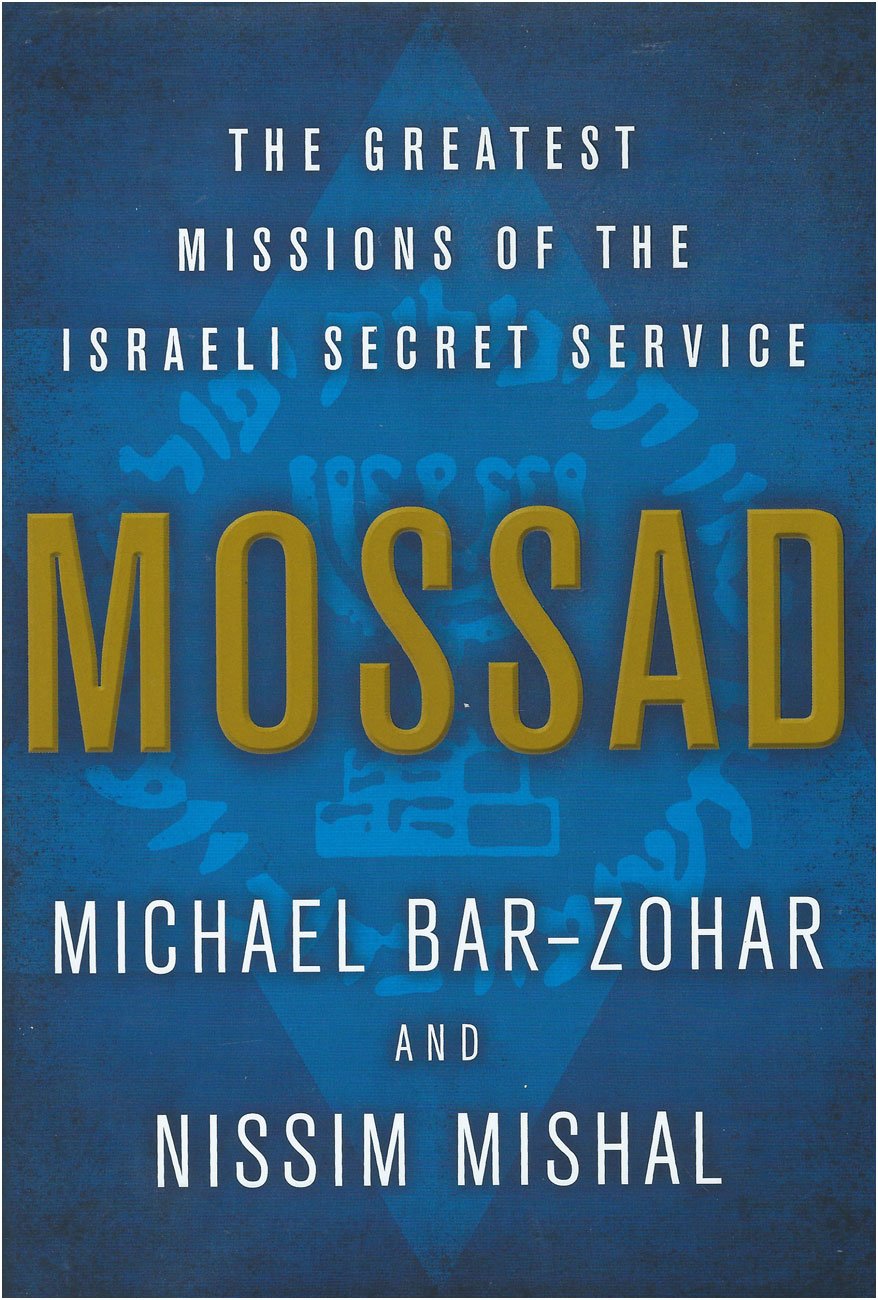
Mossad: The Greatest Missions of the Israeli Secret Service by Michael Bar-Zohar and Nissim Mishal – Inside the World of Espionage and Covert Operations
Some nonfiction books feel like history lessons. This one often reads more like a spy thriller, but the events come from history.
Mossad: The Greatest Missions of the Israeli Secret Service by Michael Bar-Zohar and Nissim Mishal takes readers through some of the best-known and most dramatic episodes linked to Israel’s foreign intelligence service.
The book moves from one operation to another, showing how agents gathered information, built cover identities, followed targets, recruited sources, and worked across borders. Among the stories are the capture of Adolf Eichmann in Argentina, Eli Cohen’s intelligence work in Syria, the operation connected with an Iraqi MiG-21 pilot, the pursuit of Black September figures after the Munich massacre, and later operations involving regional conflicts and nuclear programs.
The result is a fast, story-led introduction to intelligence history. You do not need to be an expert on espionage before starting. The authors explain the people, goals, risks, and outcomes in a direct way, making the book easy to follow even when the political background is complex.
Real Operations Told with the Pace of a Thriller
The biggest attraction of this book is simple: the stories move quickly. Instead of giving readers a long academic history of intelligence agencies, Bar-Zohar and Mishal focus on individual missions and the people involved in them.
That structure makes it easy to keep reading. One chapter may follow a man living under a false identity. Another may show agents watching a target for weeks. Another may deal with surveillance, secret meetings, coded information, aircraft, border crossings, or a plan that can fail because of one small mistake.
The tension comes from knowing that these are presented as real historical operations rather than invented adventures. A missed signal, a suspicious police officer, a wrong passport, or a change in timing could put an entire mission at risk.
Readers who normally find political history too dry may find this style much easier to enter. The book gives the background needed to understand each operation, but the focus stays on what happened, who was involved, and why the mission mattered.
The Capture of Adolf Eichmann
One of the most famous stories in the book concerns Adolf Eichmann, a senior Nazi official who helped organize the deportation of Jews during the Holocaust. After the Second World War, Eichmann escaped Europe and lived in Argentina under another name.
Israeli agents eventually located him. The operation to capture him and secretly move him from Argentina to Israel became one of the most famous intelligence missions of the twentieth century.
The book walks readers through the search, surveillance, planning, capture, and removal of Eichmann. It shows why patience can matter as much as force in intelligence work. Agents had to be certain they had the right man, learn his routine, choose the right location, and avoid alerting local authorities before they could complete the mission.
For readers interested in the history of the Holocaust, postwar justice, or intelligence operations, this section is one of the strongest reasons to pick up the book.
Spies, Defectors, Hidden Identities, and Dangerous Choices
Not every mission in Mossad follows the same pattern. That variety helps the book stay interesting.
The story of Eli Cohen, for example, is about deep undercover work. Cohen built a false identity and gained access to important circles in Syria before he was discovered, arrested, and executed. His story shows both the value and the extreme danger of long-term human intelligence.
Another chapter looks at the operation that brought an Iraqi MiG-21 fighter aircraft to Israel through the defection of pilot Munir Redfa. At a time when the MiG-21 was an important Soviet-designed fighter used by Arab states, getting access to the aircraft had major intelligence value.
Other stories involve tracking people across countries, recruiting sources, moving agents through hostile areas, and trying to act without revealing who is behind an operation.
Together, these chapters show that espionage is not one single skill. It may involve languages, psychology, patience, technology, planning, persuasion, deception, and sometimes force.
More Than Gadgets and Secret Codes
Popular movies often make spying look like a world of clever gadgets and perfect plans. This book shows something less tidy.
Many operations depend on ordinary human behavior. An agent has to know when someone is nervous. A source has to decide whether to trust another person. A team may spend days watching a house or waiting for a target. Plans can go wrong. Agents can make mistakes. Governments can face diplomatic damage when an operation fails.
The book includes successes, but it also covers failures and controversial episodes. One example is the failed 1997 attempt to kill Hamas leader Khaled Mashal in Amman, Jordan. That operation created a serious political crisis and forced Israel into difficult negotiations.
Stories like this keep the book from being only a collection of flawless victories. Intelligence work can produce unexpected consequences, especially when an operation takes place inside another country.
A Book About Intelligence History, Not a Neutral Textbook
Readers should know what kind of book this is before buying it. Mossad is written in a dramatic, highly readable style, and the authors are generally sympathetic toward Israeli intelligence personnel.
That makes the book exciting, but it also means it should not be treated as the final or completely neutral account of every operation. Some missions discussed in intelligence history remain secret, disputed, partly confirmed, or based on sources that cannot be independently checked in full.
Publishers Weekly noted that the book gives strong attention to operational detail and personalities while giving less space to the political, social, and ethical questions surrounding Mossad activity. That is useful context for readers.
If you are studying intelligence history seriously, this book works best as one source among several. If your goal is an accessible introduction to famous Mossad operations, however, its direct storytelling is a major strength.
Why the Book Is Easy to Keep Reading
Many nonfiction books have one problem: they contain good information but are hard to finish. Long blocks of explanation can slow the reader down.
Mossad takes another route. The chapters are built around missions, people, risks, and outcomes. This gives each section a clear question: Will the plan work? Will the target notice? Will the agent escape? What happens when something goes wrong?
That approach creates natural momentum.
You can read a few chapters at a time without losing the whole book. This also makes it useful for readers who have limited free time. A student, busy professional, or casual history reader can finish one operation and return later without feeling completely lost.
The simple chapter-by-chapter structure is also helpful if you want to discuss particular operations with friends or use the book as a starting point for further research.
Who Will Enjoy This Book Most?
This book is a strong match for readers interested in espionage, intelligence agencies, military history, Middle Eastern history, political history, security studies, and true stories involving covert operations.
It can also work well for people who enjoy spy novels but want to try nonfiction. The pace, suspense, disguises, secret meetings, surveillance, and high-risk decisions may feel familiar to thriller readers, even though the material is presented as history.
Students of international relations may find it useful as an accessible look at how intelligence can influence state decisions. Readers interested in Israel and the wider Middle East will also find many events that connect with larger regional conflicts.
It is less suitable for someone looking for a balanced academic study of the Israeli-Palestinian conflict as a whole. That is not what this book is trying to be. Its focus is Mossad operations and the people behind them.
What You Can Learn from the Missions
Beyond the excitement, the book gives readers several useful ways to think about intelligence work.
You see why information can sometimes be more valuable than weapons. You see how governments try to learn an opponent’s plans before making major decisions. You see why a source inside another organization can change what leaders know. You also see how intelligence operations can create political problems when they fail or become public.
The stories show that planning matters, but uncertainty never disappears. Agents may have incomplete information. Targets change routines. Local police interfere. Technology fails. Political leaders change their minds.
That is one reason intelligence history can be so interesting. It sits between careful planning and unpredictable human behavior.
A Comfortable Edition for Long Reading
A gripping book becomes less enjoyable when the physical copy is tiring to read. Bright pages, weak binding, or unclear printing can quickly break your concentration.
At Bookish Wonderland, this edition is prepared with premium eye-soothing cream paper, crystal-clear printing, and high-quality stitched plus glue binding. The softer page tone is comfortable for longer reading, while sharp text helps you move through detailed names, places, and events without unnecessary strain.
The strong binding is made for regular use. That matters with a nonfiction title you may want to return to later, especially when checking a mission, person, or historical event.
These physical features are offered together, so you get a copy made for reading as well as keeping on your shelf.
Why Order from Bookish Wonderland?
Bookish Wonderland makes it easy to order English books from anywhere in Bangladesh. Nationwide delivery is available, along with Cash on Delivery. Customers in Dhaka can also ask about fast or urgent delivery when available.
This is especially useful if you want a history or intelligence title that may not always be easy to find locally. Instead of spending time checking shop after shop, you can order the book and have it delivered to your area.
If you are checking Mossad: The Greatest Missions of the Israeli Secret Service by Michael Bar-Zohar and Nissim Mishal Book price in Bangladesh, remember to compare the full value of the copy, including paper comfort, print clarity, binding quality, and delivery support.
Book customization is also available. For special requests or questions before ordering, you can contact Bookish Wonderland through Facebook or Instagram.
Start Reading the Missions Behind the Headlines
Mossad: The Greatest Missions of the Israeli Secret Service by Michael Bar-Zohar and Nissim Mishal is for readers who want history with movement. It takes well-known names and events and places them inside stories of surveillance, recruitment, deception, capture, failure, risk, and secrecy.
You may come for the famous operations, but the most interesting part can be seeing how much depends on small decisions made by individual people.
Order your copy from Bookish Wonderland and explore some of the most discussed missions in modern intelligence history. You will get a reader-friendly edition with comfortable cream paper, clear printing, strong stitched plus glue binding, nationwide delivery, and Cash on Delivery.
For customization, availability, or urgent delivery in Dhaka, message Bookish Wonderland through Facebook or Instagram. If real-world espionage, secret operations, political history, and high-stakes decisions interest you, this is the kind of nonfiction book that can keep you turning pages long after you planned to stop.
If you require any customization or have any questions, please inbox us via FB or Insta.
| Primary Specification | |
| Author | Benjamin Isaac |
| Narrator | Michael Bar-Zohar, Nissim Mishal |
| Genre | Nonfiction, History, Espionage, Intelligence & National Security, True Crime |
| ISBN-13/ISSN | 978-0062123411 |
| ISBN-10 | 0062123416 |
| Publisher | Ecco |
| Publishing Date | September 23, 2014 |
| Language | English |
| Reading Age | 12+ years |
| Format | Printed Book |
| Physical Specification & Quality | |
| Paper Quality | Premium eye-soothing cream paper |
| Binding Quality | High quality stitched and glue binding (for longevity) |
| Print Quality | Crystal-clear print |
| Pages | 416 pages |
| Country | Israel |
| Logistics Information | |
| Weight | 436 gm |
| Length | 8.5 inches |
| Width | 5.6 inches |
| Height | 0.97 inch |