

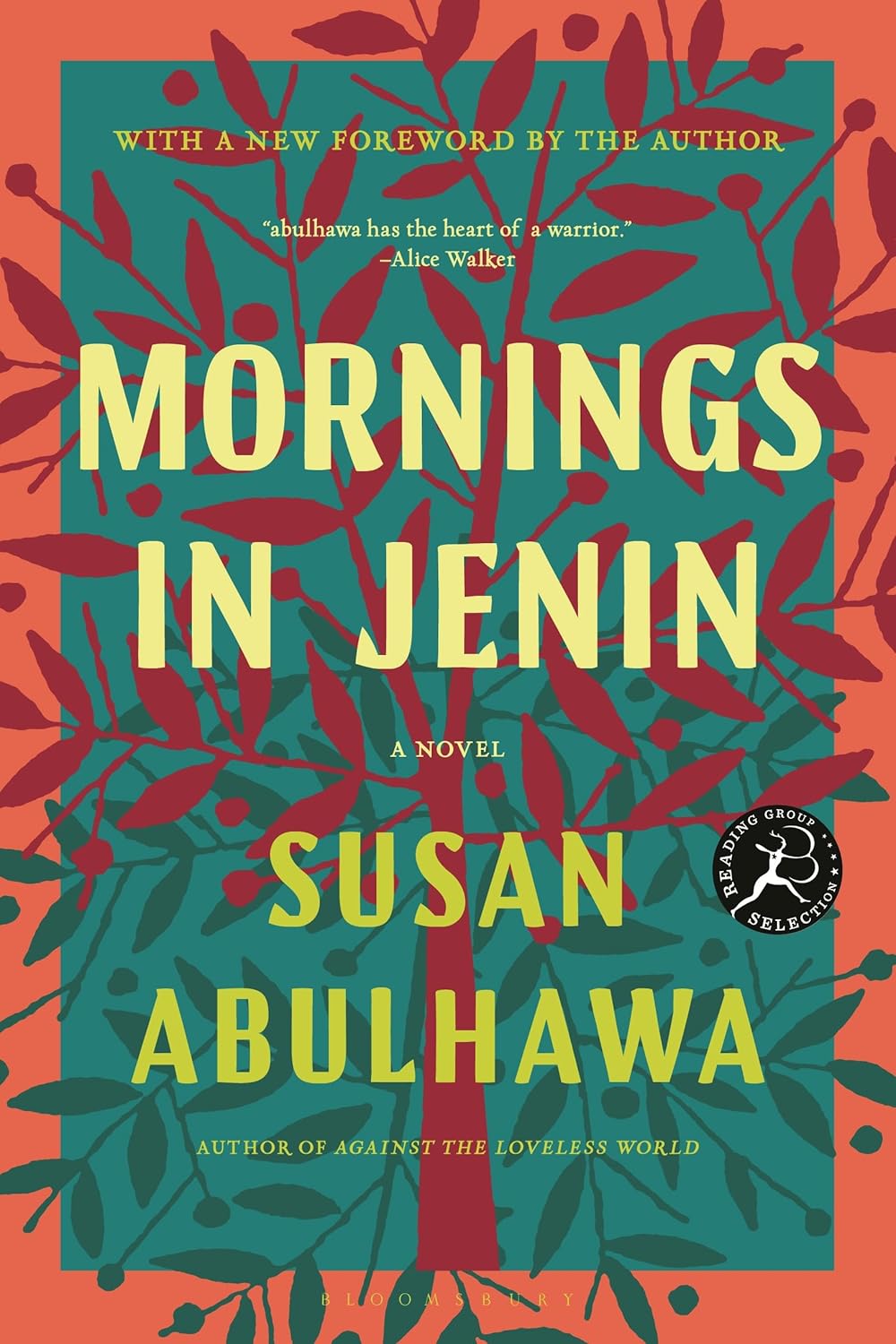
About Mornings in Jenin by Susan Abulhawa – A Family Story of Displacement, Memory, Love, Identity, and Life Across Generations
Mornings in Jenin by Susan Abulhawa follows the Abulheja family across several generations, beginning before the creation of Israel in 1948 and moving through war, displacement, refugee life, exile, and migration. The main character is Amal, a Palestinian girl born in the Jenin refugee camp after her family is forced from the village of Ein Hod.
The novel is built around family memory. Amal grows up hearing about the village her parents lost, the relatives who were separated, and the life that existed before the camp. Her story later moves beyond Jenin to Jerusalem, Lebanon, and the United States, showing how displacement can continue to shape a family long after the first loss of home.
The book is historical fiction, not a neutral history textbook. It presents the conflict mainly through one Palestinian family’s experience while also including Jewish and Israeli characters whose lives connect with the Abulhejas.
The Abulheja Family Begins in Ein Hod
Before displacement, the Abulheja family lives in the village of Ein Hod, where land, farming, family routines, and community life give them a strong sense of home.
That early part of the story matters because the novel does not introduce the family only as refugees. Readers first see them as people with work, friendships, traditions, land, and ordinary plans.
Hasan, Amal’s father, is educated and thoughtful. He has a close childhood friendship with Ari Perlstein, a Jewish refugee whose family has also experienced persecution in Europe.
Their friendship adds another layer to the novel because it shows personal bonds existing alongside larger political conflict.
As the political situation changes, those private relationships become harder to separate from questions of land, identity, safety, and national belonging.
Displacement Changes the Family’s Future
The family is forced from Ein Hod during the events surrounding the 1948 Arab-Israeli war.
They eventually live in the Jenin refugee camp.
The move changes almost every part of their lives. Home is no longer only a place they live. It becomes something remembered, discussed, and passed from one generation to another.
For the older generation, Ein Hod is a real place they knew.
For Amal, it becomes an inherited memory.
This difference is important. Children born after displacement can still grow up carrying stories, grief, habits, and hopes connected to a place they have never lived in themselves.
Abulhawa uses this family experience to show how displacement can become part of identity.
Ismael’s Separation Becomes One of the Family’s Deepest Wounds
One of the most important events in the novel is the disappearance of Amal’s brother Ismael as an infant.
He is separated from his Palestinian family and raised in an Israeli Jewish household under the name David.
This creates a major family fracture.
David grows up with a different language, national identity, history, and understanding of the conflict than the family into which he was born.
The novel later brings these divided identities into direct contact.
Through David, Abulhawa explores what happens when family origin, memory, religion, nation, and upbringing point in different directions.
The character is not simply a plot surprise. His life becomes one of the clearest examples of the novel’s larger interest in identity and belonging.
Amal Grows Up in the Jenin Refugee Camp
Amal is born after her family has already been displaced.
The camp is therefore the first home she directly knows.
Her childhood contains fear and instability, but it also contains family routines, friendship, school, food, jokes, and affection.
This balance is important.
The novel does not show refugee life as one continuous scene of suffering. People still form friendships, fall in love, study, argue, celebrate, and make plans.
Amal’s relationship with her father is especially important.
He reads poetry to her in the early morning, giving the novel some of its quietest and most memorable moments.
Those mornings connect language, family, and memory.
They also help explain the title.
Education Gives Amal Another Way Forward
School becomes one of Amal’s strongest paths toward independence.
She is intelligent and takes education seriously.
As her family faces more loss and instability, study becomes something she can still build.
This eventually takes her beyond the refugee camp.
Her education opens opportunities that many people around her do not have, and later helps her create a life in the United States.
The novel does not suggest that education removes trauma or displacement.
Instead, it shows education as one tool that can create choices.
For Amal, learning becomes connected with survival, identity, and the possibility of building a future that is not fully controlled by events around her.
Yousef Follows a Different Path
Amal’s older brother Yousef grows up under many of the same pressures, but his path is different.
He experiences family loss, political violence, imprisonment, and anger.
Over time, he becomes more directly involved in the Palestinian struggle.
His choices show another response to displacement and conflict.
Where Amal often looks toward education and personal survival, Yousef becomes drawn toward political action and resistance.
The novel does not present the siblings as simple opposites.
Both are shaped by the same family history, but their experiences lead them toward different ways of responding.
This helps the book show how one political conflict can produce very different lives even inside the same family.
Love and Marriage Give Amal a New Future
As an adult, Amal finds love with Majid.
Their relationship gives her a period of personal happiness after years shaped by family loss and displacement.
Their life together also connects the novel to Lebanon and to another stage of Palestinian exile.
Amal begins imagining a family and a future that belongs to her rather than only to the past.
However, political violence again enters private life.
The novel connects Amal’s personal story with the 1982 Lebanon War and the Sabra and Shatila massacre.
Because this is a novel, readers should understand these historical events through both the characters’ experiences and independent historical sources if they are studying the period academically.
Motherhood Changes Amal’s Priorities
Amal later becomes a mother to Sara.
Motherhood gives her another reason to think about memory and identity.
She has to decide what parts of the family story to carry forward and how much of the past should shape her daughter’s life.
This is one of the book’s recurring questions.
What does one generation owe the next?
Should children inherit every grief, or should parents try to protect them from some of it?
There is no simple answer.
Amal wants Sara to have safety and opportunity, but she also does not want the family’s history to disappear.
That tension becomes especially important when they live in the United States.
America Gives Distance but Not Complete Separation
Amal eventually lives in the United States.
Physical distance changes her daily life, but it does not erase her connection with Jenin or her family history.
She has work, motherhood, and a different social environment, yet memories remain active.
The United States becomes another part of her identity rather than a complete replacement for what came before.
This makes Mornings in Jenin a diaspora novel as well as a historical family saga.
It asks how people live when more than one place feels important and when home may mean memory, family, language, and history as much as a current address.
The Novel Covers Several Major Historical Periods
The family story moves across many decades.
It includes the end of the British Mandate period, the 1948 war, refugee life in Jenin, the 1967 war, later occupation, events in Lebanon, and the early 2000s.
These events are shown mainly through the lives of fictional characters rather than through a textbook timeline.
That approach makes history personal, but it also means the book has a clear narrative perspective.
Readers using the novel for study should treat it as literature that represents one family’s Palestinian experience and should consult historical scholarship for broader political context and competing interpretations.
Publication and Edition Details
The novel was first published in the United States in 2006 under the title The Scar of David.
A revised edition was published by Bloomsbury in 2010 as Mornings in Jenin.
Google Books lists the 2010 Bloomsbury USA edition at 331 pages with ISBN 9781608190461.
Bloomsbury also released later editions with different pagination. A 2025 Bloomsbury paperback is listed at 352 pages with ISBN 9781526687562.
Page counts therefore vary by edition.
Customers who need a particular cover, page count, or ISBN should check the exact edition before ordering.
About Susan Abulhawa
Susan Abulhawa is a Palestinian American novelist, poet, essayist, scientist, and activist.
Mornings in Jenin was her first novel and became an international bestseller.
Simon & Schuster states that the book has been translated into thirty languages and has sold more than one million copies worldwide.
Her later books include The Blue Between Sky and Water and Against the Loveless World.
She is also the founder of Playgrounds for Palestine, an organization focused on children.
Her fiction often deals with family, displacement, identity, exile, memory, and Palestinian life.
Who Will Enjoy Mornings in Jenin?
Mornings in Jenin is suited to adult readers who enjoy historical fiction, family sagas, literary fiction, multigenerational stories, diaspora fiction, and novels about identity and displacement.
It can also interest readers studying Palestinian literature or fiction connected with twentieth-century Middle Eastern history.
The novel includes war, displacement, death, imprisonment, family separation, refugee life, and other distressing material.
Readers should expect a serious story with many painful events, but also friendship, family bonds, education, love, and ordinary daily life.
Book Quality at Bookish Wonderland
Bookish Wonderland offers this title with premium eye-soothing cream paper, crystal-clear printing, and high-quality stitched plus glue binding.
The cream paper supports comfortable reading through a long family story, while clear printing keeps names, dates, dialogue, and changing locations easy to follow. Strong binding supports repeated reading and shelf storage.
The copy is suitable for personal reading, gifting, book clubs, university study, or building a literary and historical fiction collection.
Why Order from Bookish Wonderland?
Bookish Wonderland delivers books across Bangladesh, including inside and outside Dhaka. Cash on Delivery is available nationwide.
Customers in Dhaka can also ask about fast or urgent delivery when available.
If you are checking Mornings in Jenin by Susan Abulhawa Book price in Bangladesh, it is useful to compare the physical quality of the copy along with the listed price.
Book customization is also available. For stock, customization, or delivery questions, you can contact Bookish Wonderland through Facebook or Instagram.
Why Readers Choose Mornings in Jenin
Mornings in Jenin by Susan Abulhawa uses one family to explore how displacement, war, memory, identity, and migration can affect several generations.
The novel follows Amal from childhood in Jenin to adulthood and motherhood, while the stories of her brothers and parents show other paths created by the same family history.
For readers who want a multigenerational historical novel centered on Palestinian family life, exile, belonging, and memory, it offers a broad and personal story for many readers.
Order your copy from Bookish Wonderland for nationwide delivery, Cash on Delivery, premium cream paper, clear printing, and strong stitched plus glue binding.
If you require any customization or have any questions, please inbox us via FB or Insta.
| Primary Specification | |
| Author | Susan Abulhawa |
| Narrator | Suzanne Toren |
| Genre | Historical Fiction, Literary Fiction, Family Saga |
| ISBN-13/ISSN | 978-1668242070 |
| ISBN-10 | 1668242079 |
| Publisher | Washington Square Press |
| Publishing Date | September 29, 2026 |
| Language | English |
| Reading Age | 16+ |
| Format | Printed Book |
| Physical Specification & Quality | |
| Paper Quality | Premium eye-soothing cream paper |
| Binding Quality | High quality stitched and glue binding (for longevity) |
| Print Quality | Crystal-clear print |
| Pages | 352 pages |
| Country | USA |
| Logistics Information | |
| Weight | 374 gm |
| Length | 8.5 inches |
| Width | 5.6 inches |
| Height | 0.9 inch |