

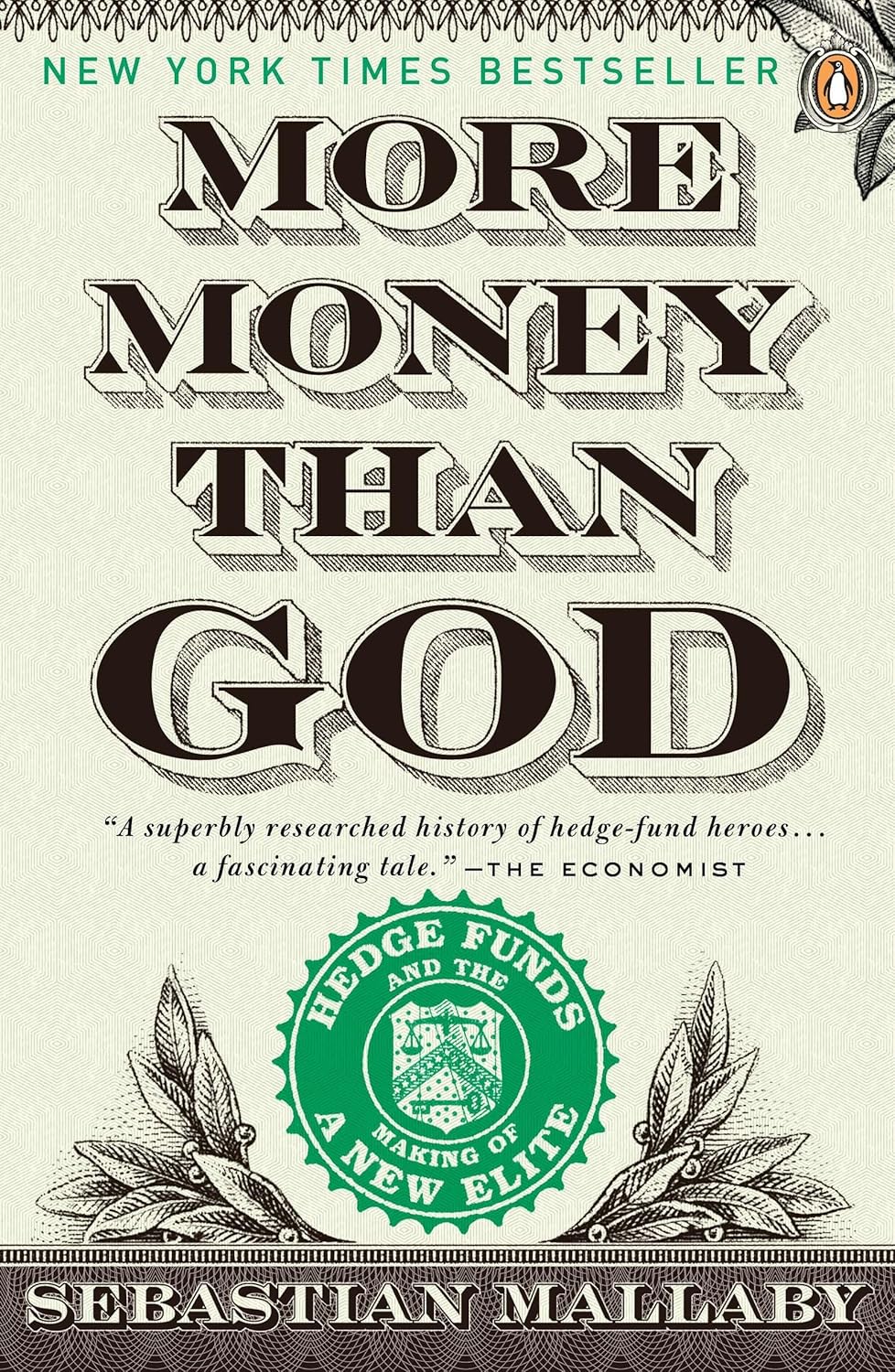
About More Money Than God by Sebastian Mallaby – A Detailed History of Hedge Funds, Investment Strategies, Financial Crises, and the People Who Changed Modern Finance
More Money Than God by Sebastian Mallaby is a history of hedge funds and the investors who helped shape modern finance. Instead of treating hedge funds as one simple type of business, Mallaby follows different managers, strategies, successes, failures, and market crises from the early days of the industry through the financial crisis of 2007 to 2009.
The book begins with Alfred Winslow Jones, who created an early “hedged fund” model in the late 1940s. It then moves through later figures such as Michael Steinhardt, George Soros, Julian Robertson, Paul Tudor Jones, Jim Simons, and Ken Griffin.
Mallaby explains how these investors used short selling, leverage, macroeconomic bets, quantitative models, arbitrage, and other methods. He also asks a larger question: what can hedge funds teach us about risk, incentives, financial markets, and the structure of the financial system?
The Book Starts With Alfred Winslow Jones
Alfred Winslow Jones is widely treated as one of the founders of the modern hedge fund.
He combined long positions in stocks he expected to rise with short positions in stocks he expected to fall. The aim was to reduce some market exposure while still making money from good security selection.
Jones also used leverage and performance-based fees.
These ideas became important features of the hedge fund business.
Mallaby uses Jones to show that hedge funds did not begin as giant institutions with thousands of employees. They began as flexible investment partnerships built around unusual strategies and strong individual judgment.
The story also shows how financial innovation can begin quietly before becoming widely copied.
Hedge Funds Try to Find an Edge
A major theme of the book is the search for an investment advantage.
Different managers try to find that advantage in different ways.
Some study companies and individual securities. Some follow currencies, interest rates, commodities, and global economic trends. Some look for pricing differences between related assets. Others use mathematics, computers, and large amounts of data.
Mallaby does not suggest that every strategy works forever.
An edge can disappear when competitors copy it, market conditions change, or a manager becomes too confident.
This makes the book useful for readers who want to understand why successful investing often depends on adapting rather than relying on one permanent formula.
George Soros Connects Markets With Big Economic Ideas
George Soros is one of the most famous figures in the book.
He became known for large macroeconomic trades involving currencies, interest rates, and national economic policies.
His Quantum Fund placed bets based on broad views of how markets and policy would move.
The book discusses Soros’s idea of reflexivity, which questions the simple belief that markets only reflect outside reality.
Soros argued that market participants can affect the reality they are trying to understand. Beliefs can influence prices, and changing prices can influence behavior, credit, investment, and policy.
For readers interested in economics as well as investing, this makes his section especially useful.
Julian Robertson Built Tiger Management
Julian Robertson founded Tiger Management and became another central figure in hedge fund history.
His style placed strong emphasis on research and finding strong companies to buy while identifying weak companies to sell short.
Tiger also became known for developing talented analysts and investment managers.
Many people who worked at Tiger later started their own funds and became known as “Tiger Cubs.”
This shows how one investment firm can influence an industry through people as well as returns.
Mallaby’s discussion of Robertson also explores a recurring problem: a strategy can have a strong long-term record and still face periods when the market moves against it.
Long-Term Capital Management Shows How Models Can Fail
The story of Long-Term Capital Management is one of the book’s most important warnings.
LTCM brought together highly respected traders and academics and used sophisticated models to find small pricing differences between related securities.
Because those differences were small, the fund used large amounts of leverage to increase potential returns.
For a time, the strategy produced impressive results.
Then market conditions changed sharply in 1998.
Positions that were expected to behave in predictable relationships moved in unexpected ways, and the fund suffered huge losses.
Major financial institutions helped arrange a private rescue because of concerns about wider market effects.
The episode shows that advanced mathematics does not remove uncertainty.
Jim Simons Represents the Rise of Quantitative Investing
Jim Simons, founder of Renaissance Technologies, brings mathematics and computer-driven trading into the story.
He came from a background in mathematics and codebreaking rather than traditional Wall Street finance.
Renaissance used data, statistical patterns, models, and computing to search for profitable signals.
This approach was very different from a manager sitting in an office making decisions mainly from company reports or economic opinions.
The rise of quantitative funds shows how finance increasingly became connected with mathematics, programming, data analysis, and technology.
For readers interested in modern markets, this section helps explain why some investment firms began hiring mathematicians, scientists, and computer specialists alongside traditional finance professionals.
Risk Management Matters as Much as Finding Opportunities
More Money Than God repeatedly returns to risk.
A profitable idea can still destroy a fund if the position is too large, too leveraged, too illiquid, or too difficult to exit.
Managers therefore need to think not only about how much they may gain but also about what happens if they are wrong.
Different funds in the book handle this problem differently.
Some survive because they reduce positions quickly. Others fail because losses grow faster than expected.
This makes the book useful even for readers who never plan to work at a hedge fund.
The basic principle applies widely: good decisions require thinking about downside as well as upside.
Incentives Help Explain Hedge Fund Behavior
Mallaby also looks at the way hedge fund managers are paid.
Performance fees can reward strong results, while many funds use high-water marks that limit performance fees after losses until previous losses are recovered.
The author compares these incentives with structures inside large banks.
His argument is that ownership, compensation, and the possibility of a fund failing can influence how managers think about risk.
Readers do not have to agree with every part of that argument to find it useful.
The book gives a clear example of how incentive systems can shape behavior inside financial institutions.
The Financial Crisis Tests the Industry
The book follows hedge funds into the global financial crisis of 2007 to 2009.
Many funds suffered losses, and thousands of hedge funds failed during the broader period Mallaby studies.
However, Mallaby argues that the hedge fund sector handled the crisis better than large banks in important ways.
His case is that hedge funds were generally smaller, could fail without requiring taxpayer bailouts, had different incentives, and could adjust positions more quickly.
This is one of the book’s central arguments rather than an uncontested fact.
Readers can use the evidence Mallaby presents and compare it with other views about financial regulation and systemic risk.
This Is History, Not an Investing Manual
More Money Than God explains many investment ideas, but it is not a step-by-step guide for choosing stocks or starting a hedge fund.
Readers should not expect trade signals, portfolio recommendations, or a simple formula for becoming wealthy.
The book is better understood as financial history and business history.
It explains how strategies developed, why certain managers succeeded, how some funds failed, and how the hedge fund industry changed.
That makes it useful for people who want context before studying more technical material about investing or financial markets.
Publication and Edition Details
Penguin Press published the original US hardcover in 2010 under the full title More Money Than God: Hedge Funds and the Making of a New Elite.
The Council on Foreign Relations lists the original edition with ISBN 9781594202551.
Penguin Books published a paperback edition on May 31, 2011, with ISBN 9780143119418 and 512 pages.
Page counts vary across editions. Bloomsbury and other international editions are listed with different pagination.
Customers who need a specific cover, ISBN, or page count should check the exact edition before ordering.
The Book Became a Major Business Bestseller
Penguin Random House identifies More Money Than God as a New York Times bestseller.
The book was also shortlisted for the 2010 Financial Times and Goldman Sachs Business Book of the Year Award.
The official award announcement lists it alongside books including The Big Short, Too Big to Fail, and Fault Lines.
These recognitions reflect the book’s place among major financial and business titles published after the global financial crisis.
About Sebastian Mallaby
Sebastian Mallaby is a financial writer and the Paul A. Volcker Senior Fellow for International Economics at the Council on Foreign Relations.
He previously worked at The Economist and was a contributing editor at the Financial Times.
The Council on Foreign Relations identifies him as a two-time Pulitzer Prize finalist.
His other books include The World’s Banker, The Man Who Knew, The Power Law, and The Infinity Machine.
His work often focuses on finance, economic policy, central banks, technology, investment, and the institutions that shape markets.
Who Will Benefit Most From This Book?
More Money Than God is a strong choice for readers interested in finance, hedge funds, investing, financial history, economic crises, trading, asset management, and Wall Street.
Business and finance students can use it to understand how major hedge fund strategies developed over time.
Investors may appreciate the case studies of risk, leverage, incentives, market psychology, and failure.
It is also suitable for readers who enjoyed books about financial institutions and want a detailed history rather than a short personal-finance guide.
The book includes financial terminology, but Mallaby explains many ideas through stories about people and events.
Book Quality at Bookish Wonderland
Bookish Wonderland offers this title with premium eye-soothing cream paper, crystal-clear printing, and high-quality stitched plus glue binding.
The cream paper supports comfortable reading through a long finance book, while clear printing keeps names, dates, market events, and financial explanations easy to follow. Strong binding supports repeated study and shelf storage.
The copy is suitable for personal reading, business study, finance courses, research, gifting, or building an economics and investment collection.
Why Order from Bookish Wonderland?
Bookish Wonderland delivers books across Bangladesh, including inside and outside Dhaka. Cash on Delivery is available nationwide.
Customers in Dhaka can also ask about fast or urgent delivery when available.
If you are checking More Money Than God by Sebastian Mallaby Book price in Bangladesh, it is useful to compare the physical quality of the copy along with the listed price.
Why More Money Than God Is Worth Reading
More Money Than God by Sebastian Mallaby gives readers a history of hedge funds through the people, strategies, risks, and crises that shaped the industry.
It explains how managers searched for advantages, used leverage, built investment styles, and responded when markets moved against them.
For readers who want financial history, business lessons, and an understanding of hedge funds without starting with a textbook, this book is a practical choice.
If you require any customization or have any questions, please inbox us via FB or Insta.
| Primary Specification | |
| Author | Sebastian Mallaby |
| Narrator | Alan Nebelthau |
| Editor | Meighan Cavanaugh |
| Genre | Business, Finance, Economics, Investment History |
| ISBN-13/ISSN | 978-0143119418 |
| ISBN-10 | 0143119419 |
| Publisher | Penguin Books |
| Publishing Date | May 31, 2011 |
| Language | English |
| Reading Age | 18+ |
| Format | Printed Book |
| Physical Specification & Quality | |
| Paper Quality | Premium eye-soothing cream paper |
| Binding Quality | High quality stitched and glue binding (for longevity) |
| Print Quality | Crystal-clear print |
| Pages | 512 pages |
| Country | USA |
| Logistics Information | |
| Weight | 534 gm |
| Length | 8.5 inches |
| Width | 5.6 inches |
| Height | 1.08 inch |