

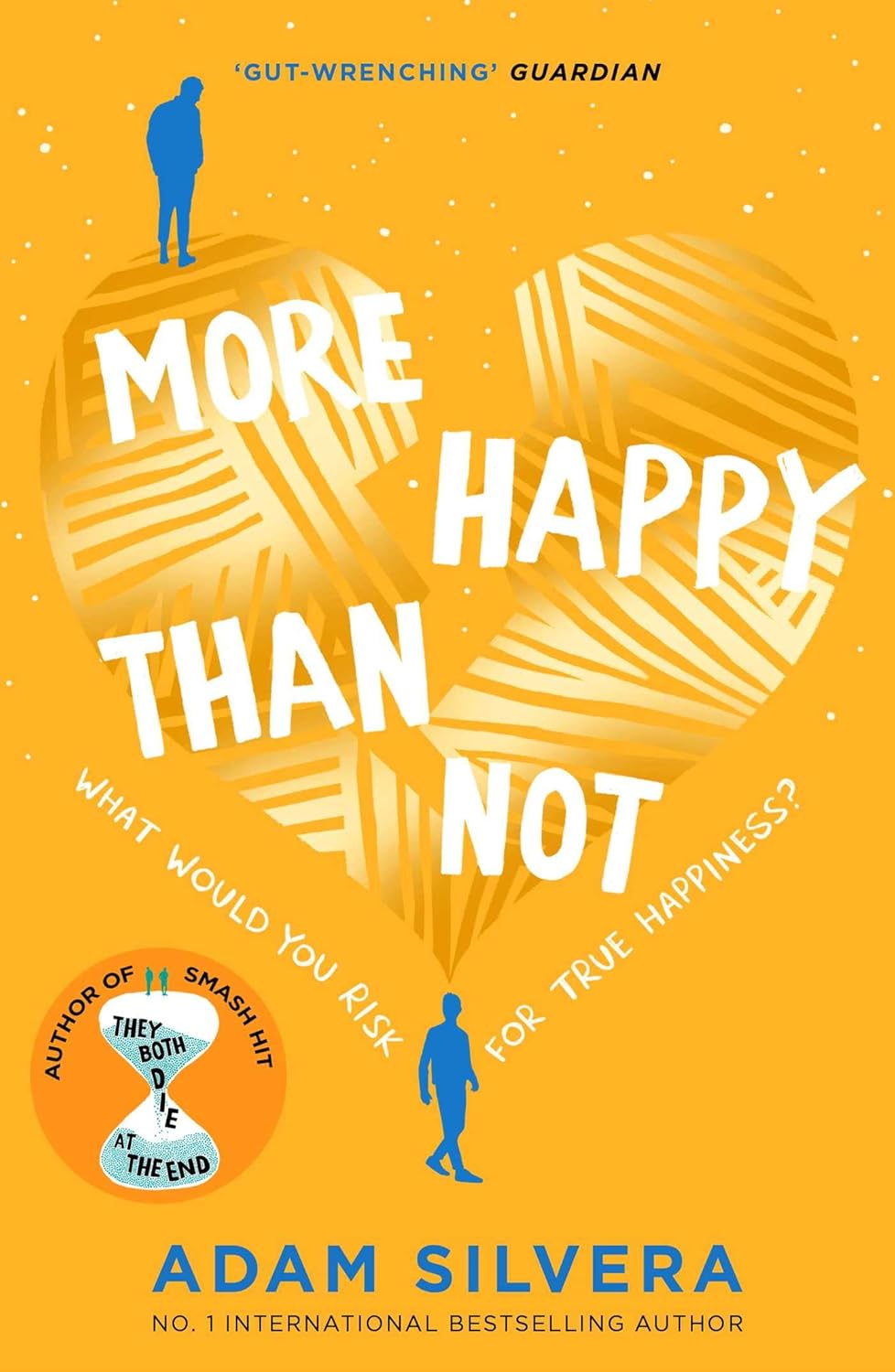
About More Happy Than Not by Adam Silvera – A Young Adult Novel About Memory, Grief, Identity, Friendship, and the Search for Happiness
More Happy Than Not by Adam Silvera follows sixteen-year-old Aaron Soto during a difficult summer in the Bronx. His father has died by suicide, Aaron is still carrying grief, and he is trying to rebuild a normal life with help from his girlfriend Genevieve, his mother, and the people around him.
Then Aaron becomes close to Thomas, a new boy in his neighborhood. Their friendship gives Aaron a sense of safety and happiness he has been missing. At the same time, it creates new questions about attraction, identity, loyalty, and what Aaron truly wants.
The novel also introduces the Leteo Institute, a company that offers a procedure designed to change or remove painful memories. For Aaron, the idea becomes deeply personal. If a memory hurts enough, forgetting it can sound easier than learning how to live with it.
Aaron Is Trying to Feel Normal Again
Aaron begins the novel in a fragile place.
His father’s death has changed the family, and Aaron is still dealing with the emotional damage left behind. He has his own history of self-harm, visible in the smile-shaped scar on his wrist, and he is trying to convince himself that life can become manageable again.
Genevieve gives him support and familiarity. His mother works hard, even while the family has limited money and many pressures.
Aaron wants ordinary things too. He wants to spend time with friends, play games, joke around, and have a relationship that feels stable.
The book understands that grief does not remove everyday life. People can be sad and still laugh. They can feel lost and still make plans for tomorrow.
Thomas Changes Aaron’s Summer
When Genevieve leaves for a few weeks, Aaron begins spending more time with Thomas.
Thomas is different from many of Aaron’s neighborhood friends. He listens, talks openly, and makes Aaron feel understood.
Their friendship becomes important very quickly.
Aaron feels calmer around him, but those feelings also create confusion. He starts questioning whether what he feels is simply friendship or something more.
That question matters because Aaron has already built an idea of who he is supposed to be.
The closer he becomes to Thomas, the harder it is to keep every part of that identity unchanged.
Silvera uses the relationship to explore how difficult self-understanding can become when desire, fear, friendship, family, and social expectations all pull in different directions.
The Leteo Procedure Creates the Main Science-Fiction Question
More Happy Than Not is mostly a realistic contemporary story, but the Leteo Institute adds a near-future science-fiction element.
Leteo offers a memory-alteration procedure.
The idea is simple to understand: if certain memories create unbearable pain, perhaps changing them could make life easier.
But the novel asks what might be lost with that relief.
Memories are connected with identity, relationships, mistakes, love, grief, and learning. Removing painful memories may also change the way a person understands themselves.
Silvera does not use Leteo only as a futuristic device.
The procedure becomes a way to ask a human question: if you could remove the part of your past that hurts most, should you?
Memory and Identity Are Closely Connected
Aaron’s struggle is not only about what happened to him.
It is also about the meaning he gives those experiences.
The novel asks whether a person remains the same if important memories are changed.
This becomes especially important when Aaron is trying to understand his sexuality and his relationships.
Memory is not presented as a simple storage system.
It shapes how people explain their lives to themselves.
A painful memory may cause suffering, but it can also contain truth.
The book therefore treats forgetting as both tempting and dangerous.
Readers who enjoy stories about memory, identity, and personal choice may find this part especially interesting.
The Novel Looks at Sexual Identity Without Making It Easy
Aaron’s feelings for Thomas force him to ask questions he has tried not to face.
His relationship with Genevieve is real, and his feelings are complicated.
The novel avoids making identity feel like a neat label that solves everything immediately.
Instead, Aaron has to deal with attraction, fear, shame, hope, and the expectations of people around him.
The story also shows how homophobia can shape the way a person thinks about themselves.
Fear of rejection does not stay outside the person. It can become internal.
That makes Aaron’s conflict more painful because part of the pressure comes from the world around him and part comes from what he has learned to fear inside himself.
Friendship Is Both Comfort and Pressure
Aaron has a close group of neighborhood friends.
They joke, play games, and share years of history.
At the same time, their ideas about masculinity and sexuality create pressure.
Aaron wants to belong.
That desire makes it harder to act honestly when honesty could change how the group sees him.
This is one of the book’s strongest social themes.
Belonging can be comforting, but it can also become a reason to hide.
The novel asks what happens when being accepted by a group seems to require rejecting part of yourself.
Genevieve Is More Than a Simple Girlfriend Character
Genevieve matters to Aaron beyond being part of a romantic triangle.
She knows him, supports him, and has her own creative interests.
Their relationship gives Aaron a kind of stability after his father’s death.
That is why his changing feelings create guilt.
He does not want to hurt someone who has cared for him.
The book allows this conflict to stay uncomfortable.
There is no easy way for Aaron to understand himself without affecting people around him.
That makes the story feel more honest than a romance where one relationship simply becomes meaningless as soon as another begins.
Grief Runs Through the Whole Story
Aaron’s father’s suicide is not only background information.
It shapes the way Aaron thinks about pain, family, memory, and survival.
His mother is grieving too, and the family is trying to continue daily life after a major loss.
Aaron’s own self-harm history makes the subject even more serious.
The novel shows how grief can mix with anger, guilt, confusion, and the wish to escape memory altogether.
Readers should know that the book includes suicide, self-harm, depression, homophobia, violence, grief, and other heavy material.
These subjects are central rather than brief side references.
Happiness Is Treated as Something Partial
The title gives an important clue about the book’s view of happiness.
The story does not suggest that people become completely happy once one problem is solved.
Aaron’s life contains grief and joy at the same time.
A good day does not erase what happened before.
A painful memory does not make every future moment worthless.
Silvera has described the idea of being “more happy than not” as a way of continuing even when heartbreak and grief remain part of life.
That gives the novel a more realistic view of recovery.
Happiness can be incomplete and still matter.
The Deluxe Edition Adds New Material
The original edition of More Happy Than Not was published by Soho Teen on June 2, 2015.
Google Books lists the original hardcover at 295 pages with ISBN 9781616955601.
A 2016 reprint is listed at 322 pages.
In 2020, Soho Press released a Deluxe Edition at 352 pages. It includes an introduction by Angie Thomas, a new final chapter titled “More Happy Ending,” and an afterword from Adam Silvera about the book’s beginnings.
Adam Silvera’s official site also lists a 2025 Collector’s Edition with a new hardcover design, reversible dust jacket, full-color endpapers, and exclusive content.
Customers should check which edition they are ordering because page count and extra material vary.
The Novel Received Strong Recognition
Adam Silvera’s official site lists More Happy Than Not as a New York Times bestselling debut.
It was also selected for TIME’s list of the 100 Best YA Books of All Time.
The book was named a Booklist Best First Novel of 2015, a Kirkus Best Teen Book of 2015, an ABA Indie Next selection, and an Amazon Best Young Adult Book of 2015.
It also received starred reviews from several major review publications.
These recognitions helped establish Silvera as a major voice in contemporary young adult fiction.
About Adam Silvera
Adam Silvera is a young adult author born and raised in the Bronx.
Before becoming known as a novelist, he worked in bookselling and children’s publishing.
His books include More Happy Than Not, History Is All You Left Me, They Both Die at the End, The First to Die at the End, The Survivor Wants to Die at the End, and the Infinity Cycle series.
His official biography identifies him as a number-one New York Times and USA Today bestselling author.
His work often explores grief, queer identity, friendship, love, memory, mortality, and difficult choices.
Who Will Enjoy More Happy Than Not?
More Happy Than Not is a strong choice for readers who enjoy young adult contemporary fiction, LGBTQ+ stories, near-future science fiction, friendship, coming-of-age themes, memory-based plots, and emotionally serious books.
It can also appeal to readers who liked They Both Die at the End and want to read Adam Silvera’s debut.
Because of the mature themes, the novel is better suited to teen and adult readers who are comfortable with difficult emotional material.
It is not a light romance, even though relationships are important.
The book focuses more broadly on identity, grief, memory, belonging, and the question of whether pain can simply be removed.
Book Quality at Bookish Wonderland
Bookish Wonderland offers this title with premium eye-soothing cream paper, crystal-clear printing, and high-quality stitched plus glue binding.
The cream paper supports comfortable reading, while clear printing keeps dialogue and the novel’s changing emotional details easy to follow. Strong binding supports repeated reading and shelf storage.
Why Order from Bookish Wonderland?
Bookish Wonderland delivers books across Bangladesh, including inside and outside Dhaka. Cash on Delivery is available nationwide.
Customers in Dhaka can also ask about fast or urgent delivery when available.
If you are checking More Happy Than Not by Adam Silvera Book price in Bangladesh, it is useful to compare the physical quality of the copy along with the listed price.
Book customization is also available. For stock, customization, or delivery questions, you can contact Bookish Wonderland through Facebook or Instagram.
Why Readers Choose More Happy Than Not
More Happy Than Not by Adam Silvera combines a realistic Bronx coming-of-age story with one speculative idea that changes the way readers think about memory.
Aaron is trying to survive grief, understand his feelings, protect relationships, and decide whether forgetting pain would actually make him happier.
The book gives readers friendship, romance, family, identity, and a mystery around memory without turning those subjects into simple lessons.
For readers who want young adult fiction that asks difficult questions about being honest with yourself, living with painful memories, and finding happiness after loss, More Happy Than Not offers a thoughtful standalone story.
Order your copy from Bookish Wonderland for nationwide delivery, Cash on Delivery, premium cream paper, clear printing, and strong stitched plus glue binding.
If you require any customization or have any questions, please inbox us via FB or Insta.
| Primary Specification | |
| Author | Adam Silvera |
| Genre | Young Adult, LGBTQ+ Fiction, Speculative Fiction, Contemporary Romance |
| ISBN-13/ISSN | 978-1641291941 |
| ISBN-10 | 164129194X |
| Publisher | Soho Teen |
| Publishing Date | September 8, 2020 |
| Language | English |
| Reading Age | 14-18 years |
| Format | Printed Book |
| Physical Specification & Quality | |
| Paper Quality | Premium eye-soothing cream paper |
| Binding Quality | High quality stitched and glue binding (for longevity) |
| Print Quality | Crystal-clear print |
| Pages | 352 pages |
| Country | USA |
| Logistics Information | |
| Weight | 375 gm |
| Length | 8.5 inches |
| Width | 5.6 inches |
| Height | 0.89 inch |