

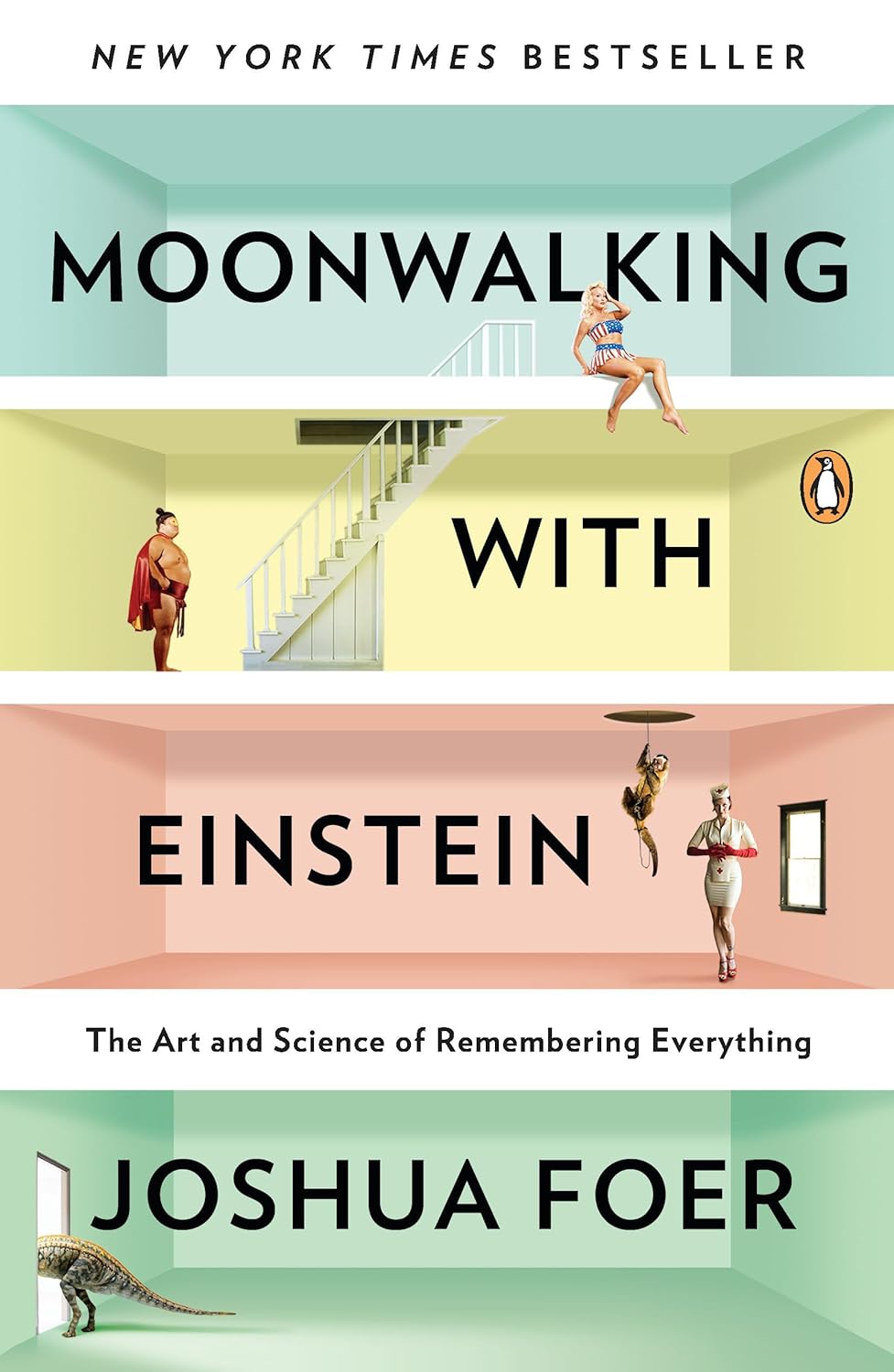
About Moonwalking with Einstein by Joshua Foer – A Practical Journey Through Memory Training, Mental Athletes, Learning, and the Science of Remembering
Moonwalking with Einstein by Joshua Foer is a nonfiction book about memory, learning, practice, and the methods used by competitive memory athletes. Foer begins as a journalist with an ordinary memory. After watching the United States Memory Championship, he becomes curious about how contestants can remember long numbers, names, poems, and shuffled decks of cards.
He learns that many memory champions do not claim to have been born with perfect memories. Instead, they use old techniques, vivid mental images, careful practice, and strong concentration.
Foer decides to train for a year under the guidance of British memory expert Ed Cooke. His experiment eventually takes him from observing memory competitions to competing in one himself.
The book combines that personal journey with psychology, neuroscience, history, education, and questions about what memory means in a world where phones and computers remember so much for us.
Foer Starts With an Ordinary Memory
One reason the book is easy to enter is that Foer does not begin as a memory prodigy.
He forgets normal things and becomes interested in memory because the performances at competitions seem almost impossible.
He watches competitors memorize long strings of random digits, lists of names, poems, and decks of cards at high speed.
At first, these abilities look like signs of unusual brains.
The people he meets explain something different. They say that much of what they do depends on technique.
That claim becomes the main experiment of the book.
If someone with an average memory learns the same methods and practices seriously, how much can that person improve?
Foer decides to find out himself rather than only report from the outside.
Ed Cooke Becomes His Memory Coach
Ed Cooke, a British Grand Master of Memory, becomes Foer’s main coach.
Cooke teaches him how competitive mnemonists turn information that is difficult to remember into images that are much easier to hold in the mind.
The method depends on imagination, place, association, and practice.
Random information has very little meaning by itself.
A strange, colorful, exaggerated mental image is harder to forget.
Cooke also teaches Foer that memory training is not simply about repeating information again and again. The goal is to encode information in a form the brain can retrieve more easily.
That difference becomes central to Foer’s training.
The Memory Palace Is the Book’s Most Famous Technique
The memory palace, also known as the method of loci, is one of the main techniques in the book.
A reader imagines a familiar place such as a childhood home, school, street, or office.
Then each item to be remembered is turned into a vivid image and placed at a specific location along a mental route.
To recall the information, the person mentally walks through the same place and notices each image in order.
The method works because humans are generally strong at remembering spaces and visual scenes.
Foer explains that the technique has ancient roots and was used long before modern digital tools existed.
It can be applied to lists, speeches, cards, numbers, and other information.
Strange Images Make Information Easier to Recall
The title Moonwalking with Einstein comes from the kind of unusual mental image Foer uses while memorizing.
Competitive memory techniques often work better when images are funny, exaggerated, surprising, emotional, or absurd.
A plain number or playing card may not create a strong memory.
A bizarre image connected to that item can.
This does not mean every reader needs to imagine the same things as Foer.
The important idea is to create associations that are vivid to you.
The more distinctive an image feels, the easier it may be to find later inside a memory palace.
The book therefore turns memorization into a creative process rather than simple repetition.
Practice Must Push Beyond the Comfortable Level
The book also discusses what Foer calls the “OK plateau.”
People often improve quickly when learning a skill, then reach a level that feels good enough.
After that, improvement slows because they keep repeating what they already know how to do.
Memory competitors try to move beyond this plateau by practicing at the edge of their ability.
They measure performance, identify mistakes, increase difficulty, and keep adjusting.
This idea applies beyond memory competitions.
A student, musician, athlete, programmer, or language learner can also improve more effectively when practice targets weak areas instead of repeating comfortable tasks.
Foer’s year of training becomes an example of deliberate, measured practice.
The Book Explores What Happens When Memory Is Lost
Foer does not only study people with unusually strong trained memories.
He also meets people with severe memory problems.
These cases help him examine how important memory is to identity and relationships.
When a person cannot form new memories, daily life changes in ways that are difficult to imagine.
Conversations disappear almost as soon as they happen. Relationships become difficult to deepen because shared experience cannot easily accumulate.
These sections give the book more weight than a simple guide to memorizing cards.
Foer begins asking what memory does for a person’s sense of self.
Remembering is not only useful for exams or competitions. It helps create continuity between yesterday, today, and tomorrow.
Memory Has a Long Cultural History
The book looks back to periods when people had fewer external ways to store information.
Before printing, smartphones, search engines, and cloud storage, trained memory had greater practical value.
Speakers, scholars, and students used mnemonic systems to organize large amounts of information.
Foer explores the history of these methods and how their importance changed as writing and printing became more common.
Modern technology allows us to store enormous amounts of information outside our heads.
That is useful, but Foer asks what may happen when we stop practicing internal memory.
The book does not argue that people should reject technology.
Instead, it encourages readers to think about what knowledge is worth keeping inside the mind.
Foer Eventually Competes in the USA Memory Championship
After months of practice, Foer enters the USA Memory Championship.
The competition tests several forms of recall, including names, numbers, poems, and playing cards.
His training produces a result he did not expect when he first began reporting on memory athletes.
In 2006, he wins the championship.
He also memorizes a shuffled deck of 52 cards in one minute and forty seconds, setting a United States record at the time.
The result supports the book’s central experiment: a person who begins with an ordinary memory can improve dramatically with the right methods and sustained practice.
Foer does not claim that training turns him into someone who remembers everything in normal life.
That limitation is important.
Better Memory Does Not Mean Perfect Everyday Recall
Competitive memory is a specialized skill.
Foer can learn to remember cards and numbers very quickly, yet he still experiences ordinary forgetfulness.
This is one of the book’s most useful lessons.
Training improves the things a person actively encodes with mnemonic methods.
It does not automatically create perfect memory for every conversation, appointment, name, or object.
The techniques require attention and effort.
If information is never encoded carefully, there may be little to retrieve later.
The book therefore gives a more realistic message than the subtitle may first suggest.
Memory can be trained, but remembering everything all the time is not the result.
This Is Not Only a Self-Help Memory Manual
Readers looking for a list of quick tricks will find practical techniques, but Moonwalking with Einstein is broader than a standard self-help guide.
It is part memoir, part science journalism, part cultural history, and part experiment.
Foer meets memory competitors, researchers, people with unusual memory conditions, and experts who think about how learning works.
The book asks why memory matters, how people have trained it, what technology changes, and what exceptional performance can teach ordinary learners.
That combination makes it suitable for readers who enjoy narrative nonfiction more than technical textbooks.
Publication and Edition Details
Penguin Random House lists the original Penguin Press hardcover as published on March 3, 2011, at 320 pages.
The Penguin Books paperback was published on February 28, 2012, also at 320 pages, with ISBN 9780143120537.
The full title is Moonwalking with Einstein: The Art and Science of Remembering Everything.
Penguin Random House also lists an audiobook edition running 9 hours and 31 minutes.
Different international editions may use different covers, layouts, or pagination, so customers who need a specific ISBN or format should check the exact edition before ordering.
About Joshua Foer
Joshua Foer is an American writer and journalist born in Washington, DC, in 1982.
His writing has appeared in publications including National Geographic, Esquire, Slate, Outside, and The New York Times.
He is also a co-founder of Atlas Obscura, a project focused on unusual places and curiosities around the world.
Moonwalking with Einstein was his first book.
Foer’s approach in the book is participatory journalism: instead of only interviewing memory experts, he trains with them and tests their claims through his own experience.
Who Will Benefit Most From This Book?
Moonwalking with Einstein is a strong choice for students, teachers, lifelong learners, public speakers, quiz enthusiasts, productivity readers, psychology readers, and anyone curious about how memory works.
It can help readers understand memory palaces, vivid association, chunking, deliberate practice, and the role of attention.
The book may also appeal to people who enjoy science writing with a personal story.
It is not a medical treatment for memory disorders, and readers with serious memory concerns should seek appropriate professional advice rather than treating competition techniques as healthcare.
Book Quality at Bookish Wonderland
Bookish Wonderland offers this title with premium eye-soothing cream paper, crystal-clear printing, and high-quality stitched plus glue binding.
The cream paper supports comfortable reading, while clear printing keeps the book’s examples, names, techniques, and explanations easy to follow. Strong binding supports repeated reading and shelf storage.
The copy is suitable for personal reading, study, gifting, learning practice, book clubs, or building a psychology and self-development collection.
Why Order from Bookish Wonderland?
Bookish Wonderland delivers books across Bangladesh, including inside and outside Dhaka. Cash on Delivery is available nationwide.
Customers in Dhaka can also ask about fast or urgent delivery when available.
If you are checking Moonwalking with Einstein by Joshua Foer Book price in Bangladesh, it is useful to compare the physical quality of the copy along with the listed price.
Book customization is also available. For stock, customization, or delivery questions, you can contact Bookish Wonderland through Facebook or Instagram.
Why Readers Still Choose Moonwalking with Einstein
Moonwalking with Einstein by Joshua Foer explains memory through a personal experiment rather than a dry textbook.
Foer begins as a journalist with an ordinary memory, learns methods used by memory athletes, trains for a year, and eventually wins the USA Memory Championship.
Along the way, he looks at memory palaces, imagery, expertise, practice, amnesia, cultural history, and the growing habit of storing information outside our minds.
For readers who want to understand how remembering works and how memory can improve through attention and technique, the book offers a practical and readable introduction for students, professionals, and curious general readers.
Order your copy from Bookish Wonderland for nationwide delivery, Cash on Delivery, premium cream paper, clear printing, and strong stitched plus glue binding.
If you require any customization or have any questions, please inbox us via FB or Insta.
| Primary Specification | |
| Narrator | Mike Chamberlain |
| Editor | Meighan Cavanaugh |
| Genre | Nonfiction, Popular Science, Psychology, Memoir |
| ISBN-13/ISSN | 978-0143120537 |
| ISBN-10 | 0143120530 |
| Publisher | Penguin Books |
| Publishing Date | February 28, 2012 |
| Language | English |
| Reading Age | 16+ |
| Format | Printed Book |
| Physical Specification & Quality | |
| Paper Quality | Premium eye-soothing cream paper |
| Binding Quality | High quality stitched and glue binding (for longevity) |
| Print Quality | Crystal-clear print |
| Pages | 307 pages |
| Country | USA |
| Logistics Information | |
| Weight | 328 gm |
| Length | 8.5 inches |
| Width | 5.6 inches |
| Height | 0.9 inch |