

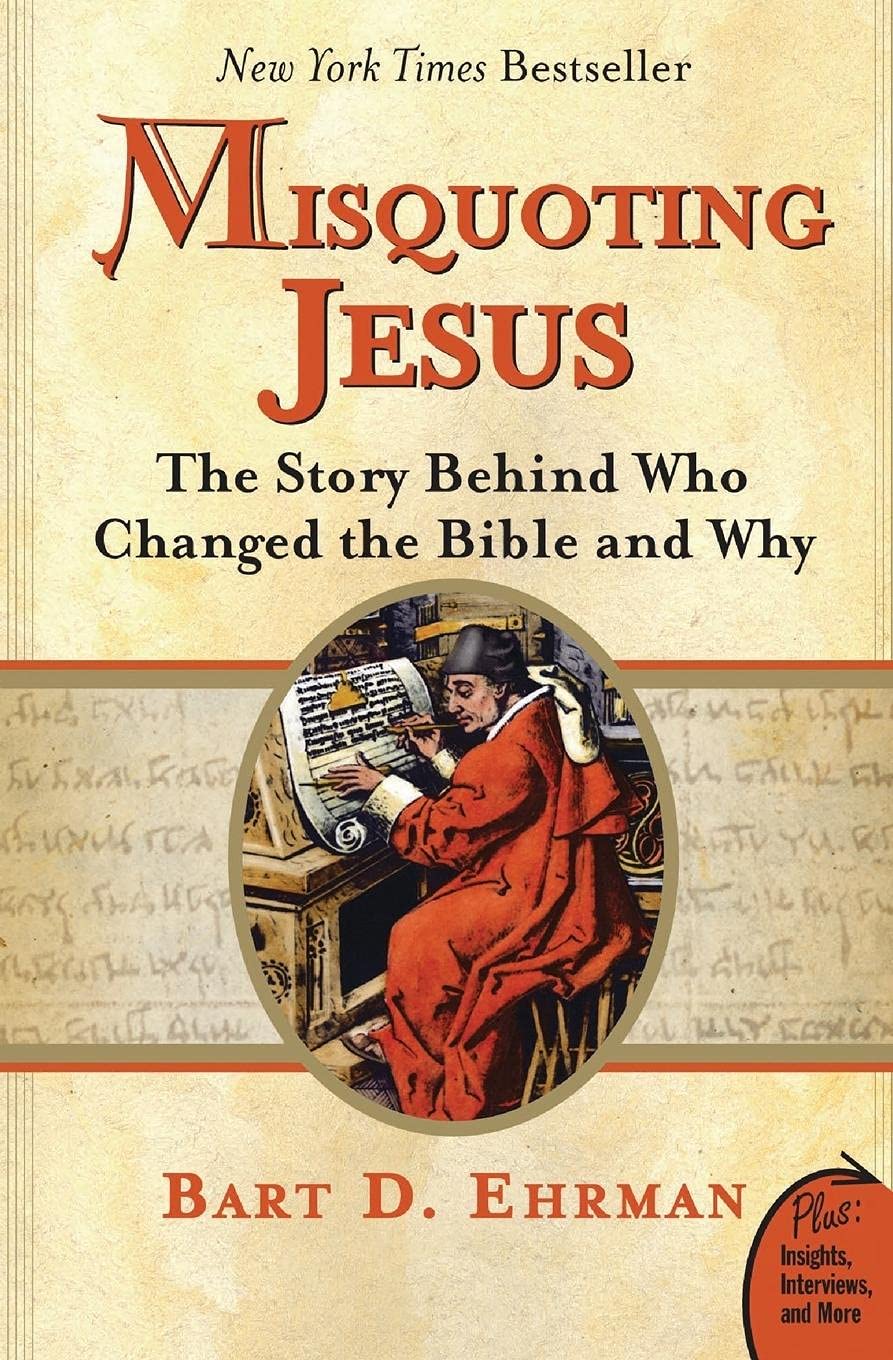
About Misquoting Jesus: The Story Behind Who Changed the Bible and Why by Bart D. Ehrman – A Clear Guide to New Testament Texts, Scribes, and Changes
Many people open a Bible and assume the words reached us in exactly the same form in which they were first written. Misquoting Jesus: The Story Behind Who Changed the Bible and Why by Bart D. Ehrman asks readers to look closely at that idea. Ehrman is a scholar of the New Testament and early Christianity, and in this book he explains how New Testament writings were copied by hand for many centuries before printing made exact reproduction much easier.
His main focus is textual criticism, the study of old manuscripts and their differences. Ehrman explains that surviving copies do not always agree word for word. Some differences came from simple copying mistakes. Others, he argues, were made when scribes tried to clarify, harmonize, or shape passages in ways that fit their understanding. The book also shows how modern scholars compare manuscripts to work out the earliest recoverable form of a text.
It is written for general readers, so you do not need to be a Bible scholar to begin. The subject is serious, but the book uses stories, examples, history, and personal reflection to make a complex field easier to follow.
Why This Book Starts with a Simple but Important Question
The question behind the book is easy to understand: if the original New Testament manuscripts no longer survive, how do scholars know what the earliest writers wrote?
Ehrman begins from the history of copying. Before printing, books had to be copied by hand. A scribe could skip a line, repeat a word, spell something differently, or make another error. In some cases, a scribe might also change wording because he thought a passage was unclear, difficult, or theologically important.
Over hundreds of years, copies were made from copies. Different manuscript families developed, and small differences spread. This does not mean every sentence became completely different. It means scholars have many textual variants to compare.
Misquoting Jesus introduces readers to that world. It asks you to think about how texts travel through time, how human hands affect transmission, and how evidence is used when no original copy is available.
See How Ancient Copying Really Worked
Today, copying a document can be perfect. A digital file can be duplicated in seconds. Ancient and medieval copying was different. A person had to read or hear words and then write them again. That process created many chances for mistakes.
Ehrman gives readers examples of common copying problems. A scribe might accidentally leave out words because two lines ended in a similar way. A word might be written twice. A spelling could change. A note in the margin might later enter the main text.
He also discusses cases where changes may have been deliberate. According to Ehrman, some scribes altered passages because of theological debates, questions about Jesus, views about women, or disagreements inside early Christianity.
The book is strongest when it shows the method behind these claims. Readers are introduced not just to conclusions, but to the work of comparing manuscripts and asking which reading best explains the others.
Learn What Textual Criticism Means Without Needing a Degree
The phrase textual criticism can sound difficult, but the basic idea is simple.
Scholars collect and compare surviving manuscripts. When different copies use different words, they study the age, location, style, and relationship of those copies. They also ask which reading is more likely to have been changed into another reading.
Ehrman walks readers through important moments in the history of New Testament textual study. He explains how scholars began collecting manuscripts, noticing differences, and creating printed editions based on comparison rather than simply following one later copy.
The Book Also Tells Ehrman's Personal Story
Misquoting Jesus is not written as a cold textbook. Ehrman connects the subject to his own life.
He describes beginning as a committed evangelical Christian who believed strongly in biblical inerrancy. His study of Greek, ancient manuscripts, and textual criticism raised questions that changed how he understood scripture.
That personal story matters because it explains why the subject became important to him. The book is not only about old parchment and copying habits. It is also about what happens when historical study challenges a person's earlier beliefs.
Readers do not have to agree with Ehrman's religious conclusions to understand the journey he describes. Some Christian scholars accept the reality of textual variants while disagreeing with parts of Ehrman's larger theological interpretation. That distinction is useful. The existence of manuscript differences is one question; what those differences mean for faith is another.
The book gives readers Ehrman's argument clearly, making it possible to examine his evidence and decide what they think.
Famous Passages Become Case Studies
The discussion becomes especially interesting when Ehrman looks at well-known New Testament passages.
He explains that some familiar stories or endings are missing from the earliest manuscripts known to scholars. Examples often discussed in textual criticism include the longer ending of the Gospel of Mark and the story of the woman caught in adultery in the Gospel of John.
These examples show why manuscript study matters. A difference is not always just a spelling mistake. Sometimes an entire passage has a complicated textual history.
Ehrman uses cases like these to show how scholars decide whether words were probably part of an earlier form of the text or added later.
For a reader who has never looked at footnotes in a modern Bible, this can be eye-opening. Many modern translations already mark major textual questions in notes. Misquoting Jesus helps explain why those notes exist and what kind of evidence lies behind them.
A Book About History, Not a Simple Attack on Faith
Because of its title, some readers may expect a book that simply tries to prove the Bible false. That is too simple a description.
The book is mainly about textual transmission: how the New Testament was copied, how variants appeared, how scholars compare manuscripts, and how those changes can affect interpretation.
Ehrman does make strong arguments about what textual variation means, and some of his conclusions are debated by other scholars. Readers should understand the book as one influential scholar's presentation of the evidence and its implications, not as the final word on every theological question.
That makes the book useful even for readers who disagree with him. It gives a clear entry point into questions that appear in biblical studies, church history, translation, and debates about scripture.
What You Can Learn from Reading It
The book can help you understand several ideas that are often discussed but rarely explained in simple language.
You can learn why original New Testament manuscripts are not available today, how hand copying created textual variants, why some variants are accidental, why scholars think some were deliberate, and how modern critical editions are produced.
You can also learn why translators sometimes place verses in brackets or footnotes. Those marks are not random. They often show that manuscript evidence differs.
The book also introduces the social world around early Christian texts. Scribes lived inside religious communities with arguments, beliefs, pressures, and expectations. Ehrman asks readers to consider how those settings may have shaped the copying process.
This wider view makes the topic more human. Texts did not move through history by magic. People copied them, read them, corrected them, discussed them, and passed them on.
A Premium Physical Edition for Careful Reading
Misquoting Jesus is the kind of nonfiction book many readers like to mark, revisit, and discuss. Bookish Wonderland offers a premium reading edition designed for comfortable use.
- Premium eye-soothing cream paper gives the pages a softer look than bright white paper and can feel more comfortable during long reading sessions.
- Crystal-clear printing keeps letters sharp, which is useful when reading names, quotations, dates, and detailed explanations.
- High-quality stitched and glue binding helps keep the pages secure during repeated reading and makes the book suitable for a personal collection.
These physical details describe the edition offered by Bookish Wonderland, not every edition published elsewhere.
The book can work well for home study, university reading, personal research, discussion groups, or readers who simply enjoy serious nonfiction. Because many ideas build on earlier chapters, having a durable printed copy makes it easy to go back and review an example.
Who Should Read Misquoting Jesus?
This book is a good fit for readers interested in the Bible as a historical text, early Christianity, religious history, manuscript studies, translation, or the development of scripture.
It can also be useful for students who want an accessible introduction before moving into more technical works on textual criticism.
Believers may read it because they want to understand questions they have heard about manuscript differences. Skeptical readers may read it because they want historical evidence behind claims about textual change. People with no religious commitment may simply enjoy the history of books and ideas.
You do not need to agree with the author before opening the book. In fact, the book can be more useful when you read carefully, check claims, compare views, and think about the evidence.
This is adult nonfiction. The language is accessible, but the ideas involve history, theology, manuscripts, and interpretation. It is best for teens with a strong interest in the topic and adult readers.
Check the Current Price and Order in Bangladesh
If you are searching for the Book price in Bangladesh for Misquoting Jesus: The Story Behind Who Changed the Bible and Why by Bart D. Ehrman, check the current amount shown on the Bookish Wonderland product page before ordering. Prices may change, so the live product listing is the best place to confirm the latest amount.
Bookish Wonderland provides nationwide delivery across Bangladesh, including locations inside and outside Dhaka. Cash on Delivery is available nationwide, which gives customers an easy way to order from home and pay when the parcel arrives.
Readers in Dhaka can also ask about fast or urgent delivery when they need the book quickly. Delivery time depends on location, order details, and service availability, so contact the store if timing is important.
Read the Evidence and Decide What You Think
Instead of asking readers to accept a simple claim, it introduces manuscripts, scribes, variants, historical debates, and the methods scholars use to compare texts. Ehrman then explains the conclusions he draws from that evidence.
For some readers, the book may challenge beliefs. For others, it may answer questions they have had for years. For students, it can open the door to a new field of study. For anyone interested in how ancient books survive, it offers a clear example of how history, language, religion, and human error can meet on a page.
Order Misquoting Jesus: The Story Behind Who Changed the Bible and Why by Bart D. Ehrman from Bookish Wonderland if you want a readable introduction to New Testament textual criticism and the history of manuscript transmission.
Read it slowly. Check the examples. Follow the evidence. Compare other views. Whether you agree with Ehrman's final conclusions or not, you will finish with a better understanding of why ancient manuscripts matter and why the story of a text can be almost as interesting as the text itself.
If you require any customization or have any questions, please inbox us via FB or Insta.
| Primary Specification | |
| Author | Bart D. Ehrman |
| Genre | Religion, Biblical Studies, History, Textual Criticism |
| ISBN-13/ISSN | 978-0060859510 |
| ISBN-10 | 0060859512 |
| Publisher | HarperOne |
| Publishing Date | February 5, 2007 |
| Language | English |
| Reading Age | 18+ |
| Format | Printed Book |
| Physical Specification & Quality | |
| Paper Quality | Premium eye-soothing cream paper |
| Binding Quality | High quality stitched and glue binding (for longevity) |
| Print Quality | Crystal-clear print |
| Pages | 242 pages |
| Country | USA |
| Logistics Information | |
| Weight | 264 gm |
| Length | 8.5 inches |
| Width | 5.6 inches |
| Height | 0.64 inch |