

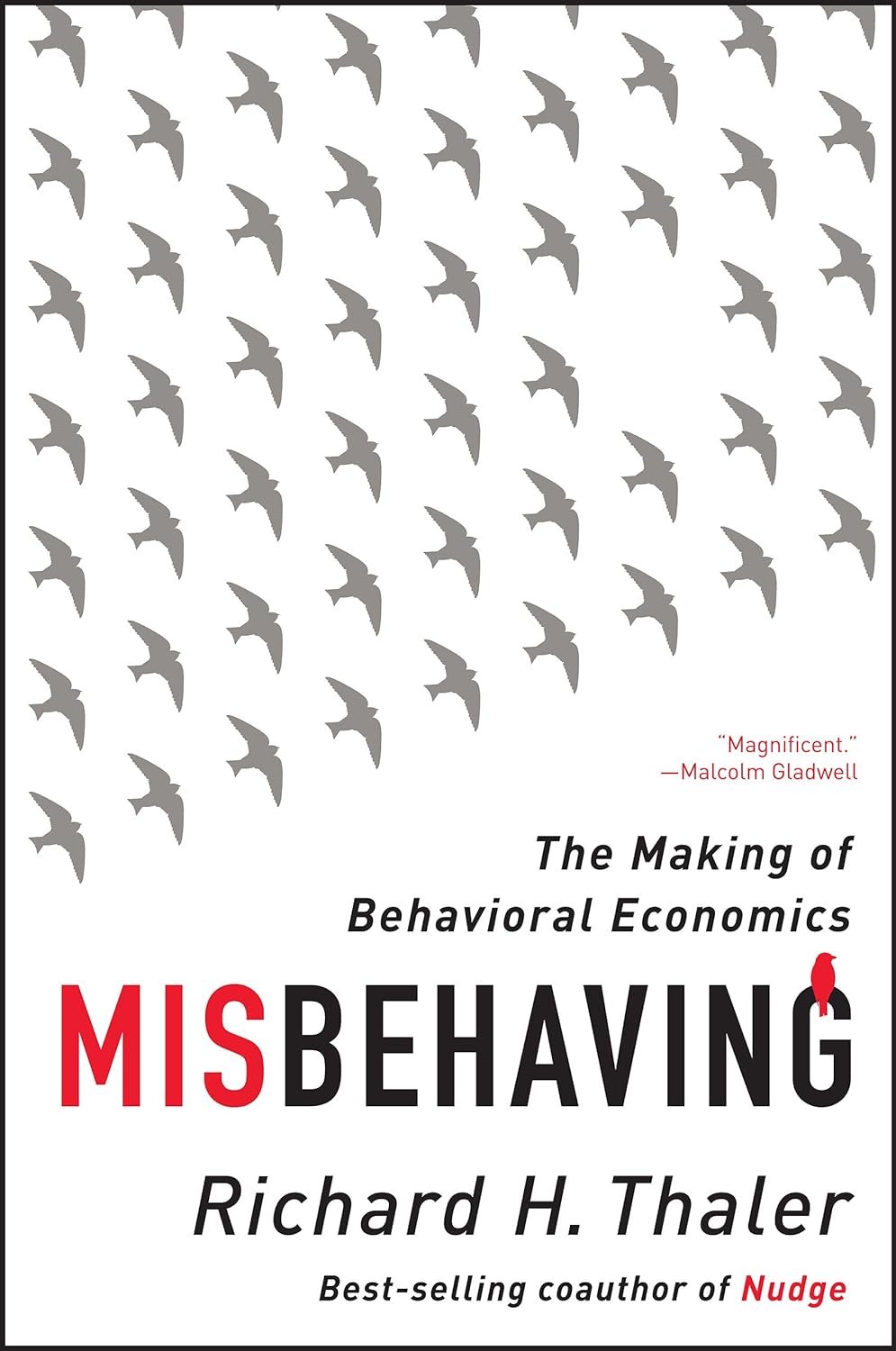
About Misbehaving: The Making of Behavioral Economics by Richard H. Thaler – A Clear and Entertaining Story of Why People Do Not Always Make Rational Choices
Misbehaving: The Making of Behavioral Economics by Richard H. Thaler explains an idea that changed economics: real people do not always make perfect choices. We forget things, follow habits, fear losses, copy others, spend money in strange ways, and sometimes choose what feels right instead of what looks best on paper. Traditional economic models often treated people as if they were always calm, informed, and rational. Thaler spent decades showing that real human behavior is much more interesting.
The book tells the story of how behavioral economics grew from a small group of unusual ideas into an important field. Instead of reading like a dry textbook, it mixes research, personal stories, experiments, arguments, and funny examples. Thaler explains how small mistakes and mental shortcuts can affect money, saving, business, markets, sports, and public policy.
If you want to understand why smart people still make poor choices, why losing money hurts so much, or why the way a choice is presented can change what people do, this book gives you a clear starting point.
Economics becomes easier when real people enter the picture
Many people think economics is only about numbers, graphs, prices, and complicated formulas. Misbehaving shows another side. Economics is also about people.
Thaler noticed that people often behaved in ways that standard economic theory did not predict. They cared about fairness. They hated losing things they already owned. They treated money differently depending on where it came from. They sometimes ignored costs they could not recover. They also struggled with self-control.
These were not tiny mistakes with no meaning. They happened again and again.
Thaler began collecting examples of behavior that seemed strange under traditional theory. Over time, those examples became part of a larger challenge to the idea that people always choose what is best for them.
This makes the book useful for beginners. You do not need to know advanced economics before reading it. The main ideas start with daily life. Once you understand the human example, the economic idea becomes much easier to follow.
Why perfectly rational people are not the whole story
Traditional economics often uses a simple model of a rational decision maker. This person knows what matters, compares options carefully, and chooses the option that gives the greatest benefit.
That model can be useful. The problem is that actual people often do something else.
We buy something because it is on sale even when we do not need it. We keep using a bad product because we already paid for it. We refuse to sell something for a price we would never have paid to buy it. We may spend a gift differently from salary money even though both are money.
Behavioral economics studies these patterns instead of treating them as noise.
Thaler uses the word “Humans” for real people and contrasts them with the perfectly rational figures used in simplified theory. This difference makes the book easy to understand. The point is not that people are foolish. The point is that human decisions are shaped by emotion, habits, limited attention, social pressure, and mental shortcuts.
Learn why losses can feel stronger than gains
One important idea in behavioral economics is loss aversion.
Imagine gaining a certain amount of money. It feels good. Now imagine losing the same amount. For many people, the pain of the loss feels stronger than the pleasure of the gain.
People may hold on to a bad investment because selling would make the loss feel final. They may avoid a useful change because they focus more on what they might lose than what they could gain. Businesses and governments also need to understand this when they design offers, policies, or choices.
Thaler connects ideas like this to the work of psychologists Daniel Kahneman and Amos Tversky, whose research helped reshape thinking about judgment and decision making.
The endowment effect explains why ownership changes value
Another famous idea connected with Thaler is the endowment effect.
People often value an object more once they own it. A mug, ticket, or other item may feel more valuable simply because it has become “mine.”
This sounds small, but it has large effects. It can influence buying, selling, negotiation, collecting, and investment decisions.
The idea helps explain why buyers and sellers may disagree even when they have the same information. The seller is giving something up, while the buyer is deciding whether to gain it. Those two situations can feel very different.
Misbehaving shows how observations like this challenged older models. Instead of assuming that value stays perfectly stable inside a person’s mind, behavioral economics looks at how context changes judgment.
Mental accounting changes the way we treat money
Money should be money, but people often divide it into mental boxes.
A person may treat salary money carefully but spend a bonus quickly. Someone may keep money in savings while carrying expensive debt. A family may have separate budgets for food, entertainment, travel, and emergencies even though all the money could technically be combined.
Thaler calls this kind of behavior mental accounting.
Mental accounts can help people organize life. They can also create strange choices. The important point is that people do not always treat every dollar, taka, or pound as perfectly equal.
Self-control is an economic problem too
People often know what they should do and still do something else.
We may plan to save money but spend it. We may plan to study but watch videos. We may plan to eat well but choose an easy snack. We may promise to start tomorrow and then repeat the same choice.
Traditional models can struggle with this because they often assume stable preferences and consistent action.
Behavioral economics takes self-control problems seriously.
Thaler’s work helped show that people sometimes benefit from systems that make good future choices easier. Automatic saving, default options, deadlines, and commitment tools can help because they reduce the need to make the same difficult decision again and again.
This is one reason the field became important outside universities. Its ideas can shape retirement plans, business design, government policy, and everyday habits.
The book also tells the story of an academic fight
Misbehaving is not only a book of concepts. It is also the story of how behavioral economics developed.
Thaler describes meetings, debates, research papers, friendships, criticism, and the slow process of convincing economists that psychology belonged inside economic thinking.
Thaler writes about people who helped shape the field and about disagreements with economists who defended more traditional views.
Behavioral economics reaches markets, sports, business and policy
The ideas in Misbehaving do not stay inside the laboratory.
Thaler discusses examples from finance, sports, saving, consumer choices, business, and public policy. He shows that human mistakes can matter even in places where money and competition should encourage careful thinking.
The point is not that markets never work. It is that saying “the market will fix everything” can be too simple when the people inside the market have predictable biases.
That wider view makes the book useful for readers in economics, finance, marketing, management, public policy, and entrepreneurship.
What makes Misbehaving worth reading
Misbehaving is especially useful because it teaches ideas through stories instead of only definitions.
Key reasons readers may enjoy it include:
- A clear introduction to behavioral economics through real human behavior.
- Famous ideas such as loss aversion, mental accounting, and the endowment effect.
- Stories about the development of an important modern field.
- Examples connected with money, markets, sports, business, saving, and policy.
- An accessible writing style that does not require advanced mathematics.
- Insights into why people make predictable mistakes.
- A mix of economics and psychology that makes abstract ideas easier to understand.
- Personal stories about research, debate, and academic change.
- Useful concepts for students, business owners, marketers, investors, and curious readers.
- A better understanding of how choice design can influence behavior.
The book was also shortlisted for the Financial Times and McKinsey Business Book of the Year Award, adding to its reputation as an important modern business and economics title.
Who should read this book?
Misbehaving is a strong choice for students of economics, business, finance, psychology, marketing, management, and public policy.
It is also useful for entrepreneurs and business owners who want to understand customers more realistically. People do not always compare every product logically. Price, framing, defaults, fear of loss, habit, and ownership can influence what they choose.
Investors may also find the book valuable because it explains why intelligence alone does not remove bias. A person can understand finance and still become overconfident, fear losses, or follow a crowd.
General readers do not need professional knowledge to enjoy the book. If you like books about human behavior, decision making, money, or psychology, Thaler gives you many examples that connect research with everyday life.
A Nobel Prize-winning economist explains the field from inside
Richard H. Thaler received the 2017 Nobel Prize in Economic Sciences for his contributions to behavioral economics.
That matters because Misbehaving is not simply an outside summary of the field. It is written by one of the people who helped build it.
Thaler explains how ideas developed, which questions interested him, where resistance came from, and how psychology slowly became more accepted inside economics.
A premium reading copy from Bookish Wonderland
A nonfiction book full of examples and useful ideas is often worth returning to, so reading comfort and durability matter.
Bookish Wonderland offers a reader-friendly copy with premium eye-soothing cream paper, crystal-clear print, and high-quality stitched plus glue binding for better longevity. These features make the book suitable for regular study, note taking, and repeat reading.
For readers comparing the Book price in Bangladesh for Misbehaving: The Making of Behavioral Economics by Richard H. Thaler, Bookish Wonderland gives you a convenient local option for ordering this modern economics classic.
Nationwide delivery is available across Bangladesh, including addresses inside and outside Dhaka. Cash on delivery is available, and fast or urgent delivery options may also be available in Dhaka.
A smart choice for understanding real decisions
The biggest lesson in Misbehaving is simple: economic decisions are human decisions.
People are not machines. We get distracted. We care about fairness. We dislike losses. We create mental budgets. We value things differently after we own them. We sometimes know the better choice and still fail to make it.
These patterns do not make economics useless. They make economics more realistic when they are included.
Start seeing everyday choices differently
Misbehaving: The Making of Behavioral Economics by Richard H. Thaler turns decades of research into an entertaining story about how economics learned to take human behavior seriously.
The book can change the way you look at shopping, saving, investing, pricing, planning, and even simple daily choices. Once you notice ideas such as loss aversion, mental accounting, self-control problems, and the endowment effect, you may start seeing them everywhere.
If you want economics explained through people instead of only formulas, this is an excellent title to choose. It gives you both the history of behavioral economics and the practical ideas that made the field important.
Order Misbehaving: The Making of Behavioral Economics by Richard H. Thaler from Bookish Wonderland and discover why ordinary human mistakes became powerful evidence for a new way of understanding economics, markets, business, and decision making.
If you require any customization or have any questions, please inbox us via FB or Insta.
| Primary Specification | |
| Author | Richard H. Thaler |
| Narrator | L. J. Ganser |
| Editor | Chris Welch |
| Genre | Business & Economics; Behavioral Economics; Consumer Behavior; Economic Psychology |
| ISBN-13/ISSN | 978-0393352795 |
| ISBN-10 | 039335279X |
| Publisher | W. W. Norton & Company |
| Publishing Date | June 14, 2016 |
| Language | English |
| Reading Age | 16+ |
| Format | Printed book |
| Physical Specification & Quality | |
| Paper Quality | Premium eye-soothing cream paper |
| Binding Quality | High quality stitched and glue binding (for longevity) |
| Print Quality | Crystal-clear print |
| Pages | 432 pages |
| Country | USA |
| Logistics Information | |
| Weight | 454 gm |
| Length | 8.5 inches |
| Width | 5.6 inches |
| Height | 0.96 inch |