

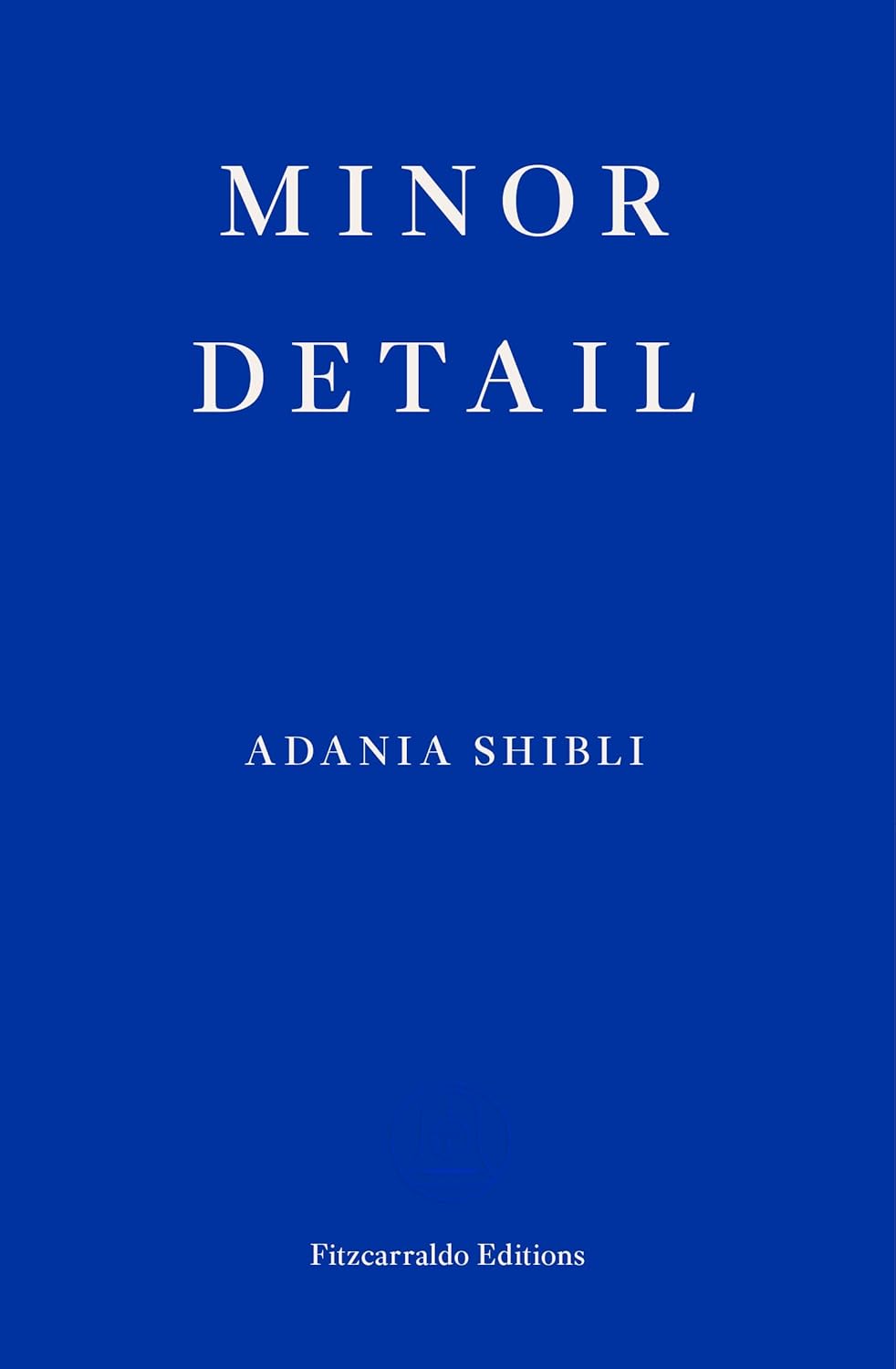
About Minor Detail by Adania Shibli – A Haunting Literary Novel About Memory, Violence, Borders and the Search for a Forgotten Story
Minor Detail by Adania Shibli is a short but powerful literary novel built in two parts. The first takes place in the Negev desert during the summer of 1949, one year after the 1948 Arab-Israeli war. A group of Israeli soldiers capture a young Palestinian Bedouin woman. She is raped, killed, and buried in the sand. The second part moves many years forward to a near-present-day Palestinian woman living in Ramallah. She reads about the earlier crime and becomes determined to learn more about it.
The connection feels personal because the crime happened exactly twenty-five years before her own birthday.
Adania Shibli does not write this story like a normal historical novel or crime thriller. The language is controlled, quiet, and precise. Small actions, repeated sounds, empty spaces, maps, dust, heat, and ordinary objects become important. Through these details, the novel asks how the past survives when records are incomplete, people are gone, and access to places and information is difficult.
Two equal parts show the past and present beside each other
One of the most striking features of Minor Detail is its structure.
The novel is divided into two narratives of roughly equal length. The first follows the 1949 events from the perspective of an Israeli military officer. The second follows a Palestinian woman in Ramallah who tries to investigate the crime decades later.
The two sections feel different, yet they reflect each other.
In the first part, routines are repeated with cold precision. Orders are given. Bodies move through heat and dust. The violence is presented without dramatic emotional explanation. That distance makes the events feel even more disturbing.
In the second part, she studies maps and plans a journey, but movement is not simple. Roads, permits, checkpoints, and different zones shape where she can go.
By placing these two sections together, Shibli shows how a past event can remain present even when the people involved never meet.
The title asks readers to notice what history calls small
The words Minor Detail sound almost harmless.
Yet the event at the center of the novel is not minor to the victim, and it is not minor to the woman who later becomes obsessed with understanding it.
The title therefore creates tension from the beginning. What gets called a minor detail? Who decides which events deserve attention? What happens to people whose names are missing from the record?
The second narrator is drawn to one small fact: the crime happened exactly twenty-five years before she was born.
That detail gives her a personal point of connection.
It does not make her part of the original event, but it gives her a reason to keep looking.
Shibli uses this idea to show how small facts can open large questions. A date, a location, a photograph, or a missing name can become the start of a search for a history that is difficult to recover.
The first section is frightening because it feels controlled
The first half of the novel is not written like a fast action scene.
Instead, it is careful and repetitive.
The officer washes, checks objects, moves through the camp, gives instructions, and notices his surroundings. The desert heat feels heavy. The environment seems empty, but the routine keeps moving.
This controlled style makes the violence more unsettling because terrible acts appear beside ordinary tasks.
The reader is not given a comforting explanation that turns the officer into a simple fictional monster. The prose stays close to actions and physical details.
That approach forces attention onto what happens rather than allowing the story to become a dramatic speech about what the reader should feel.
For readers who prefer quiet literary tension, this section can be deeply effective. It shows how violence can exist inside routine, administration, obedience, and silence.
The second narrator turns research into a dangerous journey
The woman in Ramallah begins with information she finds about the 1949 crime.
She wants more than a short account. She wants to know where it happened, what the area looked like, and what details might have been lost.
Research becomes physical.
She borrows identification, uses maps, drives through unfamiliar roads, visits archives and museums, and tries to reach places connected with the earlier event.
The journey is tense because movement is shaped by political and geographic restrictions. She must think about which roads she can use and how she may be seen.
The novel does not turn her into a professional detective. She is an ordinary person whose curiosity becomes difficult to control.
That makes the investigation feel personal. She is not solving a case for a client or institution. She is trying to understand why one forgotten story will not leave her alone.
Maps become part of the conflict between memory and place
Maps appear throughout the second part because the narrator needs them to move.
But a map is never just a neutral picture of land. Names change. Roads change. Villages may disappear from one map and survive in another memory. Political borders and controlled zones affect what a map allows someone to understand.
This makes geography central to the story.
A place can remain physically present while its history becomes difficult to see. A person can know that something happened somewhere and still struggle to locate the exact ground.
Silence is as important as speech
Minor Detail contains many things that are not said.
The murdered young woman is not given a long voice explaining her life. The later narrator does not have complete access to the past. Documents do not answer every question.
That silence is uncomfortable, and the book does not try to fill every gap.
Instead, the absence becomes part of the meaning.
Shibli asks readers to notice the limits of what can be recovered. Fiction can imagine, investigate, and connect, but it cannot magically return every missing fact.
This restraint gives the novel much of its power.
Rather than creating a large fictional biography for the unnamed victim, Shibli keeps attention on the violence of her disappearance and on the difficulty of reconstructing a life from fragments.
The novel explores memory without turning into a history textbook
Minor Detail is closely connected to the history of Palestine and Israel, but it remains a work of fiction.
The publisher describes the first section as taking place one year after the 1948 war, known to Palestinians as the Nakba and to Israelis as the War of Independence.
The book then connects that earlier period with a later Palestinian experience in and around Ramallah.
Readers do not need expert historical knowledge before starting, but some context can make the novel easier to understand.
The book is not designed to provide a complete history of the conflict. It focuses tightly on one crime and one later investigation.
That narrow focus is intentional. By staying close to one “minor detail,” Shibli shows how a single event can contain questions about memory, displacement, borders, power, and whose stories remain visible.
What makes Minor Detail worth reading
The novel is brief, but it offers a great deal to think about:
- Two carefully balanced narratives set decades apart.
- A 1949 crime that becomes the center of a later investigation.
- A Palestinian woman in Ramallah searching through maps, archives, and physical landscapes.
- A precise, restrained writing style that avoids unnecessary drama.
- Strong themes of memory, violence, silence, borders, and historical erasure.
- A structure that connects past and present without making them identical.
- A short page count that still creates a dense literary experience.
- A highly regarded English translation by Elisabeth Jaquette.
- Recognition as a 2020 National Book Award finalist for Translated Literature.
- Longlisting for the 2021 International Booker Prize.
Who should read Minor Detail?
Minor Detail is best suited to adult readers who enjoy literary fiction, translated literature, historical memory, political fiction, experimental structure, and short novels with serious themes.
It may especially appeal to readers who prefer quiet tension over fast action.
The book contains sexual violence, killing, war-related violence, and disturbing material.
Book clubs can discuss why the title is Minor Detail, how the two halves mirror each other, what maps represent, and what the novel suggests about the limits of recovering a lost story.
Elisabeth Jaquette's translation brought the novel to English readers
Minor Detail was translated from Arabic into English by Elisabeth Jaquette.
Fitzcarraldo Editions published the English-language UK edition on May 6, 2020, listing it at 120 pages.
New Directions published the U.S. paperback on May 26, 2020, listing it at 144 pages.
Different editions therefore have different page counts.
The English translation received major recognition.
The book was shortlisted for the 2020 National Book Award for Translated Literature and longlisted for the 2021 International Booker Prize.
These honors helped introduce the novel to a wider international audience while also highlighting Jaquette's work as translator.
A premium reading copy from Bookish Wonderland
A short literary novel often invites slow reading because every line carries weight.
Bookish Wonderland offers a reader-friendly copy with premium eye-soothing cream paper, crystal-clear print, and high-quality stitched plus glue binding for better longevity. The cream paper supports comfortable reading, while the clear print makes the novel's precise sentences and small details easy to follow.
For readers comparing the Book price in Bangladesh for Minor Detail by Adania Shibli, Bookish Wonderland offers a convenient local option for ordering this acclaimed work of translated literary fiction.
Nationwide delivery is available across Bangladesh, including inside and outside Dhaka. Cash on delivery is available, and fast or urgent delivery options may also be available in Dhaka.
A small book with a deliberately narrow focus
Minor Detail does not try to explain every part of a long and contested history.
Its method is much smaller.
It stays close to one act of violence, one later reader of that event, and the difficult journey between information and understanding.
That narrowness is part of the design.
The novel shows how a single date can pull someone into the past. It shows how a place can carry memories that are hard to access. It shows how archives can preserve information while still leaving major gaps.
Readers looking for a broad historical survey will need other books as well. Readers looking for a literary work about how history enters private thought will find a very different kind of experience here.
Read a novel where every small detail matters
Minor Detail by Adania Shibli asks readers to pay attention to what is easy to overlook.
A date matters. A road matters. A smell matters. A sound matters. A line on a map matters. A missing name matters.
Through two connected narratives, the novel moves from the Negev desert in 1949 to a later journey from Ramallah, showing how violence can remain present through memory, geography, silence, and unfinished questions.
It is a short book, but it is not a light one. Its controlled prose and repeated details create tension without relying on a conventional thriller structure.
Order Minor Detail by Adania Shibli from Bookish Wonderland and discover a carefully written novel about memory, violence, borders, absence, and one woman's determination to understand a story that history has reduced to a minor detail.
If you require any customization or have any questions, please inbox us via FB or Insta.
| Primary Specification | |
| Author | Adania Shibli |
| Translator | Elisabeth Jaquette |
| Narrator | Siiri Scott |
| Genre | Literary Fiction, Historical Fiction |
| ISBN-13/ISSN | 978-0811229074 |
| ISBN-10 | 0811229076 |
| Publisher | New Directions |
| Publishing Date | May 26, 2020 |
| Language | English |
| Reading Age | 18+ |
| Format | Printed book |
| Physical Specification & Quality | |
| Paper Quality | Premium eye-soothing cream paper |
| Binding Quality | High quality stitched and glue binding (for longevity) |
| Print Quality | Crystal-clear print |
| Pages | 144 pages |
| Country | Palestine |
| Logistics Information | |
| Weight | 164 gm |
| Length | 8.5 inches |
| Width | 5.6 inches |
| Height | 0.3 inch |