Skip to product information
1 of 1

Bookish Wonderland

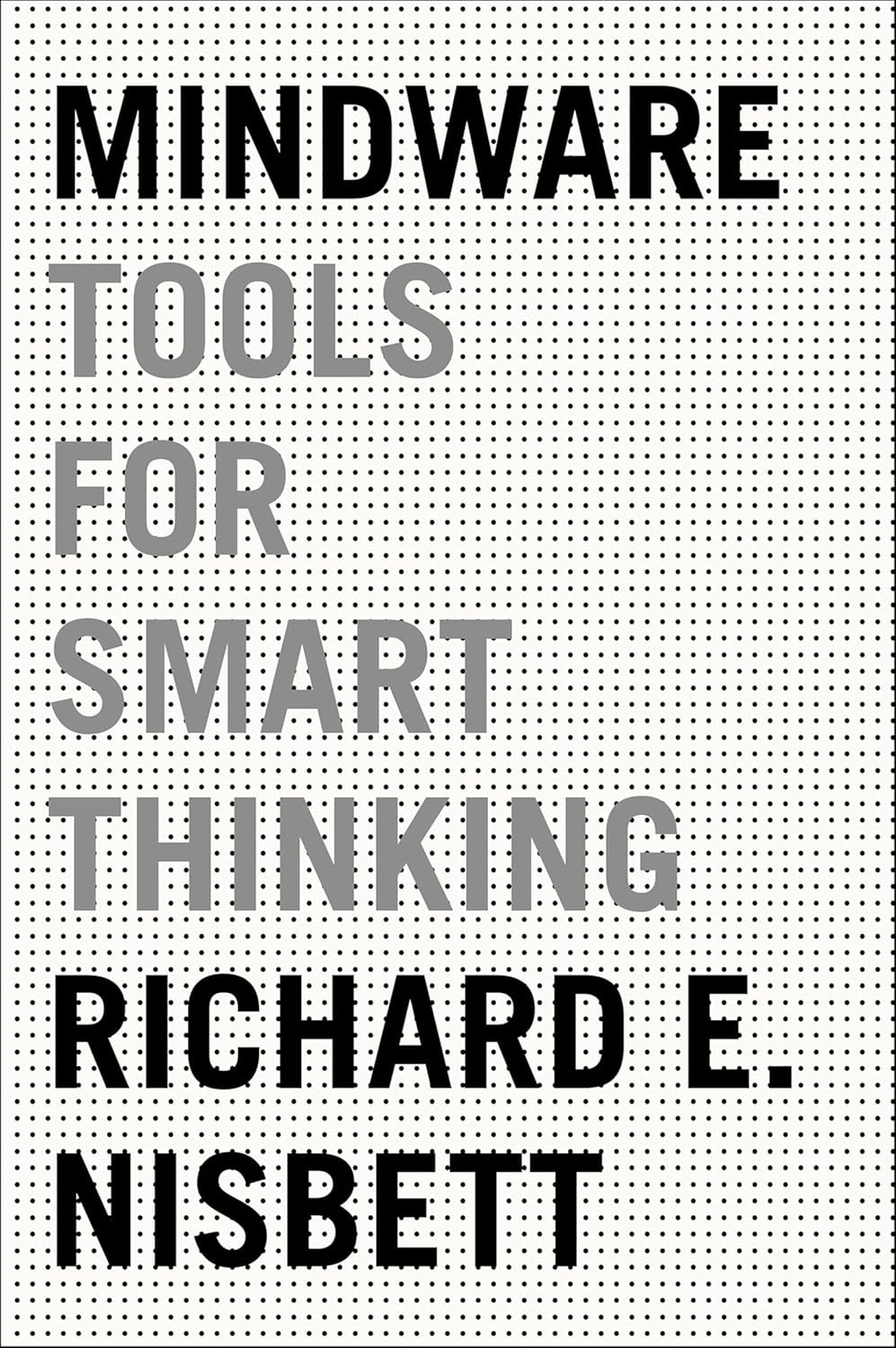
Mindware: Tools for Smart Thinking by Richard E. Nisbett

Mindware: Tools for Smart Thinking by Richard E. Nisbett

Regular price Tk 282.00 BDT
Regular price Sale price Tk 282.00 BDT
Sale Sold out
Book cover type
Quantity

Mindware: Tools for Smart Thinking by Richard E. Nisbett explores powerful concepts from psychology, statistics, economics, and scientific reasoning that can help people think more clearly and make better decisions. Nisbett explains practical ideas such as correlation and causation, statistical reasoning, cost-benefit analysis, opportunity costs, and common cognitive errors in an accessible way. Using research and everyday examples, the book demonstrates how these intellectual tools can improve judgment in personal, professional, and academic situations. It is especially useful for readers interested in critical thinking, psychology, decision-making, and understanding how the human mind interprets information. Read More

View full details

About Mindware: Tools for Smart Thinking by Richard E. Nisbett—Practical Ideas for Better Decisions Every Day

Why do smart people still make poor choices? Why can one dramatic story feel more true than a large set of facts? Why do we keep spending time or money on a bad plan simply because we have already spent so much? Mindware: Tools for Smart Thinking by Richard E. Nisbett explains the hidden habits that shape our judgment and gives readers practical tools for thinking more clearly.

This is not a book that asks you to become a math expert or philosopher. Nisbett takes useful ideas from psychology, statistics, economics, logic, and science and connects them with ordinary life. His goal is simple: help readers ask better questions, test claims, understand causes, compare choices, and avoid common traps. The result is a friendly guide for making wiser decisions at work, in business, during study, and in personal life.

Why Good Thinking Can Be Hard

The mind works quickly. It uses past experience, simple stories, feelings, and familiar patterns to understand new events. This speed is useful because nobody can study every choice for hours. However, the same shortcuts can also lead us toward a wrong answer.

We may trust a vivid example more than strong data. We may believe that two things are connected when they only happened together by chance. We may blame a person’s character while ignoring the situation around them. We may search for facts that support what we already believe.

A Toolbox You Can Use Outside the Classroom

Many useful thinking rules are taught inside university courses and then left there. Nisbett argues that these ideas belong in daily life. A basic statistical rule can help you judge a health claim. An economic idea can improve a business choice. A lesson from psychology can explain a difficult argument.

The book acts like a toolbox. You do not use a hammer for every repair, and you should not use one way of thinking for every question. Some problems need numbers. Some need careful tests. Others require you to consider context, incentives, or the view of another person.

Learn to Respect Large Numbers

One major lesson is the law of large numbers. A small group can give a strange result simply because chance has a strong effect when there are few examples. A larger group usually gives a more stable picture.

Imagine that one friend tries a study method and receives a high mark. That story may sound powerful, but it does not prove the method works for everyone. We need more people, fair comparison, and enough information before reaching a strong conclusion.

Readers learn to ask simple questions: How many cases were studied? Was the group chosen fairly? Could chance explain the result? These questions protect us from being won over by a single exciting example.

Understand Regression to the Mean

Extreme results often move closer to normal the next time they are measured. This idea is called regression to the mean, and it can explain events that people often misunderstand.

A student may perform unusually badly on one test and then improve on the next. A company may have one amazing month followed by a normal month. A sports player may shine in one game and look average later. The change may happen partly because the first result included luck or unusual conditions.

Without this tool, people may give full credit to a new reward, punishment, coach, medicine, or plan even when the result would have moved toward normal anyway. Nisbett teaches readers to look for repeated patterns and fair comparisons before deciding what caused an improvement.

Do Not Confuse Correlation with Cause

Two things can change together without one causing the other. Ice cream sales and sunburn may both rise in hot weather, but buying ice cream does not create sunburn. Heat helps explain both.

Mindware shows why correlation can be useful while still requiring care. A link may point toward a real cause, but it may also come from chance, a third factor, or the way information was collected.

This matters when people say that a food, habit, school method, marketing action, or social trend caused a result. Before accepting the claim, readers can ask whether other explanations were tested. They can also look for experiments, natural comparisons, or evidence that the supposed cause happened before the effect.

Make Smarter Choices with Economic Tools

Economics is not only about banks or national money. It also offers simple ways to compare daily choices. Mindware explains ideas such as cost-benefit analysis, opportunity cost, and sunk cost.

Cost-benefit thinking asks what a choice may give and what it may take away. Opportunity cost means that choosing one path also means giving up another. If you spend two hours on one task, you cannot use those same hours elsewhere.

A sunk cost is time, money, or effort that has already been spent and cannot be recovered. People often continue a poor plan because they do not want the earlier cost to feel wasted. Yet the better question is what will happen from this point forward.

See the Situation, Not Only the Person

When someone behaves badly, we may quickly decide that the person is careless, rude, or lazy. We often pay less attention to pressure, rules, fear, time, culture, or other parts of the situation.

Psychology shows that context can have a powerful effect on behaviour. Mindware encourages readers to consider both the person and the setting before making a final judgment.

This does not mean that nobody is responsible for their actions. It means that a fair explanation should include more than a quick label. A worker may miss a goal because the system is unclear. A student may remain silent because the class feels unsafe. A customer may sound angry because a problem has continued for days.

Test Ideas Like a Scientist

Scientific thinking begins with questions, possible explanations, and evidence that could show an idea is wrong. Mindware teaches readers to compare claims instead of protecting a favourite belief.

A good test changes one important factor while keeping other factors as fair as possible. Random assignment can help create groups that are more alike. Comparison groups show what may have happened without the new action. Repeated results give stronger support than one lucky outcome.

These ideas are useful far beyond a laboratory. A business can compare two messages. A teacher can test a new lesson method. A student can track whether a different study plan truly improves results. A person can examine whether a daily habit helps over time.

Use Logic Without Losing Real Life

Logic helps readers see whether a conclusion truly follows from the facts given. A statement may sound smooth and still contain a weak step. Mindware introduces logical thinking in an accessible way and shows why wording and structure matter.

At the same time, real life is not always a clean puzzle. People work with missing facts, uncertain chances, changing situations, and different values. The book connects formal rules with practical judgment rather than pretending every problem has one easy answer.

Readers learn to separate what they know from what they assume. They can ask whether an argument uses evidence, whether another explanation fits, and whether the conclusion is stronger than the facts allow.

What Readers Can Learn from Mindware

The book turns big ideas into useful habits. Readers may learn to:

  • Notice when a small sample may give a misleading result.

  • Understand why extreme results often move closer to normal.

  • Separate a simple connection from a true cause.

  • Compare benefits, costs, and the choices being given up.

  • Stop letting past costs control a future decision.

  • Consider the situation before judging a person’s character.

  • Test ideas with fair comparisons and better evidence.

  • Find weak steps inside a confident argument.

  • Question personal beliefs as carefully as other people’s claims.

  • Apply psychology, statistics, economics, logic, and science to daily life.

Useful for Study, Work, Business, and Daily Life

Students can use the book to judge research, plan study methods, and build stronger arguments. Teachers can use its examples to explain why evidence matters. Business owners and managers can apply its tools to marketing tests, hiring, planning, and performance reviews.

Digital marketers may find the lessons on samples, testing, and causation especially useful. A rise in sales after a campaign does not always prove that the campaign caused the rise. Better comparisons can lead to better decisions.

Parents and partners can use the psychology sections to understand behaviour with more patience. Everyday readers can apply economic tools before spending money or continuing a plan that no longer works.

Clear Ideas from an Expert Psychologist

Richard E. Nisbett is a respected psychology professor whose work has explored judgment, culture, behaviour, and thought. He writes for general readers rather than only specialists.

The book uses examples to explain difficult ideas without demanding advanced training. Readers may still need to pause over some sections, but the ideas connect with familiar problems. Short reviews of the main points help turn knowledge into a toolkit that can be remembered and used.

This balance makes the book valuable for curious beginners, university students, professionals, entrepreneurs, researchers, and anyone who wants to become less easily misled.

A Premium Edition for Active Learning

This Bookish Wonderland edition is made for comfortable study and regular reference. Premium eye-soothing cream paper gives every page a soft look. Crystal-clear printing keeps examples and explanations sharp. High-quality stitched and glue binding helps the pages remain secure during repeated reading.

The printed format makes it easy to underline a rule, add a note, or return to a useful example. Keep it near your desk, use it during study, or share its ideas in a team discussion. It also makes a thoughtful gift for a student, manager, business owner, or lifelong learner.

Why Order from Bookish Wonderland?

Bookish Wonderland offers a large collection of premium and durable English books for readers across the country. When checking the Book price in Bangladesh for Mindware: Tools for Smart Thinking by Richard E. Nisbett, consider the value of comfortable paper, sharp printing, and strong binding for long-term use.

Cash on Delivery is available across Bangladesh. We deliver inside and outside Dhaka, while customers in Dhaka may ask about fast or urgent delivery. Contact Bookish Wonderland through Facebook or Instagram for current stock, order help, or delivery details.

Give Your Mind Better Tools Today

Every day brings claims, choices, risks, and reasons to act quickly. A better decision often begins with one small pause: Is the sample large enough? Is this a cause or only a connection? Am I continuing because the future looks good, or because I dislike losing what I already spent?

Mindware: Tools for Smart Thinking by Richard E. Nisbett gives readers a practical language for asking these questions. Its lessons can help you read more carefully, plan more wisely, test ideas fairly, and understand people with greater care.

Order your copy from Bookish Wonderland today and start building a stronger thinking toolkit. Nationwide delivery, Cash on Delivery, and fast or urgent delivery options in Dhaka make ordering simple. Read one idea at a time, practise it in real life, and turn smart thinking into a daily habit.

If you require any customization or have any questions, please inbox us via FB or Insta.

Primary Specification
AuthorRichard E. Nisbett
NarratorJoe Barrett
EditorJonathan D. Lippincott
GenrePsychology, Self-Help, Critical Thinking, Decision-Making
ISBN-13/ISSN978-0374536244
ISBN-100374536244
Publisher‎ Farrar, Straus and Giroux
Publishing DateAugust 2, 2016
LanguageEnglish
Reading Age18+
FormatPrinted book
Physical Specification & Quality
Paper QualityPremium eye-soothing cream paper
Binding Quality High quality stitched and glue binding (for longevity)
Print QualityCrystal-clear print
Pages 336 pages
CountryUSA
Logistics Information
Weight356 gm
Length8.5 inches
Width5.6 inches
Height0.75 inch
What is Mindware: Tools for Smart Thinking by Richard E. Nisbett about?

Mindware: Tools for Smart Thinking is a psychology, critical-thinking, decision-making, and behavioral-science book about using powerful intellectual tools to make better judgments in everyday life. Richard E. Nisbett explains ideas drawn from psychology, statistics, economics, logic, scientific reasoning, and philosophy and shows how they can be applied outside the classroom. Major concepts include the law of large numbers, regression toward the mean, correlation versus causation, experimental thinking, sunk costs, opportunity costs, cost-benefit analysis, cognitive biases, and the influence of situations on human behavior. Nisbett’s central argument is that people do not automatically reason well simply because they are intelligent; specific thinking tools can improve how we interpret evidence and solve problems. The book therefore focuses less on memorizing theories and more on recognizing situations in which particular reasoning principles can lead to better professional, business, financial, and personal decisions.

How many books are in the Mindware series by Richard E. Nisbett, and what are they?

There are no books in a series for Mindware: Tools for Smart Thinking by Richard E. Nisbett. It is a standalone nonfiction book.

What practical thinking tools does Mindware teach readers to use?

The book introduces a broad collection of tools designed to improve reasoning. Important examples include the law of large numbers, regression toward the mean, base rates, correlation and causation, experimental controls, cost-benefit analysis, sunk costs, opportunity costs, heuristics, statistical prediction, and logical reasoning. Nisbett also discusses how context influences behavior and why people often underestimate situational factors when judging others. These concepts can be applied to questions such as whether a business improvement actually caused better results, whether a successful outcome is likely to repeat, whether past spending should influence a future decision, or whether an impressive anecdote represents a broader pattern. The value of the book lies in teaching readers to recognize which intellectual tool fits a particular problem rather than simply memorizing definitions. It is therefore especially relevant to anyone who regularly evaluates claims, data, decisions, or human behavior.

Is Mindware suitable for beginners who have never studied psychology, statistics, or economics?

Yes. Mindware is written for general readers rather than only psychologists or statisticians, and Nisbett explains most concepts through everyday situations and practical examples. Readers do not need advanced mathematics to understand the central lessons. Concepts such as sunk costs, opportunity costs, statistical regression, experiments, and correlation are introduced in accessible language before being applied to real-world reasoning. However, some readers report that sections dealing with statistics and quantitative reasoning require more concentration than the psychological examples. The book is therefore beginner-friendly, but it is not completely effortless reading. Someone new to critical thinking may benefit from reading slowly and pausing to apply each principle to a personal example. Business students, psychology students, entrepreneurs, managers, researchers, and general nonfiction readers can all use it without requiring a specialist academic background.

What does Mindware teach about correlation, causation, and scientific experiments?

One of Nisbett’s most important lessons is that correlation does not automatically prove causation. Two things may occur together because one causes the other, because the causal relationship runs in the opposite direction, or because a third variable influences both. For example, simply observing that people who behave in a certain way experience better outcomes does not establish that the behavior caused the improvement. Nisbett emphasizes experimental reasoning because well-designed experiments can help separate genuine causal effects from misleading associations. He also discusses limitations in observational statistical methods and warns against treating complicated statistical relationships as substitutes for strong causal evidence. This section is particularly useful for readers who encounter headlines about health, education, business, psychology, economics, or social trends. It encourages readers to ask not merely whether two variables are connected, but what evidence actually supports a claim that one produced the other.

How does Mindware explain sunk costs and opportunity costs in everyday decision-making?

Nisbett uses economic reasoning to show why people often make poor decisions when they focus too heavily on money, time, or effort that has already been spent. A sunk cost is something already paid or invested that cannot be recovered. Rational future decisions should normally depend on expected future costs and benefits rather than an attempt to justify the past investment. For example, finishing an unenjoyable activity simply because you already paid for it may create additional wasted time. Opportunity cost, by contrast, concerns what you give up by choosing one option over another. Spending several hours saving a very small amount of money may not be worthwhile if that time could have been used for something much more valuable. These concepts make Mindware particularly practical for business, career, education, purchasing, and personal decisions because they help readers evaluate alternatives more systematically.

What does Mindware say about cognitive biases and why intelligent people can still make bad decisions?
A central message of Mindware is that intelligence alone does not protect people from systematic reasoning errors. Human beings naturally rely on intuitive shortcuts, previous experiences, stereotypes, memorable examples, and simplified explanations. These shortcuts can be useful, but they can also produce predictable mistakes. Nisbett discusses problems such as underestimating situational influences, overinterpreting small samples, misunderstanding statistical patterns, relying excessively on intuition, and explaining decisions after the fact without recognizing the unconscious processes that shaped them. The solution is not to stop using intuition entirely. Instead, readers can learn specific rules that help identify situations where intuition is especially unreliable. Statistical thinking, experimental reasoning, considering alternative explanations, and paying attention to context can provide useful corrections. This makes the book relevant to anyone who wants to improve judgment without assuming that simply “thinking harder” will automatically produce a better answer.
How is Mindware different from Thinking, Fast and Slow by Daniel Kahneman?
The two books overlap because both examine errors in human judgment, intuition, statistics, and decision-making, but their emphasis differs. Thinking, Fast and Slow is strongly associated with Daniel Kahneman’s account of fast intuitive thinking versus slower analytical reasoning and covers decades of research on judgment and behavioral economics. Mindware is organized more explicitly as a toolkit of transferable reasoning concepts, drawing not only from cognitive psychology but also from statistics, economics, logic, philosophy of science, and Nisbett’s work on cultural differences in thinking. Reader reviews frequently compare the books, and some readers who have already consumed substantial behavioral-economics literature find parts of Mindware familiar. Others appreciate its concise practical treatment of statistics, causality, context, and cultural reasoning. For beginners, the books can complement one another; experienced behavioral-science readers should expect some conceptual overlap rather than an entirely new field of ideas.
Is Mindware by Richard E. Nisbett a premium edition at Bookish Wonderland?

Yes. Bookish Wonderland offers Mindware: Tools for Smart Thinking as a premium edition designed for readers who want a comfortable and durable physical copy for study, reference, and repeated reading. This is the type of nonfiction book readers may return to when evaluating an important decision, interpreting statistics, considering a business problem, or reviewing concepts such as regression, causality, sunk costs, and opportunity costs. Clear text reproduction makes the explanations and examples easier to follow, while the physical format allows readers to annotate useful principles or revisit chapter summaries. The edition is suitable for students, professionals, entrepreneurs, managers, researchers, psychology readers, and anyone interested in critical thinking. Its combination of readable presentation and sturdy construction makes it appropriate for a long-term psychology, business, decision-making, or personal-development collection.

What is the paper and print quality of Mindware from Bookish Wonderland?

The Bookish Wonderland edition features premium eye-soothing cream paper with crystal-clear printing. The softer cream-toned paper provides comfortable contrast for longer nonfiction reading sessions and can feel less visually harsh than bright, highly reflective white pages. Sharp printing keeps statistical terminology, examples, chapter headings, explanatory passages, and important distinctions clear throughout the book. This is especially useful in Mindware because readers may need to slow down when comparing ideas such as causation versus correlation, sunk cost versus opportunity cost, or large-sample versus small-sample reasoning. Clean reproduction reduces unnecessary distraction and makes revisiting particular sections easier. Combined with quality pages, the print standard gives the physical copy a polished presentation suitable for concentrated reading, annotation, study, or regular reference.

How durable is the binding of Mindware from Bookish Wonderland?

Mindware comes with high-quality stitched and glue binding designed for longevity. Stitching provides structural reinforcement to the page block, while adhesive adds further support so pages remain firmly secured through repeated opening, carrying, studying, and shelving. This matters for a practical critical-thinking book because many readers use it as a reference rather than simply reading it once from beginning to end. Someone might repeatedly return to the chapters on statistics, causation, economic reasoning, cognitive biases, or cultural thinking when encountering related real-world problems. Frequent reopening can weaken poorly constructed books over time. The stitched-and-glued format is designed to tolerate regular use more effectively. Combined with durable cream paper and clear printing, the physical construction makes the edition suitable for students, professionals, and readers building a permanent nonfiction reference library.

Why should I buy Mindware: Tools for Smart Thinking by Richard E. Nisbett from Bookish Wonderland in Bangladesh?

Bookish Wonderland provides a convenient way to buy Mindware: Tools for Smart Thinking by Richard E. Nisbett and other premium English psychology, business, and critical-thinking books in Bangladesh. This edition combines premium eye-soothing cream paper, crystal-clear printing, and high-quality stitched and glue binding, making it suitable for students, professionals, managers, entrepreneurs, researchers, and general readers interested in better decision-making. Cash on Delivery is available across Bangladesh, allowing customers to order and pay when the book arrives. Delivery is available both inside and outside Dhaka, while customers in Dhaka can request fast or urgent delivery when available. Bookish Wonderland also maintains a large premium and durable English book collection covering psychology, business, economics, self-development, science, philosophy, literature, technology, and many other categories, helping readers throughout Bangladesh build a practical and lasting personal library.