Skip to product information
1 of 1

Bookish Wonderland

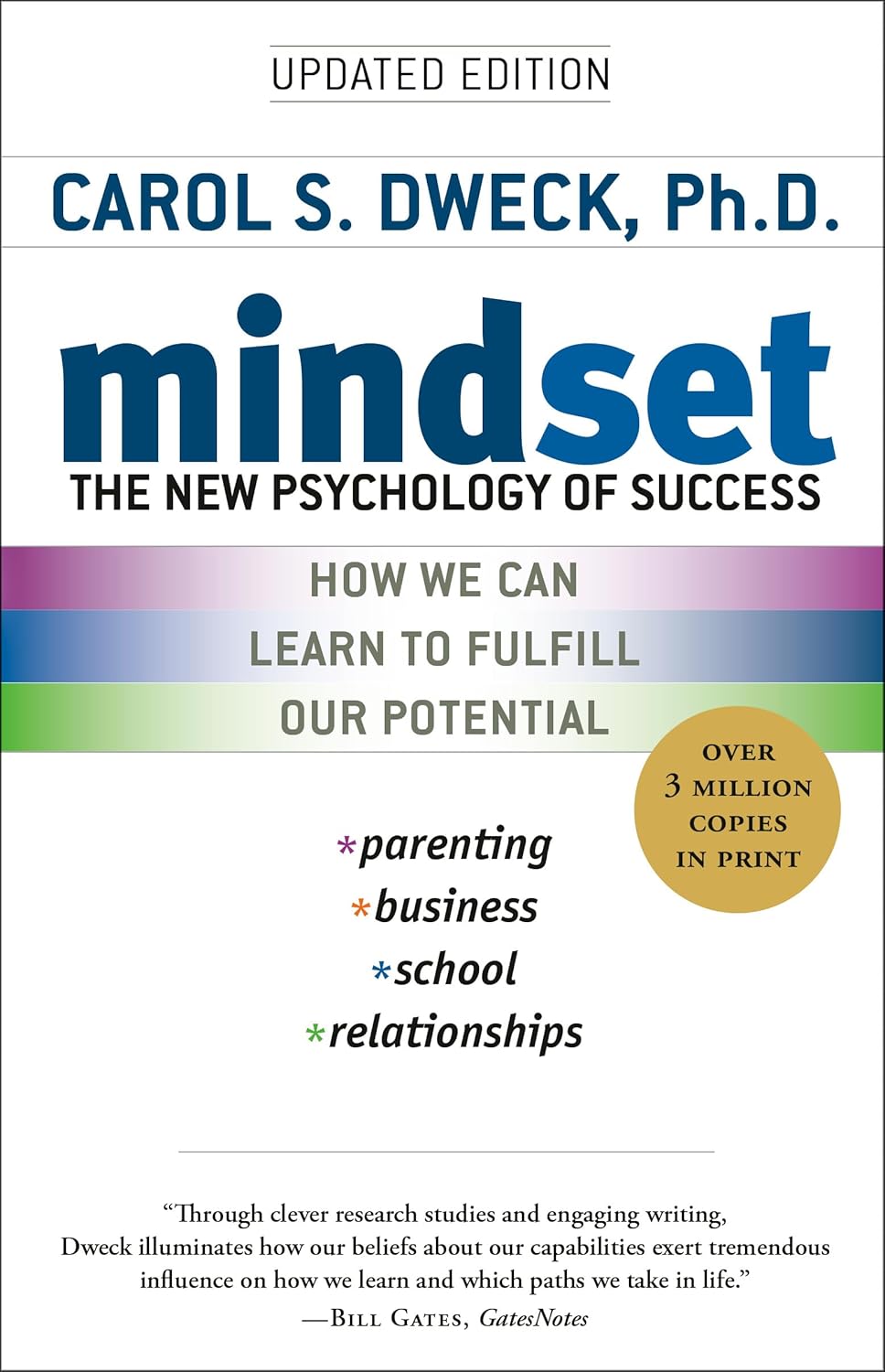
Mindset by Carol S. Dweck

Mindset by Carol S. Dweck

Regular price Tk 267.00 BDT
Regular price Sale price Tk 267.00 BDT
Sale Sold out
Book cover type
Quantity

Mindset by Carol S. Dweck explores how the way people think about intelligence, talent, and ability can influence achievement and personal growth. Dweck distinguishes between a fixed mindset, where abilities are seen as unchangeable, and a growth mindset, where skills can be developed through effort, learning, persistence, and feedback. Drawing on psychological research and real-world examples from education, sports, business, relationships, and parenting, the book explains how mindset affects motivation, resilience, and success. It also offers practical insights for recognizing limiting beliefs and developing a more flexible approach to challenges and setbacks. Mindset is widely read by students, professionals, educators, parents, and anyone interested in self-improvement, psychology, leadership, and lifelong learning. Read More

View full details

About Mindset by Carol S. Dweck—Learn How a Growth Mindset Can Change the Way You Face Life

What if the way you think about talent matters as much as the talent you have today? Mindset by Carol S. Dweck explores a simple idea with a powerful effect: people often act from either a fixed mindset or a growth mindset. One says, “This is all I can do.” The other asks, “What can I learn next?”

Using years of psychology research and clear stories, Dweck shows how beliefs about ability can shape learning, work, sport, leadership, parenting, relationships, and personal growth. The book helps readers notice when fear of looking weak stops them from trying. It also offers a better path forward built on learning, useful effort, good strategies, honest feedback, and the courage to improve.

Two Ways to See Ability

A fixed mindset treats intelligence, talent, and character as qualities that are mostly set. If you believe ability cannot change much, every result may feel like a final test. Success seems to prove that you are smart. Failure seems to prove that you are not.

A growth mindset sees ability as something that can develop. People may begin at different points and have different gifts, but learning, practice, support, and experience can help them improve. A hard task is not a final judgment. It is a chance to build skill.

Dweck does not divide the world into two perfect groups. The same person may use a growth mindset in one area and a fixed mindset in another. You may welcome hard work in business but fear mistakes in public speaking. The first step is noticing the pattern.

Why a Fixed Mindset Can Hold You Back

When your main goal is to look clever, talented, or successful, a challenge can feel dangerous. You may choose an easy task because it protects your image. You may hide a mistake, reject advice, or blame someone else when a result goes badly.

A fixed mindset can turn ordinary feedback into a personal attack. A low mark becomes “I am stupid.” A poor sales month becomes “I am bad at business.” A hard practice session becomes proof that you lack talent.

This way of thinking creates a problem. The more you try to protect your image, the fewer chances you take to learn. You may stop early, avoid people who are stronger, or repeat the same method even when it does not work.

See Challenges as Places to Grow

A growth mindset changes the meaning of difficulty. Instead of asking, “Will this make me look bad?” you can ask, “What can this teach me?”

This does not make hard work easy or remove disappointment. A failed exam, lost game, rejected idea, or broken plan can still hurt. The difference is what happens next. A growth-minded response looks for a lesson, a new method, useful help, and another chance to practise.

Challenges become training grounds. They show where your current skill ends and where new learning can begin. This can build patience because progress is no longer expected to appear at once.

Effort Matters, but It Is Not the Whole Answer

One common mistake is thinking that growth mindset means praising all effort. Dweck explains that effort alone is not enough when the method is poor or the goal is unclear.

Useful effort includes trying a better strategy, asking a question, studying an example, using feedback, seeking support, and changing the plan when needed. Working longer with the wrong method may only create more frustration.

The goal is learning, not simply looking busy. Parents, teachers, and managers can praise the process that leads to progress: focus, planning, patience, courage, improvement, and a wise change of approach.

This lesson protects readers from empty messages such as “You can do anything if you try.” Growth is not magic. It requires action, time, resources, guidance, and methods that fit the task.

Turn “I Cannot” Into “I Cannot Yet”

The small word “yet” creates room for a future. “I cannot solve this” sounds final. “I cannot solve this yet” admits the present problem while leaving space to learn.

This change is not a trick for pretending everything is fine. It is a reminder that today’s skill is not always tomorrow’s limit. The next step may be more practice, a simpler example, a helpful teacher, or a new way to see the problem.

The word works best when it leads to a real plan. Ask what skill is missing, what support is available, and what small action can happen next.

Learn from Feedback Without Losing Confidence

Feedback can feel painful because it shows a gap between what we wanted and what happened. Under a fixed mindset, that gap can feel like shame. The natural response may be to argue, hide, or stop listening.

A growth mindset treats useful feedback as information. It asks which part is true, what can be changed, and what action may improve the next result. You do not need to accept every opinion. You do need enough openness to examine it honestly.

This skill matters in school, work, art, sport, and relationships. A teacher’s note can guide study. A customer complaint can reveal a broken process. A coach can show a weak movement. A partner can explain how a behaviour feels.

Help Children Love Learning, Not Only Praise

Parents and teachers often call a child smart because they want to build confidence. Dweck’s work shows why praise focused only on natural ability can create pressure. The child may begin to fear any task that could make the label look untrue.

Process-based praise focuses on actions the child can understand and repeat. An adult might notice careful practice, a useful strategy, patient effort, a brave question, or progress after feedback.

This does not mean praising weak work as excellent. Children need honest guidance and suitable challenges. They also need to know that mistakes are a normal part of learning, not a reason for shame.

Build Stronger Teams and Better Leaders

Mindset also applies to workplaces and organisations. A fixed-mindset culture may worship star talent, hide errors, and make employees afraid to admit what they do not know. People protect status instead of solving problems.

A growth-minded leader still expects strong work. The difference is that learning is supported. Team members can ask questions, receive clear feedback, develop skills, and discuss mistakes before they grow larger.

Managers can focus on progress as well as present performance. They can give people challenging work with the training and resources needed to improve. They can reward sharing knowledge instead of creating a fight to appear smartest.

Use Growth Mindset in Sport and Creative Work

Practice, coaching, response to failure, discipline, and willingness to change all shape performance. A fixed mindset may make a player hide weakness or avoid a stronger opponent. A growth mindset invites study, training, and honest review.

Creative people face similar fear. A writer may stop because the first draft is poor. An artist may compare early work with another person’s finished work. A musician may avoid a difficult piece to protect confidence.

Grow Inside Relationships

Mindsets shape love and friendship too. A fixed view may suggest that the right relationship should work without much effort. When conflict appears, people may decide that the match is wrong or that one person has a permanent flaw.

A growth view accepts that healthy relationships need communication, learning, repair, and change from both sides. Partners can discuss a problem without turning one mistake into a full judgment of character.

This does not mean staying in a harmful relationship or accepting repeated disrespect. Growth must include safety, responsibility, and real action. It is not an excuse for empty promises.

Avoid the False Growth Mindset

Someone may say they value growth but still punish mistakes, praise only results, or tell people to try harder without offering a better strategy. A school may place a poster on the wall while making students afraid to ask questions. A manager may demand improvement without training or support.

True growth mindset is not constant positivity. It requires honest attention to fixed-mindset reactions and a real learning process. It includes useful feedback, new methods, support, challenge, and time.

What Readers Can Gain from This Book

  • Notice fixed-mindset thoughts before they control your actions.

  • Treat mistakes as information instead of a final identity.

  • Choose useful challenges rather than always protecting your image.

  • Combine effort with better strategies, feedback, and support.

  • Use the word “yet” to create a realistic next step.

  • Give children praise that supports learning and courage.

  • Build a team culture where questions and improvement feel safe.

  • Respond to criticism with curiosity instead of quick defence.

  • Recover more wisely after failure, rejection, or poor performance.

  • Keep learning in school, work, sport, art, business, and relationships.

The book does not promise that belief alone will remove every limit. It shows how beliefs can shape the actions that make improvement more likely.

Who Should Read Mindset?

This book suits students, parents, teachers, coaches, managers, business owners, athletes, artists, and lifelong learners. It is especially useful for anyone who avoids challenges, fears mistakes, struggles with feedback, or feels trapped by labels from the past.

Readers do not need a psychology background. Dweck uses research, examples, and stories to make the main ideas easy to follow. You can read the book from start to finish or return to the sections that match your current need.

A Premium Edition for Learning and Reflection

This Bookish Wonderland edition is made for comfortable reading and long-term use. Premium eye-soothing cream paper gives each page a soft look. Crystal-clear printing keeps the text sharp and easy to follow. High-quality stitched and glue binding helps the pages stay secure through repeat reading.

The printed format is ideal for underlining key ideas, adding notes, and returning to useful examples. Keep it near your study desk, use it during team training, or discuss one chapter at a time with family, students, or colleagues.

Why Order from Bookish Wonderland?

Bookish Wonderland offers a large collection of premium and durable English books for readers across the country. When checking the Book price in Bangladesh for Mindset by Carol S. Dweck, consider the value of comfortable paper, clear printing, and strong binding for regular use.

Cash on Delivery is available across Bangladesh. We deliver inside and outside Dhaka, while customers in Dhaka may ask about fast or urgent delivery. Contact Bookish Wonderland through Facebook or Instagram for current stock, order support, or delivery details.

Start Growing from Where You Are

You do not need to wait until you feel talented, fearless, or fully ready. Growth begins when you face the present honestly and choose one useful step. A mistake can become a lesson. Feedback can become a guide. A difficult task can become training.

Mindset by Carol S. Dweck gives readers a clear language for understanding fear, effort, learning, and change. Its ideas can help you become a better student, parent, teacher, leader, teammate, partner, and learner.

Order your copy from Bookish Wonderland today and begin building a healthier response to challenge. Nationwide delivery, Cash on Delivery, and fast or urgent delivery options in Dhaka make ordering simple. Read, reflect, practise, and discover how much can change when learning matters more than looking perfect.

If you require any customization or have any questions, please inbox us via FB or Insta.

Primary Specification
AuthorCarol S. Dweck
Narrator Bernadette Dunne
GenrePsychology, Self-Help, Personal Development
ISBN-13/ISSN978-0345472328
ISBN-100345472322
PublisherBallantine Books
Publishing DateDecember 26, 2007
EditionBallantine Books Trade Pbk. Ed.
Language English
Reading Age16+
FormatPrinted book
Physical Specification & Quality
Paper QualityPremium eye-soothing cream paper
Binding Quality High quality stitched and glue binding (for longevity)
Print QualityCrystal-clear print
Pages320 pages
CountryUSA
Logistics Information
Weight343 gm
Length8.5 inches
Width5.6 inches
Height0.68 inch
What is Mindset by Carol S. Dweck about?

Mindset: The New Psychology of Success by psychologist Carol S. Dweck explores how beliefs about intelligence, talent, personality, and ability can influence the way people respond to learning, challenges, criticism, failure, and success. Dweck distinguishes between a fixed mindset, in which people tend to view important abilities as relatively fixed traits, and a growth mindset, in which people believe abilities can be developed through learning, effective practice, strategies, feedback, and persistence. The book applies these ideas to education, parenting, sports, business, leadership, relationships, and personal development. Its central message is not that anyone can accomplish absolutely anything simply by believing hard enough. Instead, it asks readers to reconsider how they interpret difficulty and failure. A setback can be treated as proof that someone lacks ability, or as information showing what needs to be learned, changed, practiced, or approached differently.

How many books are in the Mindset series by Carol S. Dweck, and what are they?

There are no books in a series for Mindset by Carol S. Dweck . It is a standalone psychology and personal-development book.

What is the difference between a fixed mindset and a growth mindset?

A fixed mindset involves viewing abilities such as intelligence or talent as traits that are largely set. When people strongly identify with this perspective, difficult tasks can feel threatening because failure may seem to reveal a permanent limitation. They may therefore become more concerned with proving that they are intelligent or talented and may sometimes avoid challenges that could expose weaknesses. A growth mindset emphasizes the possibility that abilities can develop through learning, effective strategies, practice, feedback, support, and experience. Difficulty can therefore become information rather than a final judgment about ability. Dweck does not argue that everyone begins with identical talents or that people can achieve any imaginable result. She also acknowledges that individuals can show fixed thinking in one area and growth-oriented thinking in another. The practical goal is to notice fixed-mindset reactions and respond to challenges in ways that support further learning.

Does having a growth mindset simply mean trying harder and never giving up?

No. This is one of the most common misunderstandings of Dweck’s work. A genuine growth mindset is not simply endless effort. Trying the same unsuccessful strategy repeatedly without learning from the outcome is not meaningful growth. Effective development may require changing strategies, asking for feedback, seeking instruction, practicing differently, using better resources, or recognizing when another approach is needed. Dweck has specifically discussed the problem of a “false growth mindset,” in which people praise effort automatically or describe themselves as growth-minded without changing how they respond to mistakes and challenges. The important question is not merely, “Did I work hard?” but also, “What did I learn, what strategy worked, what needs improvement, and what should I do differently next?” Effort is therefore one component of growth, but learning, strategy, feedback, support, and adjustment matter as well.

Is the growth mindset scientifically proven, or is Mindset mainly a self-help idea?

The growth-mindset concept originated in psychological research, but the evidence is more nuanced than claims that simply teaching people a growth mindset will dramatically improve performance. Research generally supports the idea that beliefs about whether abilities can develop are meaningfully related to motivation and responses to challenges. However, studies of growth-mindset interventions and academic achievement have produced mixed results. Large meta-analyses have reported small average effects, and some analyses of higher-quality intervention studies have found effects that are very small or statistically uncertain. Other research has found benefits under particular conditions—for example, among certain struggling students or when interventions are implemented effectively and supported by the surrounding environment. Readers should therefore treat Mindset as a useful psychological framework rather than a guaranteed formula for high achievement. Mindset matters, but teaching quality, resources, opportunity, health, socioeconomic circumstances, strategies, knowledge, and many other factors also influence outcomes.

How can students use the lessons from Mindset in school, university, or skill learning?

Students can use the book by changing how they interpret academic difficulty. Instead of immediately concluding “I am bad at mathematics,” “I cannot write,” or “I am not intelligent enough for this subject,” a growth-oriented response asks which specific skills are missing and what method could improve them. That might involve reviewing foundational concepts, practicing different problem types, asking a teacher for feedback, studying with classmates, changing study methods, or analyzing errors after an exam. Dweck’s framework also encourages students to see useful criticism as information rather than as a personal attack. Importantly, growth mindset does not mean ignoring poor performance. A low mark still provides evidence that something needs attention. The difference is whether the student treats the result as a permanent judgment about identity or as information that can guide the next stage of learning and improvement.

What does Mindset teach parents and teachers about praising children?
One of the book’s most influential parenting and education ideas concerns how adults respond to achievement and effort. Dweck argues that repeatedly praising children primarily for being “smart,” “gifted,” or naturally talented can unintentionally make performance feel like a test of identity. A child may begin avoiding difficult tasks because struggling could threaten the label of being intelligent. Growth-oriented feedback instead pays attention to the learning process—strategies, concentration, persistence when appropriate, improvement, good decisions, asking useful questions, and responding constructively to mistakes. However, the message should not be reduced to indiscriminately praising effort. Telling a child “great effort” after an ineffective strategy may provide little useful guidance. More constructive feedback identifies what worked and what could be changed. The larger goal is to help children understand that difficulty is compatible with learning and that receiving correction does not mean they lack ability.
Is Mindset useful for business, leadership, sports, and relationships, or mainly for students?
The book deliberately applies mindset theory far beyond education. Dweck discusses business leaders, organizations, athletes, coaches, relationships, parents, teachers, and high-performing professionals. In workplaces, a fixed-mindset culture can become overly focused on identifying “geniuses,” protecting reputations, or avoiding mistakes, while a growth-oriented culture may place greater emphasis on learning, feedback, collaboration, and developing employees. In sport, the framework encourages athletes to treat coaching and difficult training as opportunities to develop rather than as evidence of inadequate talent. In relationships, Dweck examines the belief that successful partnerships should work automatically versus the view that communication and understanding can develop over time. The same principle connects these settings: when people believe ability or compatibility must already be present and effortlessly demonstrated, setbacks become threatening; when development is considered possible, setbacks can instead generate information about what needs attention.
Is Mindset by Carol S. Dweck a premium edition at Bookish Wonderland?

Yes. Bookish Wonderland offers Mindset by Carol S. Dweck as a premium edition for readers who want a comfortable and durable physical copy of this influential psychology and personal-development book. Mindset contains ideas that readers often revisit after encountering failure, criticism, difficult study, workplace challenges, or parenting situations, so it works particularly well as a long-term reference rather than a book that needs to be read only once. The clear physical presentation makes it suitable for highlighting useful passages, making notes, or returning to particular sections on education, leadership, relationships, sports, and personal improvement. It is suitable for students, teachers, parents, entrepreneurs, professionals, managers, athletes, coaches, and general readers interested in psychology, motivation, learning, and behavioral development.

What is the paper and print quality of Mindset from Bookish Wonderland?

The Bookish Wonderland edition of Mindset features premium eye-soothing cream paper with crystal-clear printing. The cream-toned pages provide softer visual contrast than very bright white paper, making extended nonfiction reading more comfortable for readers who prefer longer study sessions. Sharp printing keeps chapter headings, examples, psychological terminology, dialogue, and explanatory passages consistently easy to read. This is particularly useful for a book such as Mindset, where readers may pause frequently to compare fixed and growth reactions or return to examples involving students, parents, businesses, athletes, and relationships. Quality pages also provide a smoother physical reading experience and make the copy more suitable for regular reference. The overall presentation is designed for customers who want both readable content and a polished physical book for their personal or academic collection.

How durable is the binding of Mindset from Bookish Wonderland?

Mindset comes with high-quality stitched and glue binding designed for longevity. Stitching reinforces the page block, while adhesive provides additional support to keep pages firmly secured through repeated opening, reading, carrying, lending, and shelving. This matters particularly for practical psychology and self-development books because readers often return to specific chapters long after completing their first read. A student might revisit the education sections, a parent may return to discussions about praise, while a manager or entrepreneur may repeatedly consult the chapters dealing with leadership and organizational culture. Frequent reference places greater stress on weaker bindings than simply reading a book once from beginning to end. Combined with durable cream paper and crystal-clear printing, the stitched-and-glued construction helps the copy remain functional and presentable for long-term use.

Why should I buy Mindset by Carol S. Dweck from Bookish Wonderland in Bangladesh?

Bookish Wonderland provides a convenient way to buy Mindset by Carol S. Dweck and other premium English psychology and self-development books in Bangladesh while receiving a copy prepared for comfortable, repeated reading. This edition combines premium eye-soothing cream paper, crystal-clear printing, and high-quality stitched and glue binding, making it suitable for students, parents, teachers, professionals, entrepreneurs, managers, coaches, and readers interested in personal growth. Cash on Delivery is available across Bangladesh, so customers can place an order and pay when the book arrives. Delivery is available both inside and outside Dhaka, while customers in Dhaka can also request fast or urgent delivery when available. Bookish Wonderland maintains a large premium and durable English book collection covering psychology, self-development, business, education, leadership, science, philosophy, literature, and many other categories.