Skip to product information
1 of 1

Bookish Wonderland

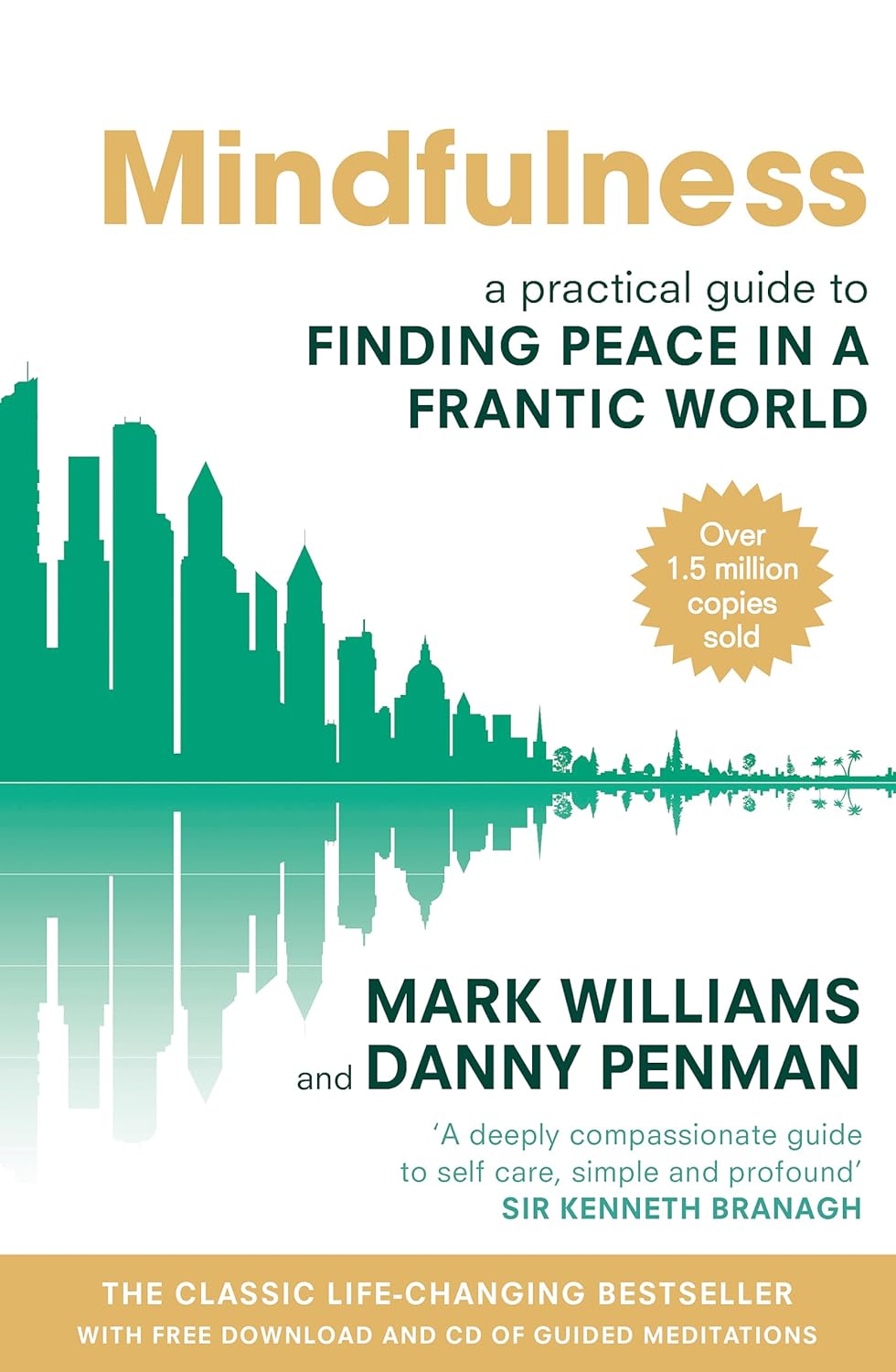
Mindfulness: A Practical Guide to Finding Peace in a Frantic World by Mark Williams and Danny Penman

Mindfulness: A Practical Guide to Finding Peace in a Frantic World by Mark Williams and Danny Penman

Regular price Tk 198.00 BDT
Regular price Sale price Tk 198.00 BDT
Sale Sold out
Book cover type
Quantity

Mindfulness: A Practical Guide to Finding Peace in a Frantic World by Mark Williams and Danny Penman is a practical self-help guide designed to help readers manage stress, anxiety, unhappiness, and mental exhaustion through mindfulness. Based on principles of Mindfulness-Based Cognitive Therapy (MBCT), the book presents simple meditation practices and everyday exercises that encourage greater awareness of thoughts, emotions, and experiences. Its structured approach helps readers develop calmer habits, reduce automatic negative thinking, and become more present in daily life. Written in an accessible style, the book combines psychological research with practical techniques, making mindfulness approachable for beginners as well as readers seeking greater emotional balance, focus, and well-being. Read More

View full details

About Mindfulness: A Practical Guide to Finding Peace in a Frantic World by Mark Williams and Danny Penman—An Eight-Week Path to Calm

Does your day feel full before it even begins? Your phone calls, work waits, worries grow, and your mind keeps moving when your body wants to rest. Mindfulness: A Practical Guide to Finding Peace in a Frantic World by Mark Williams and Danny Penman offers a way to slow down and meet life with more care.

The book presents an eight-week programme based on mindfulness practice. It teaches readers to notice the present moment instead of living on automatic pilot. Through short meditations, simple daily actions, and ideas, the programme helps you observe thoughts, feelings, and body signs without fighting each one.

You do not need special clothes, a silent room, or past experience. You need time to practise and a wish to pay attention. The book does not promise a life without hard days. It offers tools that may help you respond to those days with less rush, more choice, and kindness toward yourself.

When Your Mind Never Seems to Stop

A busy life can pull attention in many directions. You may eat while reading messages, walk while planning work, or lie in bed while replaying a talk. The body is in one place, but the mind is somewhere else. This habit can make each day feel fast, tiring, and thin.

Trying harder to stop every bad thought may create another fight. You notice worry, judge yourself for worrying, and then worry about the judgment. A small problem can grow because the mind keeps turning it over.

Williams and Penman offer a different response. Instead of forcing the mind to become empty, you learn to notice what is already happening. A thought can be seen as a thought. A feeling can be felt without becoming your whole identity. A breath can return attention to the moment in front of you.

This change sounds small, but it gives you a pause. Inside that pause, a new choice may become possible.

What Does Mindfulness Mean?

Mindfulness means paying attention to the present with openness and care. You notice the breath, the body, sounds, thoughts, feelings, and the world around you. You try not to label every experience as good or bad at once.

It does not mean that you never think about yesterday or plan tomorrow. It means knowing where your attention is and bringing it back when you choose. It also does not mean sitting still all day. Mindfulness can be practised while walking, eating, moving, washing, listening, or taking a short break.

The mind will wander. That is normal. Each return is part of the practice, not a sign that you failed. This kind view makes the book friendly for beginners who believe they are “bad” at meditation because thoughts keep appearing.

A Clear Programme You Can Follow for Eight Weeks

The book is built around an eight-week course. Each week adds ideas and exercises, giving you time to learn through experience. You read the guidance, try the suggested practice, and notice what happens in your real life.

The programme includes formal meditation and small changes to normal routines. Formal practice may ask you to sit, lie down, focus on breathing, scan the body, or move with awareness. Daily-life practice may invite you to notice food, sounds, a walk, or a common task in a fresh way.

The step-by-step shape solves a common problem. Many people want calm but do not know where to begin. A long list of tips can feel like more work. Here, the next action is clear. You practise one stage, learn from it, and continue.

Results are not a race. Missing a day does not ruin the course. You can begin again with the next breath and return to the plan without shame.

Step Out of Automatic Pilot

Automatic pilot helps people complete familiar tasks, but it can also make life pass without being fully noticed. You may reach the end of a meal without tasting it or finish a journey without seeing the road. You may answer someone while your attention is still inside a worry.

The practices in Mindfulness help bring ordinary moments back into view. Feeling water on your hands, hearing birds, tasting tea, or noticing your feet on the floor may seem simple. Yet these moments train attention to return to what is real now.

This does not remove bills, deadlines, family duties, or hard news. It changes how you meet them. When you catch automatic reactions earlier, you may have more space to choose your words, set a limit, take a break, or focus on one task.

Learn to See Thoughts as Passing Events

A thought can feel like a fact, especially when it repeats. “I cannot cope” may sound like a final truth. “Everything will go wrong” may make the body react as if the feared event is already here.

Mindfulness teaches you to observe thoughts as events in the mind. They arrive, change, and pass. Some are useful. Some are old habits. Some are guesses shaped by fear or low mood. Seeing this difference can reduce the power of a thought without asking you to pretend it is positive.

The goal is not to push thought away. Pushing often makes it return louder. Instead, you name what is happening and bring attention back to the breath, body, or task. Over time, this may help you respond instead of reacting at once.

Use the Body as an Early Warning System

Stress often appears in the body before the mind fully understands it. The jaw tightens. The shoulders rise. Breathing becomes quick. The stomach feels hard, or sleep becomes difficult. When these signs go unnoticed, strain can keep building.

Body awareness is therefore an important part of the programme. A body scan guides attention through different areas without asking you to change every feeling. Mindful movement helps you notice balance, effort, comfort, and limits.

By learning your early signs, you may pause sooner. You might loosen your hands, breathe gently, move, drink water, step outside, or ask for support. These are not magic cures. They are small, useful responses made before pressure becomes stronger.

Find Calm Inside Ordinary Moments

Many people delay peace until work is finished, the home is quiet, or every problem is solved. That day may never arrive. This book shows how awareness can be practised inside the life you already have.

You can feel one breath before opening an email. You can listen fully during a talk. You can notice the first taste of lunch. You can place your feet on the floor when a meeting feels tense. You can take a mindful walk without turning it into another goal to win.

Gentle Support for Stress and Low Mood

Mindfulness practice may help some people manage stress, anxiety, or low mood. It may also support clearer attention and a calmer response to difficult feelings. The book explains these ideas in warm, simple language and links them to daily exercises.

However, mindfulness is not right for every person or every moment. Some people may feel no benefit, and others may feel worse when they sit closely with thoughts or body feelings. If a practice feels too strong, stop, open your eyes, move, speak with someone you trust, or seek qualified support.

This guide is not a replacement for a doctor, therapist, medicine, or urgent help. Readers facing serious or lasting mental-health problems should talk with a qualified professional. The safest goal is not to force meditation. It is to find support that fits your needs.

What Can This Book Help You Practise?

  • Notice when your mind has moved away from the present.

  • Return attention gently without calling yourself a failure.

  • Build a regular habit through an eight-week structure.

  • Use breathing, body awareness, movement, and daily activities.

  • See thoughts as mental events rather than certain facts.

  • Recognise early body signs of stress and tiredness.

  • Pause before speaking or acting from strong emotion.

  • Give normal moments more attention and meaning.

  • Meet difficult days with patience instead of harsh blame.

  • Learn when to stop and ask for professional support.

The main benefit is choice. You may not control every event, thought, or feeling. You can learn to notice more clearly and choose your next step with greater care.

Who Will Find This Guide Useful?

This book is suitable for adults who feel rushed, distracted, stressed, tired, or trapped in repeated thought. It can help beginners who want to try meditation but do not know how to start. It also suits readers who prefer a clear weekly plan instead of loose advice.

Students can use the practices to return attention during study. Workers may use short pauses before meetings or tasks. Parents and caregivers may value ways to notice stress before reacting. Creative people may use mindful attention to reconnect with the senses and the world around them.

Make the Eight-Week Plan Fit Real Life

Choose a regular time and begin with the practice given for that week. A quiet place can help, but waiting for perfect silence may stop you from starting. Use a chair, bed, mat, or safe place that feels comfortable.

If you miss a session, return without punishment. If one exercise does not suit you, try a shorter version or another safe practice. The course works best as an invitation to learn, not a strict test you must pass.

Comfortable Quality for Regular Practice

This Bookish Wonderland edition is made for reading, marking, and returning to throughout the programme. Premium eye-soothing cream paper gives every page a soft appearance. Crystal-clear printing keeps instructions easy to follow. High-quality stitched and glue binding helps the pages stay secure through regular use.

The printed book can sit beside your journal or practice space without phone alerts. Add page markers, underline useful ideas, and return to the current week's guidance whenever needed. It also makes a thoughtful gift for someone who wants a kinder and more attentive daily routine.

Why Choose Bookish Wonderland?

Bookish Wonderland offers a large collection of premium and durable English books for readers across the country. When checking the Book price in Bangladesh for Mindfulness by Mark Williams and Danny Penman, consider paper comfort, clear printing, and strong binding for eight weeks of study and later use.

Cash on Delivery is available across Bangladesh. We deliver inside and outside Dhaka. Customers in Dhaka may also ask about fast or urgent delivery. Contact Bookish Wonderland through Facebook or Instagram for current stock, order help, or delivery details.

Begin with One Breath Today

You do not need to make your mind blank or change your whole life in one day. Begin by noticing one breath, one sound, or one step. When attention moves away, guide it back with care. This simple return is where the practice begins.

Mindfulness: A Practical Guide to Finding Peace in a Frantic World gives you a clear route through eight weeks of learning. Mark Williams and Danny Penman make meditation feel practical, flexible, and connected to normal life. Their guidance can help you notice automatic habits, understand stress signals, and create a pause before your next response.

Order your copy from Bookish Wonderland today and start building a calmer relationship with the present moment. Nationwide delivery, Cash on Delivery, and fast or urgent delivery options in Dhaka make the ordering process simple.

If you require any customization or have any questions, please inbox us via FB or Insta.

Primary Specification
AuthorMark Williams and Danny Penman
GenreSelf-Help, Mindfulness, Psychology, Personal Development
ISBN-13/ISSN978-1609618957
ISBN-101609618955
PublisherRodale Books
Publishing Date November 13, 2012
Edition1st
LanguageEnglish
Reading Age18+
Format Printed book
Physical Specification & Quality
Paper QualityPremium eye-soothing cream paper
Binding Quality High quality stitched and glue binding (for longevity)
Print QualityCrystal-clear print
Pages288 pages
CountryUK
Logistics Information
Weight308 gm
Length8.5 inches
Width5.6 inches
Height0.71 inch
What is Mindfulness: A Practical Guide to Finding Peace in a Frantic World about?

Mindfulness: A Practical Guide to Finding Peace in a Frantic World by Mark Williams and Danny Penman is a practical psychology and meditation guide designed to help readers become more aware of their thoughts, emotions, bodily sensations, and everyday experiences without automatically reacting to them. The book is based on principles from Mindfulness-Based Cognitive Therapy, or MBCT, and combines accessible explanations with a structured eight-week programme of guided practices. Instead of promising a life without stress or difficult emotions, the authors teach readers how to notice habitual reactions, step out of “autopilot,” relate differently to thoughts, approach difficulties more consciously, and reconnect with activities that make life meaningful. The programme includes breathing meditation, body awareness, mindful movement, attention to thoughts and sounds, befriending practice, and short exercises that can be incorporated into ordinary daily routines.

How many books are in the Mindfulness series by Mark Williams and Danny Penman, and what are they?

There are no books in a series for Mindfulness: A Practical Guide to Finding Peace in a Frantic World by Mark Williams & Danny Penman . It is a standaloneMindfulness & Meditation Guide.

How does the eight-week mindfulness programme in the book work, and how much time does it require each day?

The programme is arranged progressively across eight weeks, with each stage introducing a new aspect of mindfulness. Early practices focus on noticing automatic behavior and reconnecting with bodily sensations. Later weeks explore reactions to difficulty, thoughts and worries, self-critical patterns, kindness, and ways of carrying mindfulness into ordinary life. The published programme includes practices such as mindfulness of body and breath, the body scan, mindful movement, the Three-Minute Breathing Space, Sounds and Thoughts meditation, working with difficulty, and befriending practice. The exact daily schedule can vary depending on the edition and how closely a reader follows the programme, but versions of the Finding Peace course commonly recommend roughly 10–20 minutes of home practice per day. The important element is regularity rather than trying to meditate for extremely long periods.

Is Mindfulness: A Practical Guide to Finding Peace in a Frantic World suitable for complete beginners?

Yes. The book is specifically designed to make mindfulness approachable for people who have little or no previous meditation experience. Readers do not need knowledge of Buddhism, psychology, cognitive therapy, yoga, or formal meditation before beginning. Williams and Penman explain why attention wanders, why people become caught in repetitive thinking, and why difficulty during meditation does not mean the practice has failed. The exercises also begin relatively simply rather than expecting readers to sit silently for an hour from the first day. One reason the programme is frequently recommended to beginners is its combination of explanation and guided practice: readers learn a concept and then experience it through an exercise. The main requirement is willingness to practise consistently. Simply reading the chapters without doing the exercises will not provide the same experience as following the eight-week programme itself.

Is the mindfulness taught in this book religious or spiritual?

The programme is presented in a secular, practical format and does not require readers to adopt a religion or particular spiritual belief. Mindfulness meditation has historical connections with Buddhist contemplative traditions, but the approach taught by Williams and Penman is framed through psychology, attention training, well-being, and Mindfulness-Based Cognitive Therapy. Readers can therefore practise the exercises whether they are religious, non-religious, agnostic, or atheist. The authors also emphasize that mindfulness does not require sitting cross-legged, emptying the mind, or achieving a mystical state. A person can practise while sitting on a chair, walking, eating, noticing bodily sensations, or paying attention to ordinary activities. The goal is to develop greater awareness of present experience and a less automatic relationship with thoughts and emotions rather than to convert readers to a belief system.

Can Mindfulness help with stress, anxiety, or depression, and is this book a substitute for therapy?

The book is based on techniques related to Mindfulness-Based Cognitive Therapy, and mindfulness-based interventions have been studied for stress, anxiety, depression, and psychological well-being. MBCT in particular has an established clinical role for some people with recurrent depression. However, reading Mindfulness should not be treated as a guaranteed treatment or as a replacement for professional assessment when someone has significant mental-health symptoms. The Finding Peace programme was designed as an accessible adaptation suitable for the general public and people dealing with the pressures of everyday life, whereas formal clinical MBCT normally involves a structured therapeutic programme led by appropriately trained professionals. Readers experiencing severe depression, suicidal thoughts, major anxiety, trauma-related difficulties, or other serious symptoms should seek qualified professional support rather than relying only on a self-guided book. The safest way to view the book is as a structured mindfulness resource that may complement, rather than automatically replace, appropriate care.

Does the book include guided mindfulness meditations, and can I access the audio exercises online?
Yes. Guided meditation is an important part of the programme. The official Finding Peace in a Frantic World website provides audio practices associated with the book, so readers are not expected to learn every meditation solely from written instructions. Available practices include Mindfulness of Body and Breath, Body Scan, Mindful Movement, Breath and Body, Sounds and Thoughts, Exploring Difficulty, Befriending, the Three-Minute Breathing Space, and the Chocolate Meditation. Updated resources also include extended versions and tracks containing more silence for readers who become comfortable with the basic practices. Older physical editions may refer to accompanying audio in formats such as CDs, while newer versions commonly direct readers to streaming or downloadable resources. Because packaging can differ between editions, customers should not assume that every printed copy physically contains a CD; the meditation resources themselves are available through the programme’s official online resources.
What will I actually learn to do differently after following the Mindfulness programme?
The programme aims to help readers notice how their minds react automatically rather than trying to make every unpleasant thought disappear. A reader may become more aware of rumination, self-criticism, physical tension, emotional reactions, rushing, and the tendency to become mentally trapped in the past or future. Practices such as the Three-Minute Breathing Space create a deliberate pause between an event and a reaction, while the Sounds and Thoughts meditation teaches readers to observe thoughts as mental events rather than automatically treating every thought as a fact. The programme also asks readers to reconnect with nourishing activities and become more attentive to ordinary experiences that are often missed while operating on autopilot. The objective is therefore not constant relaxation or happiness. It is greater awareness, flexibility, and choice in how someone responds to pleasant, unpleasant, stressful, or emotionally complicated moments.
Is Mindfulness: A Practical Guide to Finding Peace in a Frantic World a premium edition at Bookish Wonderland?

Yes. Bookish Wonderland offers Mindfulness: A Practical Guide to Finding Peace in a Frantic World as a premium edition intended for readers who want a comfortable and dependable physical copy for an eight-week practice programme and later reference. Unlike a book that may be read once and shelved, this title encourages readers to return repeatedly to individual weekly chapters, meditation instructions, explanations, and exercises. A clear physical layout therefore makes it easier to keep track of progress and revisit practices when needed. The edition is suitable for beginners exploring meditation, psychology readers, university students, professionals managing demanding routines, and readers interested in practical personal development. Its quality construction also makes it useful as a long-term mindfulness reference after the formal eight-week programme has been completed.

What is the paper and print quality of Mindfulness from Bookish Wonderland?

The Bookish Wonderland edition features premium eye-soothing cream paper with crystal-clear printing. The cream-toned page surface provides softer visual contrast than harsh bright-white paper, which can make extended reading and practice sessions more comfortable. Sharp printing keeps weekly instructions, meditation explanations, headings, exercises, and psychological concepts clear and easy to follow. This is particularly useful for a structured guide because readers may move repeatedly between explanatory chapters and the practical sections for each week. Clean reproduction also helps when returning to specific exercises such as the Body Scan, Three-Minute Breathing Space, or practices involving difficult thoughts and emotions. The combination of readable text and comfortable page quality provides a smoother physical experience for readers who intend to work through the book gradually rather than rush through it like a conventional self-help title.

How durable is the binding of Mindfulness from Bookish Wonderland?

Mindfulness: A Practical Guide to Finding Peace in a Frantic World comes with high-quality stitched and glue binding designed for longevity. Stitching reinforces the page block, while adhesive adds support to help pages remain securely attached through frequent opening, carrying, practising, and shelving. This durability is particularly valuable for an eight-week guide because readers may reopen the same weekly chapters or meditation instructions every day for several days before moving forward. Even after completing the programme, practices such as the breathing space, body scan, or befriending meditation may be revisited regularly. Repeated use can quickly weaken poorly constructed books, so stronger binding provides practical long-term value. Combined with premium cream paper and clear printing, the physical construction makes the edition suitable for sustained personal use and permanent placement in a psychology, wellness, or self-development collection.

Why should I buy Mindfulness by Mark Williams and Danny Penman from Bookish Wonderland in Bangladesh?

Bookish Wonderland provides a convenient way to buy Mindfulness: A Practical Guide to Finding Peace in a Frantic World by Mark Williams and Danny Penman and other premium English psychology and self-development books in Bangladesh. This edition combines premium eye-soothing cream paper, crystal-clear printing, and high-quality stitched and glue binding, making it suitable for meditation beginners, students, professionals, psychology readers, and customers interested in practical mindfulness. Cash on Delivery is available across Bangladesh, allowing customers to order and pay when the book arrives. Delivery is available both inside and outside Dhaka, while customers in Dhaka can also request fast or urgent delivery when available. Bookish Wonderland maintains a large premium and durable English book collection across psychology, mindfulness, self-development, business, philosophy, science, literature, and many other categories.