Skip to product information
1 of 1

Bookish Wonderland

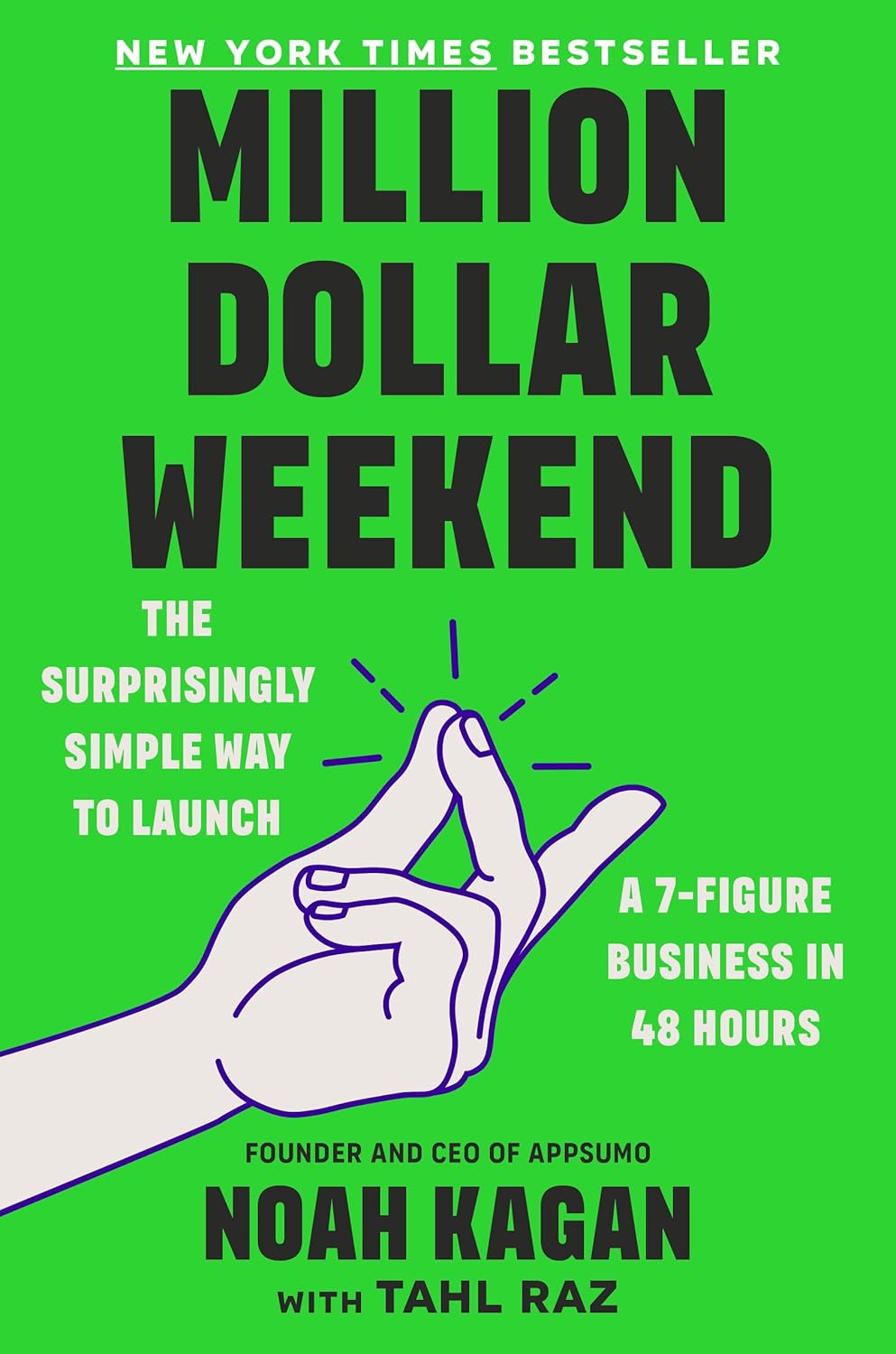
Million Dollar Weekend by Noah Kagan

Million Dollar Weekend by Noah Kagan

Regular price Tk 217.00 BDT
Regular price Sale price Tk 217.00 BDT
Sale Sold out
Book cover type
Quantity

Million Dollar Weekend by Noah Kagan is a practical entrepreneurship book about starting a business quickly, validating ideas, finding customers, and generating revenue without overcomplicating the process. Kagan argues that many aspiring entrepreneurs delay action because of fear, perfectionism, and excessive planning. Drawing on his experience building and investing in companies, he presents a step-by-step framework for testing business ideas over a short period, making direct offers, gathering customer feedback, and improving based on real demand. The book emphasizes action, sales, experimentation, confidence, and learning through execution rather than waiting for the perfect idea. It is designed for aspiring founders, freelancers, creators, and professionals who want a straightforward approach to turning an idea into a potentially profitable business. Read More

View full details

About Million Dollar Weekend by Noah Kagan: Turn One Free Weekend Into the Start of a Real Business

You may have a good business idea but still feel unable to begin. You may worry about money, failure, rejection, or choosing the wrong idea. Million Dollar Weekend by Noah Kagan is written for this exact moment. It offers a fast, practical way to stop waiting and test a business idea with real people in only forty-eight hours.

The book does not say that everyone will earn one million dollars in one weekend. Its true promise is more useful. It teaches you how to find a real problem, shape a simple offer, ask people to pay, and learn from the answer before spending months building something nobody wants. Instead of starting with a costly website, logo, office, or large product, you start with a customer and a need.

Noah Kagan shares lessons from building several successful companies, including AppSumo. His style is direct, lively, and focused on action. Each main idea leads toward a task you can try. By the end, you should not have only pages of notes. You should have clearer numbers, honest customer feedback, stronger courage, and a tested direction for your next move.

Stop Waiting for the Perfect Business Idea

Many people want to start a side business, but they remain stuck in planning. They watch videos, save posts, choose names, compare tools, and keep searching for the perfect idea. This feels like work, yet it can become a safe way to avoid the one thing that matters most: asking a customer to pay.

Kagan calls attention to the fears hiding under delay. A person may fear hearing “no,” looking foolish, losing money, or finding out that an idea is weak. Because that truth feels uncomfortable, it becomes easy to spend weeks on colours and websites instead of speaking with possible buyers.

Million Dollar Weekend offers a clear solution. Act before your fear grows. Find a problem people already care about, make a simple offer, and ask for a real payment. A quick “no” can save months of wasted time. A real “yes” can show that your idea deserves another step. Either answer gives you useful information and moves you forward.

What Does the Forty-Eight-Hour Method Really Mean?

The weekend method is a test, not a promise of instant wealth. Its aim is to help you move from an untested thought to a business idea supported by real customer action. The process has three simple steps: find a problem, create an offer with strong earning potential, and get paid before building the full product or service.

The book is divided into three parts called Start It, Build It, and Grow It. Start It helps you build courage, make asks, and understand the amount of monthly income you need. Build It guides you through the actual weekend test. Grow It explains ways to use email, social media, experiments, systems, and regular habits after people have shown that they want your offer.

Every stage asks you to do something, not only agree with an idea. This matters because confidence often comes after action, not before it. You may still feel nervous when you contact a customer, but making the ask gives you practice. The next ask becomes easier, and the business becomes based on evidence instead of hope.

Friday: Find a Problem People Want Solved

The first step is not sitting alone and trying to invent a clever product. It is looking for people with a clear problem. A useful business often begins with a complaint, a slow task, an unwanted cost, a missing service, or a result that customers already spend money to reach.

Kagan’s customer-first approach asks you to notice your own problems, listen to friends and workers, study groups you understand, and look at services people already buy. Your experience, job, hobbies, city, and personal network can show you needs that outsiders miss. You do not need to create a new human desire. You can make an existing result easier, faster, clearer, safer, or more enjoyable.

This step removes pressure because your first idea does not need to be brilliant. It needs to be useful to a clear person. The goal for Friday is to collect possible problems, choose promising ones, and decide whom you can speak with soon.

Saturday: Check Whether the Numbers Can Work

A popular idea is not always a healthy business. Saturday is for turning an interesting problem into a simple business model. The book teaches readers to estimate how many customers may exist, what they might pay, what each sale may cost, and how much profit could remain.

This is simple “napkin math,” not a huge financial report. You use clear guesses to test whether the idea could become large enough for your goal. If an offer earns only a tiny amount from a very small group, it may not lead where you want. If the numbers look stronger, you have a reason to test it with buyers.

The fast calculation protects your time and money. It helps you reject weak ideas before building them and compare several choices without becoming emotionally attached. The numbers will not predict the future perfectly, but they can expose an idea that does not make sense and point you toward a better offer.

Sunday: Ask Real Customers to Pay

Interest is easy to give. Friends may say an idea sounds great because they want to support you. A social media like may feel exciting, but it does not prove that someone will spend money. Sunday focuses on a stronger sign: payment from a real customer.

The forty-eight-hour money challenge asks you to seek three paying customers before building the complete offer. You begin with the people most likely to need the result. Explain the problem you solve, describe the clear outcome, state the price, and ask whether they want to buy. The offer can begin small, manual, or simple as long as you can deliver what you promise.

Three payments show that the idea has early demand. Fewer payments do not make the weekend useless. They may show that the customer, offer, price, message, or problem needs to change. You can learn cheaply, improve the idea, and test again instead of discovering the problem after a large investment.

Practical Ideas You Can Use Immediately

Million Dollar Weekend is designed as a working guide, not only an inspiring story. Its main features include:

  • A forty-eight-hour process for testing a business idea with customers

  • Simple exercises that push readers from thinking toward action

  • A customer-first method for finding useful business problems

  • Quick calculations for checking price, cost, sales, and profit

  • A challenge to seek three paying customers before fully building

  • Practice for handling rejection and becoming better at asking

  • Guidance on email, social media, experiments, and business systems

  • Real examples from Noah Kagan’s work and business experience

These tools can reduce a common startup risk: spending too much before learning whether customers care. They also make the book easy to revisit. When one idea fails, you can use the same process on another idea. The method turns failure into a small test with a lesson instead of a long and costly disaster.

Together, these lessons help you test faster, spend less, face rejection, understand basic numbers, and build a simple growth plan only after customers prove that they want your offer.

Who Should Read Million Dollar Weekend?

This book is useful for students, workers, freelancers, creators, small business owners, and new entrepreneurs. It suits people who want a side income but feel unsure about risk. It can also help anyone who has many ideas but rarely finishes one, or who has built products before finding customers.

You do not need a business degree, a large team, or deep technical skill to understand the method. The language is lively, the exercises are clear, and the first tests can be small. A reader can try the ideas with a service, local business, online product, class, event, shop, or creative offer.

Experienced owners may also find value in returning to the basics. When a new product is planned, the same questions still matter: Who needs it? What problem does it solve? Will anyone pay? Can the numbers work? How can the offer grow without creating waste?

Use the Book During a Real Weekend

For the best experience, do not read the whole book and place it aside. Choose a weekend, keep a notebook ready, and complete the exercises while the ideas are fresh. On Friday, collect problems and choose possible customers. On Saturday, shape the offer and check the basic numbers. On Sunday, contact buyers and ask for payment.

You can use the method alone, with a friend, or with a small team. A partner can help you practise the sales message, question weak guesses, and keep the work moving. Set a clear finish time so planning does not take over the whole challenge.

After the weekend, review every response. Write down why people said yes, no, or maybe. Look for repeated words and concerns. Then choose the next move based on evidence. You may deliver the first version, improve the offer, choose a different group, or test another idea the following weekend.

A Premium Copy Made for Active Reading

This Bookish Wonderland edition is designed for readers who want to underline ideas, mark exercises, and return to useful pages. Premium eye-soothing cream paper gives the pages a softer look during longer reading sessions. Crystal-clear printing keeps the text and lists sharp, while high-quality stitched and glue binding helps the pages remain secure through repeated use.

The printed format works well for a practical book because you can keep a notebook beside it, add page markers, and move between the plan and your own business ideas. It also makes a useful gift for a student, freelancer, entrepreneur, or friend who keeps talking about starting but needs a clear push toward action.

Order Easily from Bookish Wonderland

When checking the Book price in Bangladesh for Million Dollar Weekend by Noah Kagan, consider the value of a durable copy that can support planning, marking, and repeat reading. Bookish Wonderland offers nationwide delivery, including addresses inside and outside Dhaka, so readers across the country can order without searching many physical shops.

Cash on Delivery is available for a simple payment experience. Customers in Dhaka may also ask about fast or urgent delivery when they need the book quickly. Contact Bookish Wonderland through Facebook or Instagram to confirm current stock, delivery cost, estimated arrival time, or any customization request before placing the order.

Start Before Another Weekend Passes

A business cannot become real while it stays only inside your head. Million Dollar Weekend by Noah Kagan gives you a clear way to move from fear and planning toward a problem, an offer, and an honest customer answer. You may finish the weekend with paying buyers, or you may find that the first idea needs to change. Both results teach you more than another month of waiting.

Choose a weekend, follow the challenges, and make the first ask. Order your copy from Bookish Wonderland today and begin testing the business idea you keep delaying. Nationwide delivery, Cash on Delivery, and fast or urgent delivery options in Dhaka make the buying process easy.

If you require any customization or have any questions, please inbox us via FB or Insta.

Primary Specification
Author Noah Kagan, Tahl Raz
NarratorNoah Kagan
EditorTanya Maiboroda
Genre Business, Entrepreneurship, Personal Development
ISBN-13/ISSN‎ 978-1529146189
ISBN-101529146186
PublisherEbury Edge
Publishing Date‎ January 30, 2024
LanguageEnglish
Reading Age18+
FormatPrinted book
Physical Specification & Quality
Paper QualityPremium eye-soothing cream paper
Binding QualityHigh quality stitched and glue binding (for longevity)
Print QualityCrystal-clear print
Pages 240 pages
CountryUSA
Logistics Information
Weight260 gm
Length8.5 inches
Width5.6 inches
Height0.67 inch
What is Million Dollar Weekend by Noah Kagan about?

Million Dollar Weekend: The Surprisingly Simple Way to Launch a 7-Figure Business in 48 Hours is a practical entrepreneurship book about moving from endless planning to testing a real business idea with actual customers. Noah Kagan, founder and CEO of AppSumo, argues that aspiring entrepreneurs often spend too much time creating websites, logos, products, and detailed plans before discovering whether anyone will pay for what they are building. His alternative is an action-focused 48-hour process: identify a problem people genuinely have, shape a simple solution, ask potential customers for money, and use real purchases as evidence of demand. The book also discusses overcoming fear of rejection, finding business ideas, calculating whether an opportunity can become large enough, getting initial customers, marketing, email, social media, and creating systems for growth. It is designed as a practical startup playbook rather than an academic business textbook.

How many books are in the Million Dollar Weekend series by Noah Kagan, and what are they?

There are no books in a series for Million Dollar Weekend by Noah Kagan . It is a standalone business and entrepreneurship book.

Does Million Dollar Weekend really teach you how to make one million dollars in a weekend?

No. The title should not be interpreted as a promise that every reader will earn $1 million within 48 hours. The weekend framework is primarily designed to help readers start and validate a business quickly instead of spending months preparing something nobody wants. Kagan encourages aspiring founders to identify a customer problem, create a simple offer, and try to secure real paying customers within the weekend. The “million dollar” element refers to evaluating whether an idea could potentially grow into a large business over time. The book includes simple calculations for thinking about market size, pricing, customer numbers, and possible revenue so readers can avoid pursuing ideas that do not fit their goals. Its practical promise is therefore speed of validation and action, not guaranteed millionaire status by Monday morning.

What is the 48-hour business validation process in Million Dollar Weekend?

The process is built around taking an idea from assumption to real-world customer evidence as quickly as possible. Kagan encourages readers to begin with a customer problem rather than an elaborate product, then test whether a simple solution is something people will actually pay for. The weekend approach can be summarized as finding a problem, shaping an offer, and attempting to get paying customers before building extensively. One of Kagan’s practical benchmarks is to aim for several paying customers—often framed as three—within 48 hours. Payment matters because someone saying “that sounds like a good idea” is much weaker evidence than someone actually spending money. If people refuse to buy, the founder gains inexpensive information and can revise the offer or test another idea rather than wasting months of development. The approach therefore treats rapid customer feedback as more valuable than prolonged speculation.

Do I need a lot of money to start the businesses suggested in Million Dollar Weekend?

No. One of the book’s recurring principles is to avoid spending heavily before proving that customers want the offer. Kagan deliberately challenges the belief that a startup must begin with significant funding, a sophisticated website, expensive branding, employees, or a finished product. His preferred order is closer to customer first, payment second, and investment or expansion later. Depending on the business, a person might begin with a service, simple prototype, manual process, preorder, or other low-cost test. That does not mean every business can ultimately be built without capital—manufacturing, inventory-heavy businesses, regulated industries, and some technology ventures can require substantial investment. The book’s lesson is instead to postpone unnecessary spending until real demand has been demonstrated. This makes it particularly relevant to side-hustle founders and first-time entrepreneurs working with limited financial resources.

What are the Dollar Challenge, Coffee Challenge, and “ask muscle” in Million Dollar Weekend?

These exercises are designed to reduce the fear of asking people for money or risking rejection. Kagan argues that many aspiring entrepreneurs do not fail because they lack ideas; they avoid making direct offers because hearing “no” feels uncomfortable. The Dollar Challenge asks readers to persuade someone to give them a small amount of money, while another exercise involves asking for a discount in an ordinary purchasing situation. The financial amount itself is not the main point. The purpose is to experience asking, possible rejection, and the realization that a refusal is usually survivable. Kagan describes this as strengthening the “ask muscle.” In a real business, founders eventually need to ask customers to buy, partners to collaborate, suppliers to negotiate, employees to join, or audiences to pay attention. These small challenges are intended to make those larger asks psychologically easier.

How does Million Dollar Weekend help you find and validate a profitable business idea?
Kagan recommends starting with problems people already experience, particularly problems they care enough about to spend money solving. Rather than waiting for one brilliant invention, readers are encouraged to notice personal frustrations, complaints from friends or customers, inefficient services, underserved audiences, and things people already purchase but dislike. The next step is to examine whether enough potential customers exist and whether the economics could support the type of business the founder wants. Most importantly, validation requires making an actual offer. Likes, compliments, survey responses, and friends saying they would “probably buy” can be misleading because they involve no financial commitment. Kagan therefore favors asking potential customers to pay before investing heavily in the product. This customer-first approach is one of the book’s most frequently discussed ideas because it turns entrepreneurship from speculation into a testable process.
Is Million Dollar Weekend useful for complete beginners, side hustlers, and people without a large online audience?
Yes, especially for beginners who are stuck in the planning stage, although some reader criticism is relevant here. The book is written in straightforward, energetic language and assumes readers may have no previous startup experience. It explains idea generation, validation, asking for payment, marketing, and early growth without requiring an MBA or advanced financial knowledge. Side-hustle founders can also use the weekend format without immediately leaving their jobs. However, some readers point out that several of Kagan’s examples benefit from his extensive entrepreneurial experience, contacts, or access to an existing audience, which may make certain tactics easier for him than for an unknown beginner. Readers without a network may therefore need more outreach attempts and patience. The core principles—solve a real problem, ask directly, seek payment, and validate before investing—can still be applied on a smaller scale.
Is Million Dollar Weekend by Noah Kagan a premium edition at Bookish Wonderland?

Yes. Bookish Wonderland offers Million Dollar Weekend as a premium edition for readers who want a comfortable and durable physical copy of this practical entrepreneurship book. Because Kagan includes challenges, business exercises, calculations, validation ideas, and customer-acquisition concepts, many readers may want to highlight sections, make notes, or return to individual chapters while testing an actual business idea. A dependable printed copy is therefore useful beyond a single cover-to-cover reading. The edition is suitable for entrepreneurs, business students, freelancers, side-hustle builders, marketers, startup founders, creators, and professionals who want to turn an idea into a real offer. Its physical quality is designed to support repeated reference as readers progress from idea generation to validation, first customers, marketing, and growth.

What is the paper and print quality of Million Dollar Weekend from Bookish Wonderland?

The Bookish Wonderland edition features premium eye-soothing cream paper with crystal-clear printing. The cream-toned pages offer comfortable contrast for extended reading and study, while sharp printing keeps business concepts, examples, exercises, chapter headings, and numerical ideas easy to follow. This is useful for a hands-on business book because readers may repeatedly move between explanations and their own notes while evaluating ideas, contacting potential customers, or completing the weekend challenges. The durable page quality also makes the book suitable for highlighting important sections and revisiting them as a business develops. Rather than focusing only on appearance, the paper and print combination is intended to support practical use, making the physical copy comfortable for students, entrepreneurs, professionals, and readers who prefer to learn from a printed business guide.

How durable is the binding of Million Dollar Weekend from Bookish Wonderland?

Million Dollar Weekend comes with high-quality stitched and glue binding designed for longevity. Stitching strengthens the page block, while adhesive provides additional support to help the pages remain secure through repeated opening, studying, carrying, and shelving. This durability matters because Million Dollar Weekend is structured more like an action manual than a book readers necessarily use only once. A founder may revisit the idea-generation section before launching a project, return to customer-validation advice during another experiment, or review marketing and growth chapters after securing early customers. Frequent reference can place substantial stress on weaker bindings. The stitched-and-glued construction therefore helps the copy remain functional through regular use, while premium cream paper and crystal-clear printing complete a physical edition suitable for long-term business reference.

Why should I buy Million Dollar Weekend by Noah Kagan from Bookish Wonderland in Bangladesh?

Bookish Wonderland provides a convenient way to buy Million Dollar Weekend by Noah Kagan and other premium English business and entrepreneurship books in Bangladesh. This edition combines premium eye-soothing cream paper, crystal-clear printing, and high-quality stitched and glue binding, making it suitable for entrepreneurs, freelancers, startup founders, business students, digital marketers, creators, and readers planning a side hustle. Cash on Delivery is available across Bangladesh, allowing customers to place an order and pay when the book arrives. Delivery is available both inside and outside Dhaka, while customers in Dhaka can request fast or urgent delivery when available. Bookish Wonderland also maintains a large premium and durable English book collection covering entrepreneurship, marketing, finance, psychology, self-development, technology, literature, and many other categories.