

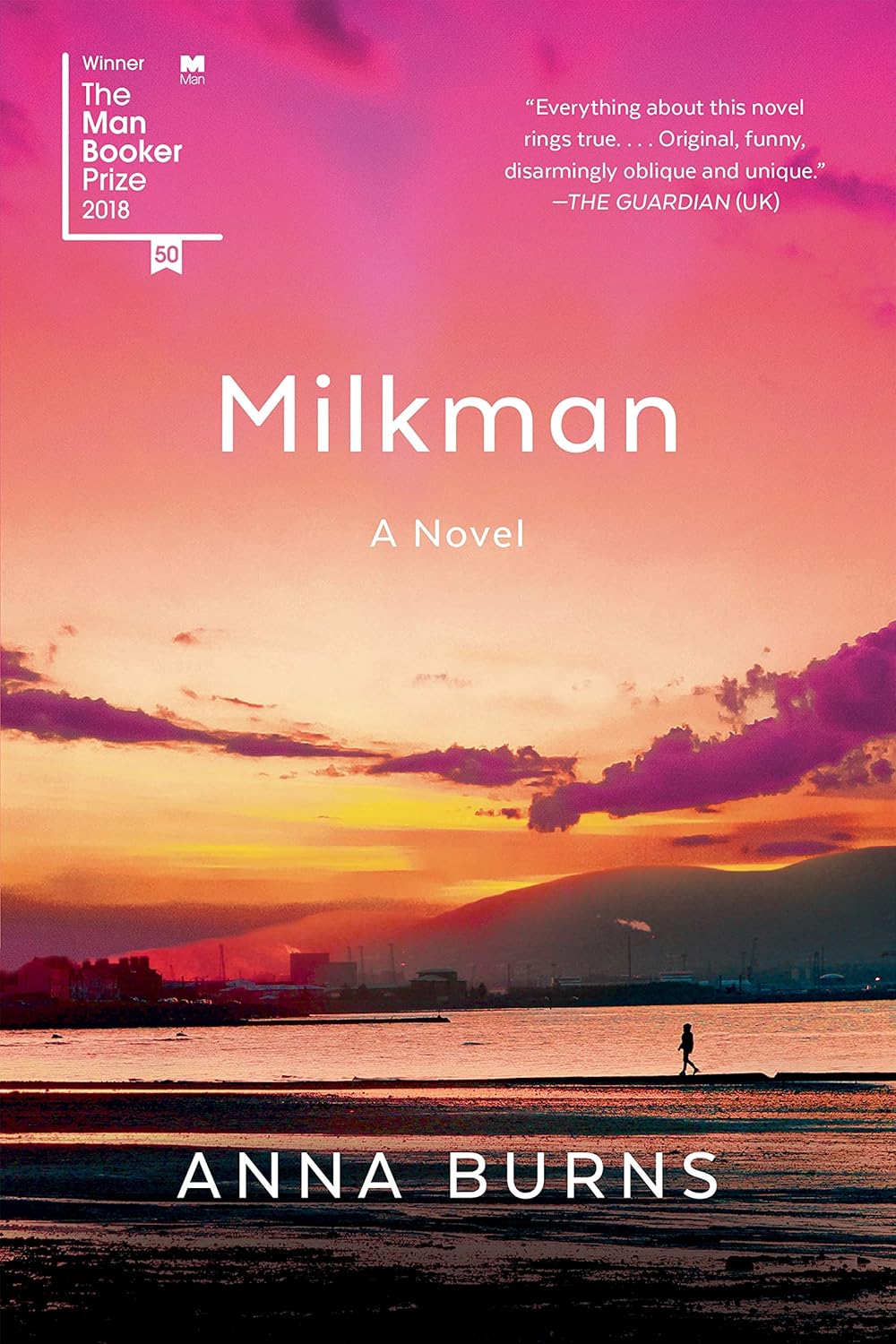
About Milkman by Anna Burns: Enter a World Where Rumour Can Be More Dangerous Than Truth
In a place ruled by fear, even a normal walk can make people talk. Milkman by Anna Burns follows an unnamed eighteen-year-old woman known as middle sister. She wants to read her books, protect her private life, and stay outside the political struggle around her. Then an older, powerful, married man called Milkman begins giving her unwanted attention.
Middle sister does not welcome him, but her community quickly creates a different story. People decide that she is having a secret relationship with him. The rumour grows until it changes how family, neighbours, and friends see her. Her own voice is pushed aside by a story that other people prefer to believe.
Winner of the 2018 Booker Prize, this is a bold literary novel about stalking, gossip, silence, control, and life inside a divided community. Anna Burns uses an unusual voice, unnamed characters, long thoughts, and dark humour to show how fear enters daily life. The result is strange, sharp, demanding, and deeply memorable.
When Being Noticed Becomes a Threat
Middle sister lives in an unnamed Northern Irish town during the Troubles. Violence and political division shape the area, but danger does not always arrive as an open attack. It can appear through a look, a question, a car slowing beside someone, or a neighbour repeating a story.
The young narrator tries not to stand out. She walks while reading old novels and keeps her relationship with maybe-boyfriend private. These choices seem harmless, yet the community treats anything unusual with doubt. People watch one another, read secret meanings into small acts, and decide what a person must be thinking without asking.
When Milkman notices her, privacy becomes almost impossible. His power means that even his attention can work like a threat. Middle sister knows that refusing him openly may be dangerous, while silence allows others to invent their own meaning. Burns makes the reader feel how frightening it is when every possible response carries a risk.
A Rumour That Steals Her Own Story
The central problem is not only Milkman’s behaviour. It is also the community’s decision to believe that middle sister wants his attention. A false story moves from person to person until it begins to feel stronger than the truth. People judge her, warn her, question her, and place responsibility on her shoulders.
This pressure shows how gossip can become a form of control. The rumour tells her what kind of woman she is supposed to be. It changes the way her mother speaks to her and puts strain on her connection with maybe-boyfriend. Her wishes matter less than the public version of her life.
Readers may recognise this problem even if their own world is very different. A lie can grow when people repeat it without checking. A victim may be blamed because the true story is harder to face. Milkman asks what happens when a whole group protects its rules and stories instead of listening to one frightened young person.
Why the Characters Do Not Have Normal Names
Anna Burns does not give most characters ordinary names. The narrator is middle sister. Her partner is maybe-boyfriend. Other people are known through family roles, jobs, habits, or the place they hold in the community. At first, this may feel strange, but it becomes an important part of the world.
Without names, identity feels less private and more controlled by other people. A person becomes a label. The label says how the community sees them, not everything they truly are. This makes the setting feel closed, watched, and difficult to escape.
The lack of names also makes the story larger than one street or one period. The novel grows from the Troubles, yet its fear, gossip, pressure, and treatment of women can be understood in many places. Readers are asked to focus on patterns of power rather than treating the events as a distant history that could never happen again.
Reading While Walking Should Not Be a Crime
Middle sister is known for reading nineteenth-century novels while she walks. She uses books as a private space away from the conflict around her. Reading helps her turn her attention toward another time and another world, even while her body moves through dangerous streets.
To her neighbours, this habit makes her odd. In a place where standing out can bring suspicion, even loving books becomes political. People believe that a person who acts differently must be hiding something. Her quiet habit is studied, judged, and added to the rumours about her.
This detail will stay with many book lovers. Reading is usually seen as safe and peaceful, yet here it becomes one more reason for attention. Burns shows how an unhealthy community can turn normal freedom into evidence against someone. The image is simple, but it explains the narrator’s deep wish to keep one part of herself beyond public control.
Fear Lives Inside Ordinary Conversations
Milkman contains political violence, but much of its tension comes from ordinary speech. People avoid direct words. They use hints, labels, warnings, jokes, and long stories because saying the wrong thing can expose a belief, a connection, or a side. Language becomes a way to survive and a way to control.
The narrator often circles around what she means. Her thoughts move through memories, rules, fears, and possible meanings before reaching a point. This voice shows a mind trained to check every word. It also places the reader inside the pressure of a society where simple truth may not feel safe.
The style can be demanding, especially at the beginning. Sentences may be long, and thoughts may move in unexpected directions. Readers who slow down often begin to hear the rhythm and understand why the voice works this way. The form is not only decoration. It helps us feel confusion, watchfulness, and the tiring weight of constant danger.
A Story About Control Over Women
Milkman’s interest in middle sister is unwanted, yet many people treat her as if she caused it. This response reveals how easily a woman can be blamed for a powerful man’s actions. Her clothes, habits, movements, and private relationships become open subjects for public judgment.
The danger is difficult to prove because Milkman often works through suggestion. He appears, knows details, offers rides, and makes his power understood without needing to state every threat. Middle sister feels trapped between what she knows and what others demand as proof.
Burns shows that harassment is not always one clear event. It can be a steady invasion that changes where a person walks, what she says, whom she trusts, and how safe she feels inside her own mind. The novel gives serious attention to that experience without turning the narrator into only a symbol of suffering.
What Makes This Novel Worth Reading
Milkman offers more than a plot about one threatening man. It gives readers a close view of how fear can shape language, family, love, friendship, and public life. Its key strengths include:
-
A distinctive first-person voice that places readers inside middle sister’s thoughts
-
An unnamed setting filled with suspicion, surveillance, gossip, and hidden rules
-
A powerful study of harassment, victim-blaming, silence, and social control
-
Dark humour that appears beside danger without weakening its seriousness
-
Unnamed characters whose labels reveal how the community defines people
-
A young woman trying to protect her identity inside a divided society
-
Rich themes for discussion about truth, power, gender, conflict, and resistance
-
Award-winning literary writing that rewards slow and thoughtful attention
These qualities make the book ideal for readers who want fiction that continues to grow in the mind after the final page. It does not give easy comfort, but it offers a reading experience that feels original and important.
Who Will Connect with Milkman?
This novel is best for adults and mature readers who enjoy literary fiction, unusual voices, social themes, and character-led stories. It may suit readers interested in Northern Irish history, life during the Troubles, women’s experiences, political pressure, or the way communities use gossip to enforce rules.
Readers who enjoy fast chapters, simple sentences, clear names, and direct action should know that Milkman asks for patience. Its power comes from voice, mood, repetition, and the slow growth of pressure. The book may feel confusing at first because the narrator’s mind moves in circles and names are withheld.
Give the style time before deciding whether it works for you. Read in a quiet place and follow the feeling of the sentences instead of trying to solve every detail at once. When the rhythm becomes familiar, the narrator’s world can feel very close, and small moments can carry great force.
A Strong Choice for Study and Discussion
Milkman can support deep classroom, university, or book-club discussion. Readers can explore why characters have no names, why middle sister reads while walking, how rumours gain power, and why direct language is avoided. Each choice opens a question about identity and survival.
The novel also invites discussion about listening to victims. Why do people accept a public story instead of the narrator’s own account? Why does her mother trust gossip? How does political fear change personal relationships? These questions connect the setting to problems that still exist today.
For independent reading, keep a short list of character labels and important relationships. Read in steady sections rather than rushing. After each section, note what the community believes, what middle sister knows, and what she cannot safely say. This simple method can make the complex voice easier to follow without removing its mystery.
A Premium Edition for Careful Reading
This Bookish Wonderland edition is made for readers who want a comfortable copy for slow reading, study, and repeat visits. Premium eye-soothing cream paper gives each page a soft look. Crystal-clear printing keeps the long passages easy to see, while high-quality stitched and glue binding helps the pages remain secure over time.
The printed format is useful for adding page markers, underlining key lines, and keeping notes about characters or themes. It can also make a thoughtful gift for a literary-fiction reader, a Booker Prize collector, or a student studying modern novels, political fiction, gender, voice, and social pressure.
Order Milkman Across Bangladesh
When checking the Book price in Bangladesh for Milkman by Anna Burns, consider a copy made for comfortable reading and long-term use. Bookish Wonderland provides nationwide delivery to customers inside and outside Dhaka, giving readers across the country an easy way to order this major modern novel.
Cash on Delivery is available for simple payment. Customers in Dhaka may ask about fast or urgent delivery based on their location and current stock. Contact Bookish Wonderland through Facebook or Instagram to confirm availability, delivery cost, expected arrival time, or any customization request before ordering.
Enter the Story Everyone Thinks They Understand
Middle sister wants to be left alone, but one man’s attention and one community’s gossip make that impossible. Milkman by Anna Burns turns her struggle into a powerful study of fear, identity, silence, and the stories people force onto others. Its voice may challenge you, but that challenge is part of what makes the novel unforgettable.
Read it for the tension, the dark humour, the strange language, and the young woman fighting to keep hold of her own truth. Order your copy from Bookish Wonderland today and experience the Booker Prize-winning novel that transforms private fear and public rumour into bold literary art.
If you require any customization or have any questions, please inbox us via FB or Insta.
| Primary Specification | |
| Author | Anna Burns |
| Narrator | Bríd Brennan |
| Genre | Literary Fiction, Historical Fiction, Political Fiction |
| ISBN-13/ISSN | 978-1644450000 |
| ISBN-10 | 1644450003 |
| Publisher | Graywolf Press |
| Publishing Date | December 4, 2018 |
| Language | English |
| Reading Age | 18+ |
| Format | Printed book |
| Physical Specification & Quality | |
| Paper Quality | Premium eye-soothing cream paper |
| Binding Quality | High quality stitched and glue binding (for longevity) |
| Print Quality | Crystal-clear print |
| Pages | 360 pages |
| Country | UK |
| Logistics Information | |
| Weight | 385 gm |
| Length | 8.5 inches |
| Width | 5.6 inches |
| Height | 0.8 inch |