

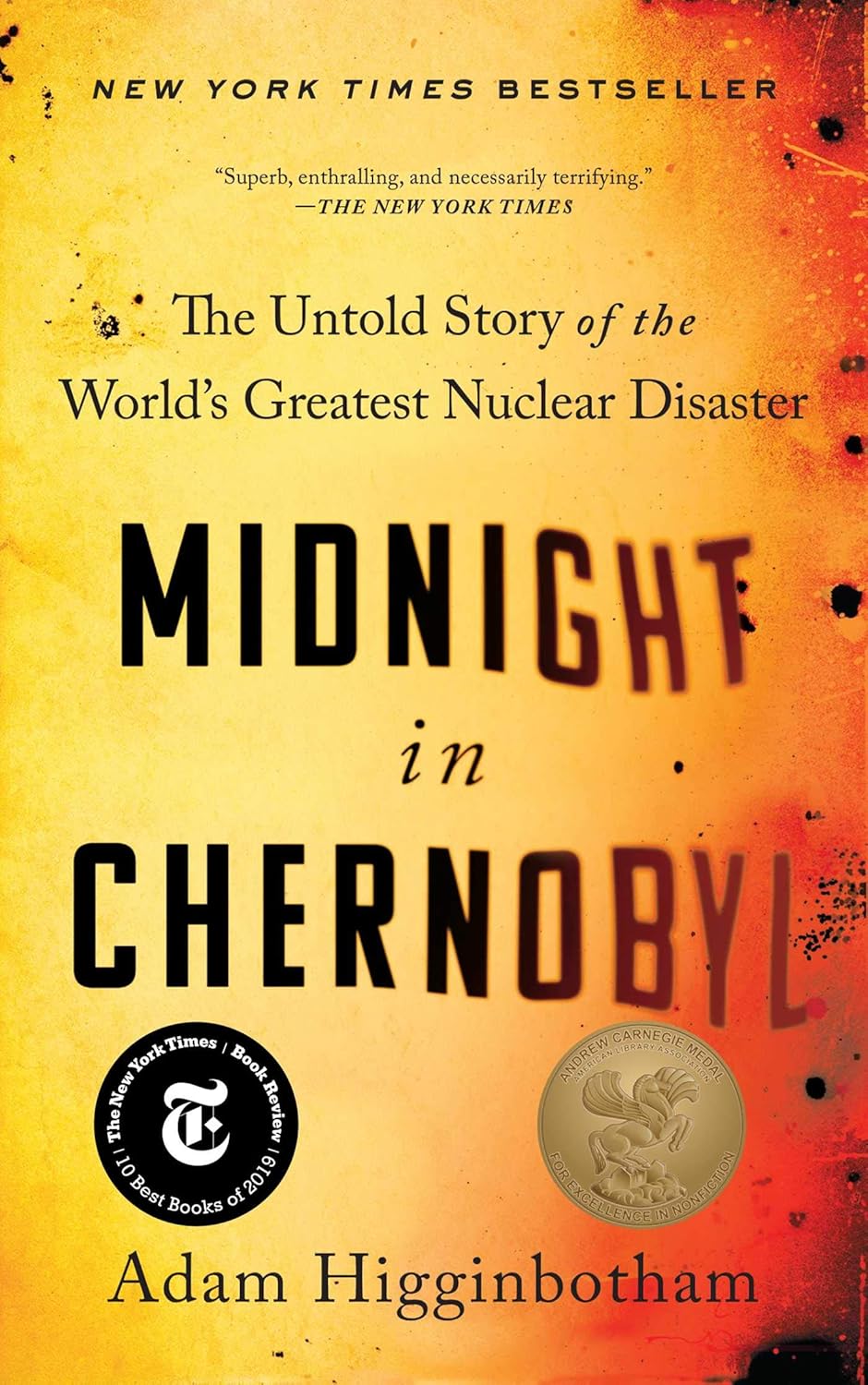
About Midnight in Chernobyl by Adam Higginbotham — The Human Story Behind a Nuclear Disaster
Midnight in Chernobyl by Adam Higginbotham tells the true story of one of the worst nuclear disasters in history. On April 26, 1986, Reactor Number Four at the Chernobyl Nuclear Power Plant exploded during a late-night safety test. The blast sent fire, smoke, and dangerous radioactive material into the air. But this book is not only about a broken reactor. It is about people: the workers in the control room, the firefighters who rushed into danger, the families living nearby, the scientists who tried to understand what happened, and the leaders who had to decide what to tell the public.
Adam Higginbotham explains a very complex event in clear, story-driven language. He shows how the disaster grew from a mix of technical flaws, human mistakes, pressure inside the Soviet system, poor communication, and secrecy. The result is a detailed history that reads with the speed of a serious thriller. You know the explosion is coming, yet the people, choices, and small moments make every chapter feel tense.
Why This Book Matters
Many people know the name Chernobyl, but they only know a few facts. They may know that a reactor exploded, that radiation spread, and that the nearby city of Pripyat was later emptied. What is often missing is the full chain of events. Midnight in Chernobyl fills that gap.
The book takes a huge historical event and makes it easier to understand by following real people. Instead of giving only technical facts, Higginbotham shows what those facts meant in real life. You see workers making decisions under pressure. You see emergency teams moving toward danger before they fully understand what they are facing. You see families waiting for clear answers. You also see how a powerful system can fail when fear, pride, rules, and secrecy become more important than open truth.
A Clear Answer to a Difficult Question
The main question many readers have is simple: how could a disaster this large happen?
There is no one-sentence answer. That is exactly why this book is valuable. Higginbotham does not reduce Chernobyl to one mistake or one person. He looks at the reactor design, the safety test, the people inside the plant, the rules they worked under, and the larger culture around the Soviet nuclear program. Piece by piece, the book shows how several risks came together.
This approach solves a common problem with Chernobyl books and documentaries. Some versions become too technical. Others become too simple. Midnight in Chernobyl stays detailed without becoming impossible to follow. It gives enough science to help readers understand the reactor and enough human detail to show why the decisions mattered.
What You Will Find Inside
The story begins before the disaster. Higginbotham builds the setting by explaining the growth of the Soviet nuclear industry and the world around the Chernobyl plant. This background helps the reader understand why the plant existed, how it was managed, and how people inside the system thought about safety and authority.
The book then moves toward the night of the accident. The pace becomes tighter as the test begins and problems grow. After the explosion, the focus expands. Firefighters arrive. Plant workers search for answers. Local officials struggle to understand the scale of the danger. Radiation moves through the area. People in Pripyat continue their normal routines for a time because they have not been told the full truth.
The later chapters follow the emergency response, the evacuation, the investigation, the cleanup, and the political effect of the disaster. The book also looks at the people who paid the highest price for decisions made before and after the explosion.
Easy to Read Without Making the Story Simple
Nuclear science can be hard. Reactor design, radiation, control rods, cooling systems, and emergency procedures are not simple topics. Higginbotham explains these ideas in a way that supports the story instead of stopping it.
You do not need to be a scientist or engineer to follow the book. The important technical ideas are placed inside the events where they matter. When a reactor feature becomes important, the book explains why. When a safety decision matters, the reader gets enough information to understand the risk.
This balance is one of the reasons the book works for a wide range of readers. A history reader can follow the science. A science reader can study the human system around the technology. A general reader can stay focused on the people and events without needing special knowledge.
The result is serious nonfiction that remains readable from beginning to end.
Real People Make the History Feel Close
A major strength of Midnight in Chernobyl is the attention given to individuals. The disaster involved thousands of people, but the book brings key figures into focus so the reader can follow what happened through human experience.
You meet plant staff who were present during the test. You see the firefighters who reached the burning reactor complex. You follow officials, engineers, doctors, scientists, and families. Their actions show how confusing the first hours were.
This human focus also makes the scale of the disaster easier to understand. Radiation is invisible, so danger was not always obvious. Some people walked, worked, or stood near highly contaminated areas without understanding the risk. Others were asked to act quickly with limited information.
More Than a Story About One Explosion
Chernobyl is often remembered as a technical disaster, but the book shows that technology was only part of the story. Systems, leadership, communication, and culture also mattered.
A machine can fail because of a bad part. A large organization can fail because people are afraid to report problems, because information moves slowly, or because leaders do not want to admit weakness. Midnight in Chernobyl shows how these kinds of failures can connect.
That makes the book useful beyond nuclear history. Business students can learn from its examples of poor communication and rigid authority. Engineers can think about safety systems and risk. Leaders can study how decisions change when people are punished for bad news. Students of history can see how the Soviet state worked during a major crisis.
The book is therefore not only about what happened in 1986. It also gives lessons about how complex systems can break when people ignore warning signs.
Features That Make This Book Worth Reading
-
A detailed true account of the Chernobyl nuclear disaster.
-
A clear timeline that helps readers follow the events before, during, and after the explosion.
-
Simple explanations of important reactor and radiation concepts.
-
Strong focus on workers, firefighters, scientists, officials, and families.
-
A wider look at Soviet institutions, secrecy, leadership, and public communication.
-
A narrative style that makes serious history feel active and easy to continue reading.
-
Useful context for readers who already know the basic Chernobyl story but want deeper understanding.
-
A standalone work, so you can read it without needing any earlier or later book.
What You Gain From Reading It
The biggest benefit is understanding. After reading the book, Chernobyl no longer feels like one mysterious explosion from the past. You can see the steps that led toward the disaster and the choices that shaped the response.
You also gain a better sense of how people behave during a crisis. Some act with courage. Some follow orders. Some make mistakes. Some hide information. Others push for the truth. These different reactions make the book useful for anyone interested in leadership and decision-making.
The book can also improve your understanding of nuclear power and radiation without forcing you through a textbook. It does not turn the subject into a simple good-versus-bad debate. Instead, it shows how design, training, policy, safety, and human judgment work together.
For students, the book can support study in modern history, disaster management, engineering ethics, politics, public policy, communication, and risk management. For general readers, it offers a strong true story with real stakes and lasting importance.
A Good Choice for Many Types of Readers
Midnight in Chernobyl is a strong choice if you enjoy true history that reads like a story. It works well for readers who like books about disasters, major world events, science, technology, the Cold War, the Soviet Union, or real investigations.
Students can use it to build a deeper understanding of a major twentieth-century event. Teachers may also find it useful as supporting reading for discussions about technology, government, ethics, and crisis response.
Professionals who work with systems, safety, operations, engineering, or leadership may see lessons that go beyond nuclear energy. The book shows what can happen when technical risk and organizational pressure meet.
A Reading Experience Built for Long Sessions
At Bookish Wonderland, this edition is prepared for readers who want a comfortable physical book for long reading sessions. The pages use premium eye-soothing cream paper, which gives the text a softer background than bright white paper. The print is crystal clear, helping letters stay sharp and easy to read.
The binding uses high-quality stitched and glue construction for better longevity. This helps the pages stay secure through repeated reading and careful long-term use. The physical build is suited to a serious nonfiction title that readers may return to for reference, study, or rereading.
These quality choices are especially useful for a detailed history book. Midnight in Chernobyl is not a title you need to rush. You may stop, think, return to an earlier section, or check a name again. A comfortable page and durable binding support that kind of reading.
A Strong Addition to a History Collection
Some books are read once and forgotten. This one has value as a reference because it covers a major event in modern history in depth. It can sit beside books about the Cold War, nuclear energy, the Soviet Union, engineering, disasters, or political history.
It is also a good choice for readers building a nonfiction collection. The book combines research, storytelling, science, and history, so it can connect with several interests at once.
Buying Midnight in Chernobyl from Bookish Wonderland
For readers comparing the Book price in Bangladesh for Midnight in Chernobyl by Adam Higginbotham, Bookish Wonderland offers a premium reading copy with quality paper, clear print, and durable binding.
Bookish Wonderland provides nationwide delivery across Bangladesh, with delivery available both inside and outside Dhaka. Cash on Delivery is available, making ordering simple for customers who prefer to pay when the book arrives. Readers in Dhaka can also ask about fast or urgent delivery when they need the book sooner.
The store focuses on a large collection of premium and durable English books, making it easier for readers to find important fiction and nonfiction titles in one place.
Read the Full Story Behind Chernobyl
Midnight in Chernobyl by Adam Higginbotham is for readers who do not want only the headline version of history. It shows the people, the machines, the decisions, the fear, and the system behind the disaster. It explains difficult ideas clearly and gives the event enough space to be understood in full.
If you want a serious nonfiction book that is informative, readable, and difficult to put down, this is a strong title to choose. It can change the way you understand Chernobyl, not by making the story louder, but by making it clearer.
Order Midnight in Chernobyl by Adam Higginbotham from Bookish Wonderland and add a deeply researched modern history title to your reading list. Choose a premium edition made for comfortable reading, long-term use, and careful study.
If you require any customization or have any questions, please inbox us via FB or Insta.
| Primary Specification | |
| Author | Adam Higginbotham |
| Narrator | Jacques Roy |
| Editor | Paul Dippolito |
| Genre | History, Nuclear History, Investigative Journalism |
| ISBN-13/ISSN | 978-1501134630 |
| ISBN-10 | 1501134639 |
| Publisher | Simon & Schuster |
| Publishing Date | February 4, 2020 |
| Language | English |
| Reading Age | 18+ years |
| Format | Printed book |
| Physical Specification & Quality | |
| Paper Quality | Premium eye-soothing cream paper |
| Binding Quality | High quality stitched and glue binding (for longevity) |
| Print Quality | Crystal-clear print |
| Pages | 560 pages |
| Country | USA |
| Logistics Information | |
| Weight | 583 gm |
| Length | 8.5 inches |
| Width | 5.6 inches |
| Height | 1.4 inch |