

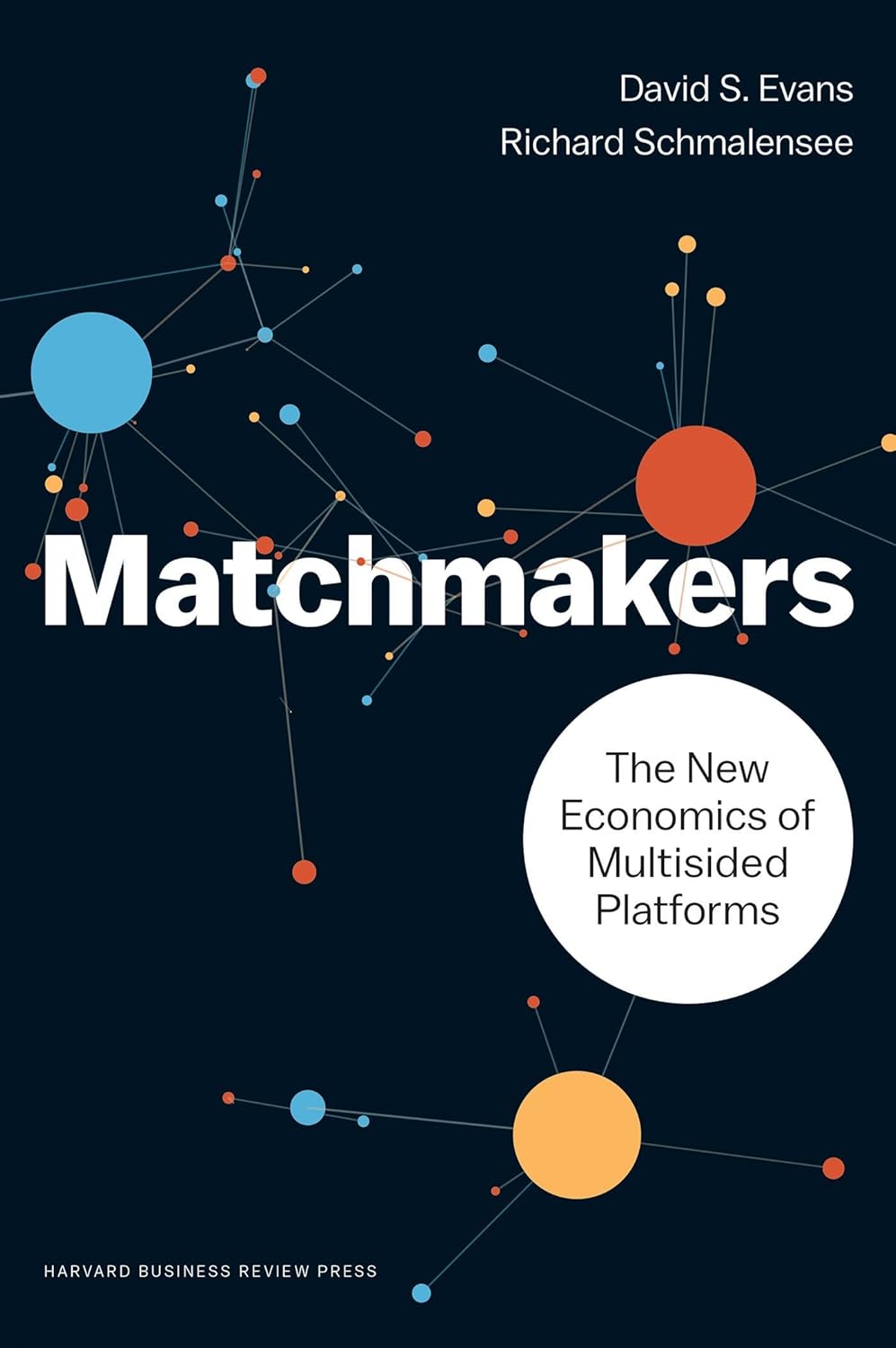
About Matchmakers: The New Economics of Multisided Platforms by David S. Evans & Richard Schmalensee — How Businesses Bring People Together
Why can a service that owns no hotel rooms help people find places to stay? Why does a payment card become more useful when more shops accept it? And why can a busy marketplace struggle even when it has plenty of buyers?
Matchmakers: The New Economics of Multisided Platforms explains the business idea behind questions like these. David S. Evans and Richard Schmalensee look at companies that bring different groups together and help them deal with one another. Their examples include Airbnb, Uber, Alibaba, Facebook, and Visa. The book shows why bringing people together can create value, but also why it is hard to build a business that does it well.
This is a useful read if you run a business, plan to start one, study business, or simply want to understand the services you use every day. It gives you a way to look past an app’s design or a company’s size and ask a better question: Who needs to meet whom, and what makes that meeting work?
Why is it hard to start a platform?
Think of a place where people can sell used books. Buyers will visit if they can find books they want. Sellers will join if buyers are there. But at the start, there may be few of either. Each group is waiting for the other.
That simple problem sits at the heart of many platform businesses. A ride service needs both drivers and riders. A booking service needs both places to stay and guests. A payment network needs both cardholders and shops. Getting one group to join is only part of the job. The business must give both groups a reason to stay and take part.
Matchmakers helps you think through that challenge. It explains why a platform needs to make useful connections, remove steps that slow people down, and decide how to serve each group. It also shows why copying a famous platform’s visible features may miss the reason that platform works.
You do not need to own a technology company to find this helpful. The same questions can matter when you plan a local marketplace, a service directory, a booking system, or a way for customers and providers to find each other. First, you need to understand what each group wants. Then you need to understand what stands in their way.
What does “multisided platform” mean?
The term sounds complex, but the basic idea is easy to picture. A multisided platform helps two or more groups connect. Those groups may want to buy and sell, pay and get paid, find work and offer work, or share information with the people who need it.
A shop usually buys products and sells them to customers. A platform can have a different role: it helps other people make an exchange. Its value often depends on how well it helps those people find each other and complete what they came to do.
That is why the word matchmakers fits. The match may be between a guest and a host, a shopper and a seller, or a cardholder and a shop. The platform has to understand both sides. If one side has a poor experience, the other side may lose interest too.
Evans and Schmalensee use this idea to make familiar businesses easier to understand. You may know what these companies do as a customer. The book asks you to look at what they must do behind the scenes to make each connection possible. That change in view is one of its strongest reasons to read it.
A closer look at the businesses you already know
It is easy to see a popular app and think its success came from putting people online. Yet a website or app only gives people a place to go. They still need a good reason to use it.
Imagine opening a booking app and finding no useful choices. Or offering a room and receiving no interest from guests. The app may work perfectly, but neither person gets what they need. The hard part is making the service useful for both of them at the same time.
That is the kind of problem this book brings into focus. It looks at how platforms create connections and why some grow while others fail to get enough activity. Its examples give the ideas a real setting, so you can think about people and businesses instead of trying to learn economic words on their own.
As you read, you may start to notice platform decisions in everyday life. Why does one service feel easy while another asks you to do too much work? Why are sellers willing to join one marketplace but ignore another? Why might a company help one group join before asking it to pay? These are practical questions, whether you are building a business or trying to understand one.
What will you learn from this book?
Matchmakers gives you a way to examine the work a platform does. Instead of treating every online marketplace as the same kind of business, you can look at the people involved and the steps needed to bring them together.
The book is especially useful for thinking about these points:
- The groups a platform serves: A platform must know who needs the service and what each group hopes to gain.
- The connection between those groups: Bringing in more people helps only when they are people the other group wants to meet.
- The steps that get in the way: Searching, comparing, trusting, paying, and arranging an exchange can all take effort.
- The reason people keep using it: A match has to be useful enough for people to come back or tell others.
- The challenge at the start: A new service has to become useful before it has a large crowd on either side.
These points can help you ask clearer questions about a business idea. If someone says, “Let’s build a marketplace,” you can ask who will join first, what they will find there, and why the next group will follow. If someone says, “Our app connects people,” you can ask what problem that connection solves.
The book does not turn every business into a platform. Its value is in helping you see when bringing groups together is the main job and what that job demands.
Why do the examples matter?
Business books can feel distant when they only give rules. Here, the examples make the subject easier to grasp. You can picture a rider looking for a trip, a guest looking for a room, or a customer trying to pay at a shop. Then you can ask what must happen for the other person or business to take part.
Those examples also show that platforms do not all look alike. A payment network is different from a place to book a stay. A marketplace is different from a social network. They may connect groups, but the groups want different things and face different problems.
That matters if you want to use the book’s ideas. A method that helps one platform may not fit another. Reading across several kinds of business can help you spot the question behind each decision instead of memorising one company’s path.
For a reader in Bangladesh, the ideas may feel close to home. Many people use online shopping, delivery, booking, and payment services. You can use the book to think about those experiences from both sides: what customers need and what sellers or service providers need. The examples in the book are global, but the questions are useful wherever people meet to exchange something of value.
Is this book easy to follow?
You will meet some ideas from economics, but you do not need to be an economist to understand the central question. The authors explain platform businesses through the people who use them and the choices those businesses make. That gives you a way into the subject even if “multisided platforms” is a new phrase for you.
Take your time with a chapter and pause at each example. Ask who the groups are. Ask what each one wants. Ask what would happen if one group stopped taking part. Those three questions can make a difficult sounding idea much clearer.
It may also help to think of a business you already know while you read. A local service, an online shop with many sellers, or an app on your phone can give you something familiar to compare with the book’s examples. You may find that the most useful reading happens when you test an idea against something you have seen yourself.
This is a good choice for readers who enjoy learning how businesses work. It is also a useful change from books that focus only on motivation or success stories. Here, the focus is on the choices and problems behind a business model.
Who should read Matchmakers?
If you are starting a business, this book can help you check an early idea. You may have thought about bringing customers and sellers together, but have you worked out why both groups would join? Have you made the exchange easier for them? Those questions are worth asking before you spend time building a service.
If you already manage a business, the book can help you look at growth from another angle. More users sound good, but the right mix of users may matter more. A group that joins and finds no one useful to deal with may leave. Understanding that relationship can help you think more carefully about what your service offers.
If you study business, marketing, or economics, the examples can give you real cases to think about. They show how an idea about two groups becomes a question about prices, access, trust, and activity. That can make classroom terms easier to remember.
Investors and people who follow technology companies may also enjoy it. The book gives them questions to ask about a platform’s strength beyond how many people have downloaded its app. And if you are simply curious about the services around you, it offers a new way to understand why some become part of daily life.
A useful book for a business idea you have not built yet
You do not have to be ready to launch a company to benefit from reading Matchmakers. You may only have a rough idea: a place for people to find tutors, a service that connects customers with skilled workers, or a marketplace for a certain kind of product.
The book gives you a way to test the idea in plain terms. Who has a problem? Who can help solve it? How will they find each other? What might make either group hesitate? What would make the first visit useful enough for them to return?
Writing down your answers as you read could help you see gaps in the idea. You may discover that one group is easy to reach while the other is not. You may find that people can already connect, but arranging payment or building trust is the real difficulty. You may also see that a smaller, clearer service could be more useful than trying to serve everyone at once.
The book cannot make those decisions for you. It can help you ask better questions before you make them. For an entrepreneur, that alone can make a reading session worthwhile.
A physical copy you can return to
Some business ideas make more sense after you have seen them in action. A physical copy lets you mark a point, pause, and return to it when you notice a similar problem in your own work.
Bookish Wonderland offers this printed book with premium eye-soothing cream paper, crystal-clear print, and high-quality stitched and glue binding. These details make it comfortable to read, take notes from, and keep for later reference. If you use books to develop ideas for work or study, having a copy close by can be useful when a new question comes up.
You might first read Matchmakers to understand the main idea. Months later, you could return to it while planning a service, reviewing a company, or preparing a business assignment. The subject rewards that kind of second look because the examples around you may change, while the basic question stays useful: how does this business help different people work together?
What can you take away after the last page?
A good business book gives you more than names of successful companies. It changes the questions you ask when you see a new business.
After reading Matchmakers, you may find yourself looking at a service and asking who must show up for it to work. You may notice the effort it saves people. You may wonder which group needs help joining first. You may also become more careful about assuming that a popular app has an easy business behind it.
Those are useful habits for a founder, a manager, a student, or a curious reader. They can help you talk about a business with more detail than “it connects people.” You can explain which people it connects, why they need each other, and what makes the connection valuable.
That is the appeal of this book. It takes a business model many of us use every day and makes its hard parts visible. The result is a clearer way to think about marketplaces, payment services, and other businesses built around bringing groups together.
Ready to understand the business behind the connection?
Choose Matchmakers: The New Economics of Multisided Platforms if you want a clearer view of how platform businesses work. Read it for your next business idea, for your studies, or because you want to understand the companies that connect people every day.
To check the Book price in Bangladesh for Matchmakers by David S. Evans and Richard Schmalensee, see its current listing at Bookish Wonderland. You can order with Cash on Delivery and get delivery inside or outside Dhaka, with nationwide delivery available across Bangladesh. If you need it soon, ask about the fast delivery option in Dhaka.
If you require any customization or have any questions, please inbox us via FB or Insta.
| Primary Specification | |
| Author | David S. Evans and Richard Schmalensee |
| Narrator | John McLain |
| Genre | Business and economics; platform strategy |
| ISBN-13/ISSN | 978-1633691728 |
| ISBN-10 | 9781633691728 |
| Publisher | May 24, 2016 |
| Publishing Date | Harvard Business Review Press |
| Language | English |
| Reading Age | 18+ years |
| Format | Printed book |
| Physical Specification & Quality | |
| Paper Quality | Premium eye-soothing cream paper |
| Binding Quality | High quality stitched and glue binding (for longevity) |
| Print Quality | Crystal-clear print |
| Pages | 272 pages |
| Country | USA |
| Logistics Information | |
| Weight | 291 gm |
| Length | 8.5 inches |
| Width | 5.6 inches |
| Height | 1 inch |