

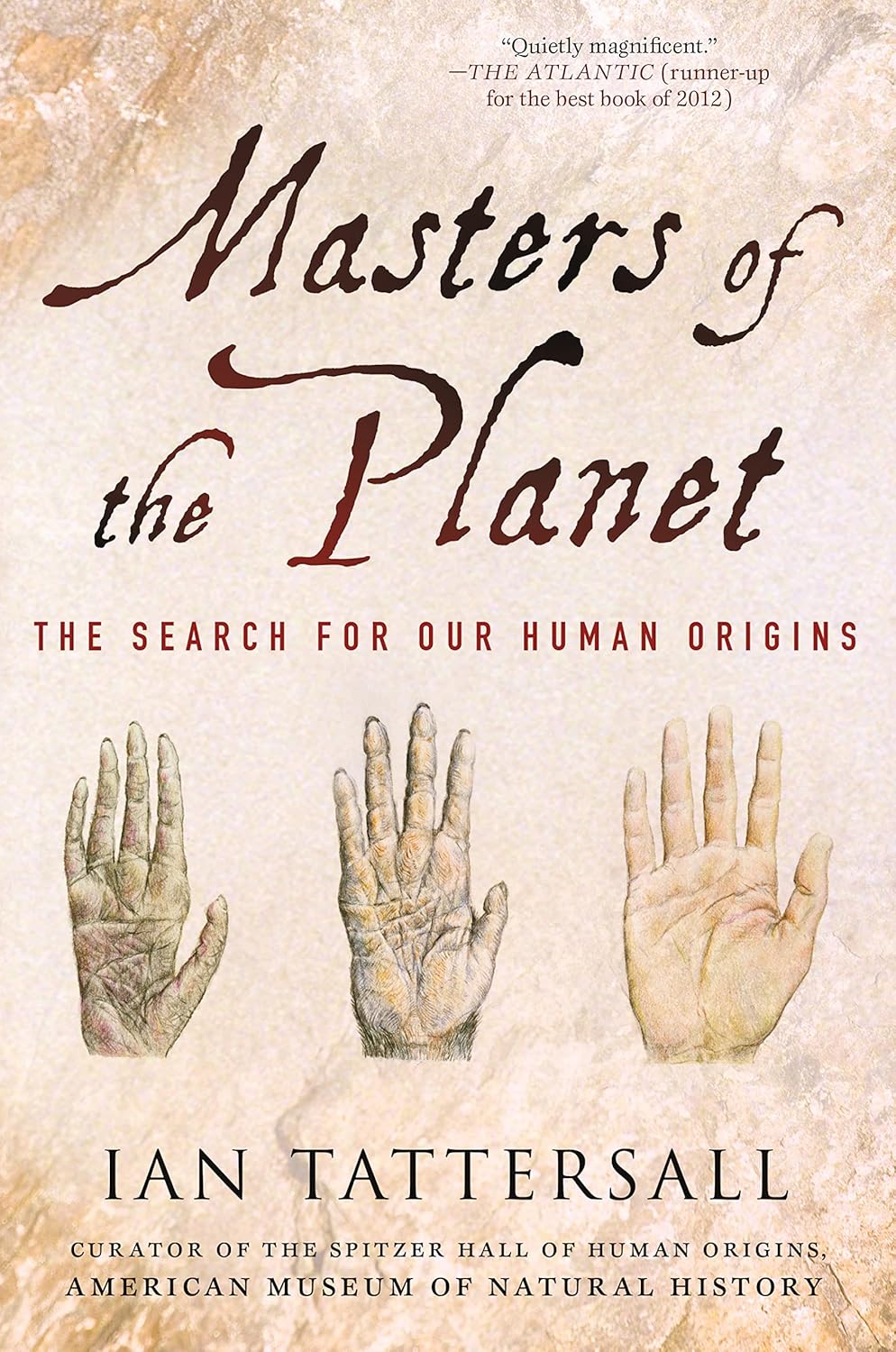
About Masters of the Planet: The Search for Our Human Origins by Ian Tattersall — Explore How Humans Became Different
What makes us human? We speak, share ideas, plan ahead, and ask questions about our past. Yet our place in the world has a history that reaches far beyond towns, farms, and written records. Masters of the Planet invites you to explore that deeper past and think about how our species came to live as it does today.
Ian Tattersall examines human origins through fossils, changes in the body, and the rise of language and thought. His central question is simple: how did Homo sapiens become so different from other human species that once existed? He presents an account of that change while asking readers to look closely at the evidence.
For readers who enjoy science and big questions, this book offers a subject worth taking time over. Choose it from Bookish Wonderland when you want your next read to give you more to think about than a list of dates or names.
Start with the question that interests you most
Perhaps you want to know why humans walk on two legs. Perhaps you wonder how speech began, or why no other human species survives today. Questions like these can lead in many directions. It can be hard to see how one part of the past connects with another.
A book focused on human origins gives you space to follow those links. You can pause, turn back, compare ideas, and build your understanding at your own pace. Instead of trying to remember every new term at once, begin with one question and let it guide your reading.
This approach makes the subject feel more manageable. You do not need to finish with every answer. Finding a better question, or understanding why an answer is difficult, can be just as useful. That is part of the pleasure of reading science with care and an open mind.
Follow a past with many branches
The book moves through early human origins, upright walking, different ancient human groups, and life in changing settings. Its contents also cover movement out of Africa, early Europeans, Neanderthals, and the rise of symbolic behaviour. These topics help show the range of questions involved in studying our past.
You can think of this reading journey as a chance to look beyond a single picture of an ancient person. Different bodies, different places, and different ways of living all deserve attention. Keep a small note of the groups you meet if their names feel hard to remember.
There is no need to turn your reading into a memory test. The aim is to notice patterns and differences. Ask what has changed, what seems familiar, and what remains unclear. Even a short reading session can leave you with one useful idea to carry into the next chapter.
Look closely at what makes thought special
Tattersall gives particular attention to symbolic thought and language. In simple terms, symbolic thought means using something to stand for something else. A word, for example, can refer to a thing that is not in front of us. Such abilities are central to his account of what makes our species distinctive.
He argues that our unusual mental abilities did not emerge through a smooth, steady path of improvement alone. The book presents a more sudden arrival of the combination that changed human life. This is the author's argument, and it is worth reading as an explanation to examine rather than a final answer to every question.
As you read, consider ordinary moments in your own day. You describe a plan, recall an event, or explain a rule. Thinking about these familiar acts can make an abstract topic easier to approach and give your reading a clear point of connection.
Enjoy the questions as well as the answers
A science book can be most rewarding when you read with a pencil nearby. You might mark a passage that seems clear, write a question beside one that feels difficult, or note an idea you want to discuss later. These small habits can help you stay involved.
Try separating three things in your notes: the evidence described, the meaning the author gives it, and your own questions. This keeps your response thoughtful without making the process hard. You are allowed to pause over a claim instead of accepting it simply because it appears in print.
That way of reading is useful beyond this book. It can help when you meet claims in a video, a news report, or a classroom discussion. You gain practice in asking what supports an idea and what would make you change your mind. The value lies in active reading, not in rushing to agree.
See whether this is your kind of book
Choose this title if you enjoy nonfiction about human origins and want a sustained discussion of the subject. It may appeal to readers drawn to anthropology, ancient life, and the relationship between our bodies and minds. You can come to it through curiosity rather than a formal course.
The plain wording on this product page should not be taken to mean that the book itself is written for young children. Scientific names and detailed arguments may require slow reading. If you prefer a very light introduction, consider whether you are ready to spend time with unfamiliar terms.
For a patient reader, that effort can become part of the enjoyment. Keep your first goal small: understand the main question in a section before trying to recall every detail. A book does not have to feel easy on every page to offer a satisfying and worthwhile reading experience.
Make room for a different kind of evening
Set aside a little quiet time and read a section without moving between other tasks. Keep a bookmark where you stop and write a short reminder of the idea you were following. When you return, that note can help you settle into the subject again.
You might enjoy this book after watching a documentary about early humans. Use your reading to form questions of your own, then notice where the two accounts place their focus. You do not need to treat either source as a complete picture of the subject.
It can also suit a weekend spent learning something outside your usual work or study. There is no required pace. A few pages read with care can be more rewarding than many pages skimmed without thought. Let your interest, rather than a fixed daily target, shape the time you give it.
Turn your reading into a useful discussion
For a reading group, start with a question everyone can approach: what do we mean when we say that humans are different? Let each person choose a passage that shaped their view. This gives the discussion a clear starting point and keeps attention on the text.
Students can use a similar approach for personal notes. Write the author's main point in your own words, then add one question you still have. If you plan to use any claim in assessed work, check your course requirements and consult suitable academic sources as well.
For a personal learning journal, record what surprised you and why. Return to that note after a few chapters. Has your view changed? Do you now understand the first question differently? These simple uses can make the book part of a longer learning habit, rather than something you read once and quickly forget.
A premium printed copy for regular reading
Bookish Wonderland offers this title for readers who value the feel of a printed book. Our premium edition uses eye soothing cream paper, crystal clear print, and high quality stitched and glue binding for longevity. These are the store's production features for the offered copy.
The cream pages provide a soft background for the text. Clear printing helps keep letters easy to follow, while the combined binding supports repeated handling. Together, these features are intended to make everyday reading pleasant and help the copy hold up with normal care.
Use a bookmark, turn pages gently, and keep the book away from water and damp places. Avoid forcing the spine flat when reading. Good materials matter, but simple care also helps preserve a printed copy. If you need details about the available cover or any other edition feature, ask before placing your order.
Choose a thoughtful gift for a curious reader
This could be a fitting gift for someone who often asks how people came to be the way they are. Think about the person's interests and reading habits first. A reader who enjoys science discussions may welcome the chance to explore one subject at greater length.
You can make the gift feel personal with a short note explaining why you chose it. Mention a question you have discussed together or an interest you share. That gives the book a connection to the recipient without needing an elaborate message.
For your own collection, choose it because you want to spend time with its subject. There is no need to buy a science book simply because its title sounds important. The best reason is that its central questions matter to you and make you want to open the first page.
Read it as a complete work
Masters of the Planet is a self-contained nonfiction book. You can approach it without buying an earlier volume or following a numbered story. Publisher listings associate it with MacSci, also called Macmillan Science, which is a publishing collection rather than a numbered Ian Tattersall narrative series.
For that reason, there is no invented Book 1 or Book 2 sequence here. The supplied product information does not include a list of other titles to reproduce. Your purchase can focus on this book and the questions it explores, without a separate reading order to plan.
Check the price and plan your order
Book price in Bangladesh can vary by the offered edition and available stock. Check the current listing for Masters of the Planet by Ian Tattersall at Bookish Wonderland, or contact the store for the price before ordering. No fixed price has been supplied in this description.
Nationwide delivery is available, including addresses inside and outside Dhaka. Cash on Delivery is offered, and readers in Dhaka can ask about the fast or urgent delivery option. Share your location and any required date so the available arrangement can be confirmed for your order.
If you are choosing the book as a gift, checking these details early can help you plan. You may also message Bookish Wonderland through Facebook or Instagram with questions about the copy. Clear information about your needs makes it easier to confirm the right order details before dispatch.
Get your copy and begin exploring
Some books start with a question that stays with you long after a reading session ends. How did humans become capable of imagining, explaining, and changing so much? This title gives you a focused reason to sit with that question and explore an account of our deeper past.
Choose Masters of the Planet: The Search for Our Human Origins by Ian Tattersall from Bookish Wonderland if that is the kind of reading you want next. Open it with curiosity, take your time with unfamiliar ideas, and keep track of the questions that matter most to you.
Order your copy today and make space for a thoughtful read about human origins. Whether you read alone, share ideas with a friend, or use it to begin wider study, start with the simple wish to understand more about the human story.
Begin with one chapter, note one new idea, and give yourself time to see where the next question takes your reading.
If you require any customization or have any questions, please inbox us via FB or Insta.
| Primary Specification | |
| Author | Ian Tattersall |
| Narrator | Bob Souer |
| Editor | Letra Libre, Inc. |
| Genre | Popular Science, Human Evolution, Physical Anthropology |
| ISBN-13/ISSN | 978-1137278302 |
| ISBN-10 | 9781137278302 |
| Publisher | St. Martin's Griffin |
| Publishing Date | May 28, 2013 |
| Language | English |
| Reading Age | 16+ years |
| Format | Printed book |
| Physical Specification & Quality | |
| Paper Quality | Premium eye-soothing cream paper |
| Binding Quality | High quality stitched and glue binding (for longevity) |
| Print Quality | Crystal-clear print |
| Pages | 288 pages |
| Country | USA |
| Logistics Information | |
| Weight | 304 gm |
| Length | 8.5 inches |
| Width | 5.6 inches |
| Height | 0.68 inch |