

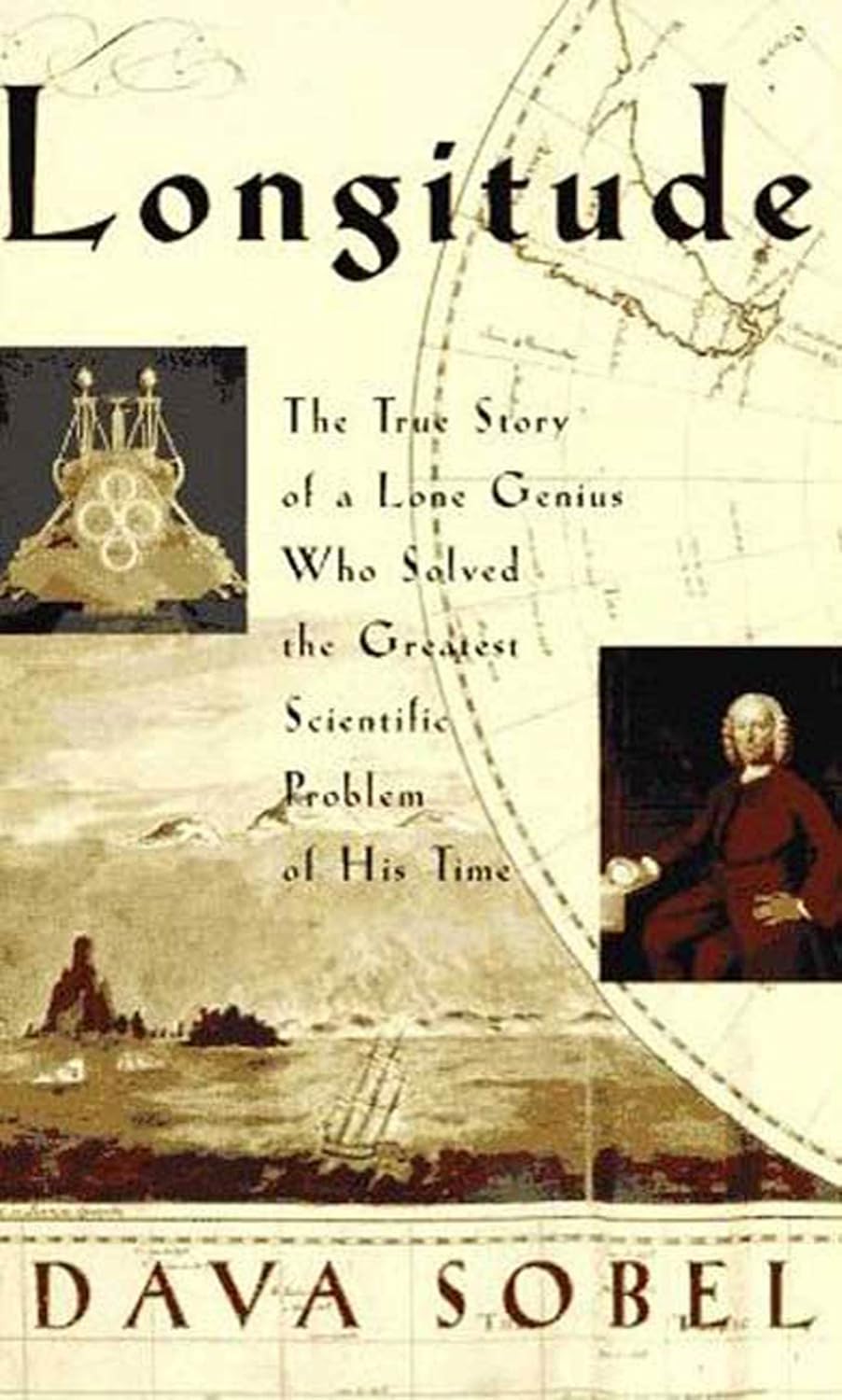
About Longitude by Dava Sobel: The Clockmaker Who Helped Sailors Find Their Way
A ship can know how far north or south it is and still be lost at sea. For centuries, sailors faced that problem every time they crossed a wide ocean. They could find their latitude by looking at the sun or stars. Finding their longitude—how far east or west they had travelled—was much harder. A wrong guess could put a ship near dangerous rocks when its crew thought land was still far away.
Longitude by Dava Sobel tells the true story of the people who tried to solve that problem. At its centre is John Harrison, an English clockmaker who believed a very accurate clock could help. His idea sounded simple. Making it work on a moving ship took decades.
This is a history book with a clear question driving it forward: How could sailors know where they were before modern navigation? Sobel follows that question through sea voyages, scientific debate, careful craft, and Harrison’s long fight to have his work recognised.
Why did longitude matter so much?
Imagine travelling across the sea with no road signs. You can see the sky and feel the ship move, but the water around you looks much the same for days. You need to know where you are so you can choose a safe course. For sailors in the past, an error in longitude could mean a longer voyage, missed land, or a shipwreck.
The problem affected more than one captain or one country. As ocean travel grew, ships carried people, supplies, and goods over longer distances. A dependable way to find longitude would make those journeys easier to plan and safer to complete. Governments and scientists had strong reasons to search for an answer.
That is what gives this small question such a large place in history. Longitude is a line on a map, but the need to measure it shaped real lives at sea. Sobel makes that need easy to understand before showing how people tried to meet it. You do not have to start the book knowing how navigation works. The danger and the goal are clear from the beginning.
A solution hidden inside a clock
Harrison approached the problem as a clockmaker. If a sailor knew the time at a fixed place and compared it with the local time at sea, that difference could help show how far east or west the ship had gone. The hard part was keeping a clock accurate throughout a voyage. Ships rocked. Conditions changed. A small loss or gain of time could lead to a large mistake in position.
Harrison set out to build a timekeeper that could face those conditions. His work required patience, new ideas, and repeated tests. He did not solve the problem with one quick flash of insight. He spent years improving his designs and checking whether they could do what sailors needed.
That long effort gives Longitude its human story. You see a skilled maker trying to turn an idea into a useful tool. You also see why proving that a tool works can be nearly as difficult as building it. Harrison had to deal with people who favoured other ways of finding longitude and with the bodies responsible for judging proposed solutions. Sobel follows both the invention and the struggle around it.
What is Longitude by Dava Sobel about?
Longitude is narrative nonfiction: it tells a true story in the flowing style of a storybook. Sobel explains the search for a way to measure longitude at sea, then focuses on Harrison’s work on accurate marine timekeepers. Along the way, she shows how science, craft, money, and public decisions all played a part.
The book is about more than the answer to a maths problem. It asks what happens when someone with a practical idea has to persuade others to take it seriously. It shows the care needed to make an object that people can trust with their lives. And it reminds readers that tools we now take for granted came from years of work by real people.
Sobel had worked as a science reporter, and her writing is aimed at readers who want to understand the story without first studying the subject. She explains why time matters to navigation while keeping the people and their choices in view. If a page full of technical terms usually puts you off a science book, this one gives you a human reason to keep reading.
A true story that is easy to follow
You do not need to know how to build a clock to enjoy this book. The main idea is straightforward: sailors needed a reliable way to know where they were, and Harrison believed accurate time could provide it. Once you understand that, each test and setback has a purpose. You know what he is trying to achieve and why it matters.
The book can appeal to someone who likes history but rarely reads about science. It can also work for someone interested in science who wants to learn about the people behind an invention. Ships, maps, clocks, and competing ideas come together around one problem, so the subject never feels like a loose collection of facts.
Readers who enjoy stories of patient work may find Harrison especially interesting. He kept returning to a difficult task, adjusting his timekeepers and trying again. His skill was practical: he had to make something that could work beyond a drawing or a theory. That makes the question at the heart of the book feel concrete. Could a clock keep good enough time at sea to help a ship find its position?
What makes this book worth reading?
- One clear question: The search for longitude gives the history a strong thread to follow.
- A real person at the centre: Harrison’s work shows what invention can demand over many years.
- Science with a purpose: The book explains an idea that mattered to people travelling at sea.
- A look at how ideas are judged: Building a solution and gaining acceptance were different challenges.
- An approachable style: You can follow the story without a background in clocks or navigation.
These features make Longitude a useful choice when you want to learn something new but still want the pull of a story. You can read to find out how the problem was solved, or you can read for the people, arguments, and decisions that shaped the search. Either way, the book gives you a reason to think differently the next time you see a map or check the time.
For readers who ask how everyday things came to be
Many objects we use are so familiar that we stop asking who made them possible. A clock tells time. A map shows a place. On a modern journey, finding your position can feel simple. Longitude takes you back to a time when knowing the hour accurately on a ship could change what people were able to do.
That makes it a good book for a curious reader. If you have ever wondered how sailors crossed oceans before today’s tools, this story offers a starting point. If you like biographies, Harrison’s work gives you a person to follow. If you enjoy the history of inventions, the book shows why an invention must survive testing and doubt before it can be widely trusted.
It is also a thoughtful gift for someone who likes ships, exploration, maps, or clocks. The topic is specific, yet the question is easy to grasp. You can open the book without needing to finish a series first or learn a set of characters from an earlier volume. One problem leads you into the story, and the search for its answer carries you through.
When might you reach for Longitude?
Read it when you want a break from fiction but still want events to unfold with purpose. A chapter can teach you something about navigation while leaving you interested in what Harrison will try next. It suits a quiet evening, a weekend reading session, or a place on your list of books about real discoveries.
It can also start a conversation. Why might people trust an old method more than a new one? What does it take to test an invention fairly? How many years would you spend trying to solve one problem? Sobel’s account gives those questions real people and real stakes.
For students and general readers, the book offers another benefit: it connects subjects that are often kept apart. Geography explains the need to find a position. Timekeeping offers a possible answer. History shows the world in which the work happened. The story helps you see how those subjects meet in a practical problem.
You can enjoy Longitude for any one of those reasons. You do not have to read it as a lesson. You can simply follow a clockmaker who believed he had an answer and wanted to prove it.
A premium copy for comfortable reading
Bookish Wonderland offers a premium printed copy of Longitude by Dava Sobel for readers in Bangladesh. Its eye-soothing cream paper is made for comfortable reading. Crystal-clear print helps keep the text easy to see, while high-quality stitched and glue binding is intended to support the book through repeated use.
Those details matter for a book you may want to return to. You might reread a passage to understand how time helps locate a ship. You might come back to Harrison’s story after reading more about exploration. A comfortable page and a durable binding make it easier to spend that time with the book.
Bookish Wonderland has a large collection of premium, durable English books. If Longitude is your next nonfiction read, you can order it for delivery inside or outside Dhaka. Nationwide delivery is available across Bangladesh, with Cash on Delivery available. If you are in Dhaka and need the book soon, ask about the fast or urgent delivery option when placing your order.
A closer look at the reading experience
The pleasure of this book comes from seeing a familiar fact become a question again. Today, you can look at a map and expect a location to be there. Sobel asks you to picture the uncertainty that came before reliable answers. A ship might have travelled for weeks. Its crew could work hard, watch the sky, and still be unsure of its east-west position.
From there, a clock becomes much more than an object that sits on a table. It becomes a possible way to help people travel. But the word “possible” matters. A good idea had to work on a real voyage, where a ship moved and conditions changed. It had to keep doing its job when people depended on it.
That gap between an idea and a dependable tool is one of the most interesting parts of Harrison’s story. Readers can see why careful making matters. They can also see why a single successful test may not end a debate. Other people had their own ideas about the best solution, and Harrison had to keep making his case.
Sobel brings that history down to a size a reader can hold. The book deals with a world-changing problem, but you follow it through understandable aims: find a position, keep accurate time, test the clock, and decide whether it works. Each step helps explain the next. That is why Longitude can interest someone who usually avoids science writing. The facts serve a story you can follow.
Why choose this book now?
Choose Longitude by Dava Sobel if you want a true story that leaves you knowing how people worked through a hard problem. It offers the satisfaction of understanding an idea, along with the interest of watching someone try to make that idea real.
The book suits readers who ask simple but powerful questions. How did sailors know where to go? Why was an accurate clock so hard to make? Why did it take so long for a useful answer to be accepted? These are the kinds of questions that make history feel close to everyday life. They turn a line on a map into a story about people who needed to find their way.
It is a strong pick for a reader moving from novels into nonfiction. The subject is focused, the central problem is clear, and Harrison gives the story a person to care about. It also suits a reader who already enjoys popular science and wants to learn about a problem that joined timekeeping with travel at sea.
You may finish the book with a new respect for the ordinary act of knowing where you are. That is a useful thing for a history book to give you: a fresh way to see something familiar.
Order Longitude from Bookish Wonderland
If you are comparing Book price in Bangladesh options for Longitude by Dava Sobel, consider the reading experience as well as the price. Bookish Wonderland’s premium copy pairs cream paper and clear print with binding designed for longevity.
Order your copy today and follow the true story of John Harrison’s search for an accurate sea clock. Bookish Wonderland delivers across Bangladesh, offers Cash on Delivery, and has a fast or urgent delivery option in Dhaka.
If you require any customization or have any questions, please inbox us via FB or Insta.
| Primary Specification | |
| Author | Dava Sobel |
| Narrator | Kate Reading, Neil Armstrong |
| Genre | Popular science; history of science |
| ISBN-13/ISSN | 978-0802715296 |
| ISBN-10 | 0007790163 |
| Publisher | Bloomsbury USA |
| Publishing Date | November 5, 2007 |
| Edition | First |
| Language | English |
| Reading Age | 16+ years |
| Format | Printed book |
| Physical Specification & Quality | |
| Paper Quality | Premium eye-soothing cream paper |
| Binding Quality | High quality stitched and glue binding (for longevity) |
| Print Quality | Crystal-clear print |
| Pages | 208 pages |
| Country | USA |
| Logistics Information | |
| Weight | 229 gm |
| Length | 8.5 inches |
| Width | 5.6 inches |
| Height | 0.65 inch |