

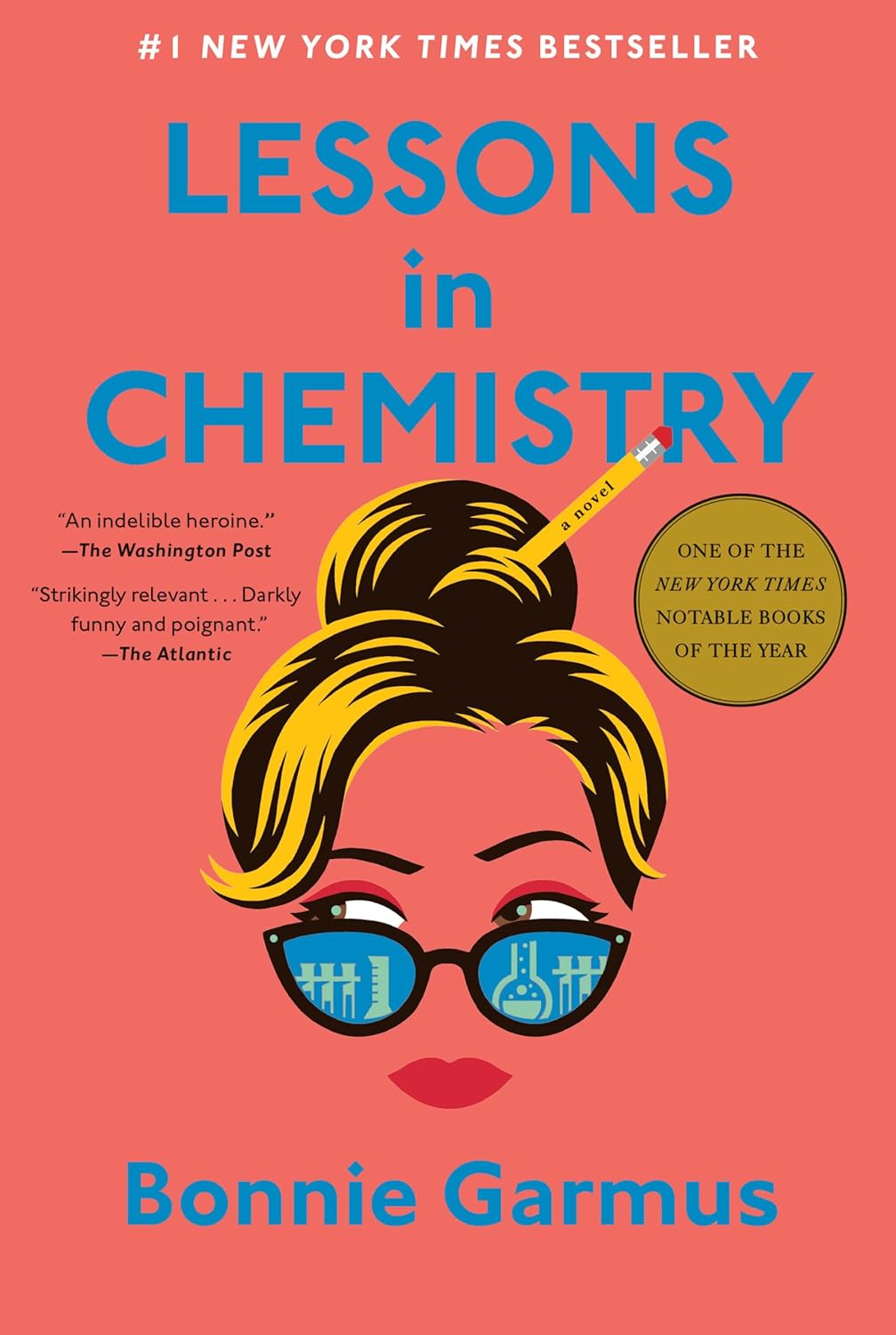
About Lessons in Chemistry by Bonnie Garmus – A Historical Novel About Science, Equality, Motherhood, Work, and Finding a Voice
Lessons in Chemistry by Bonnie Garmus follows Elizabeth Zott, a talented chemist working in California during the early 1960s. She wants to be taken seriously as a scientist, but the men around her often see her gender before they see her ability.
At Hastings Research Institute, Elizabeth meets Calvin Evans, a respected and gifted chemist who values her mind and treats her as an equal. Their relationship becomes important to both of them, but Elizabeth’s life does not move in a simple direction.
A few years later, she is a single mother and no longer working in the laboratory she wanted. An unexpected opportunity puts her on television as the host of a cooking show called Supper at Six. Elizabeth refuses to treat cooking as something small. She explains it through chemistry, asks women to think for themselves, and slowly gains a large audience.
The novel combines science, work, family, sexism, grief, friendship, motherhood, and social change.
Elizabeth Zott Wants to Be a Scientist
Elizabeth is serious about chemistry.
She does not see science as a hobby or as something she should give up when other people become uncomfortable with her ambition.
The problem is that the workplace around her is shaped by rules that favor men.
Her ideas can be ignored, her work can be undervalued, and her confidence can be treated as a problem.
The novel shows how exhausting it is to keep proving basic competence in a place where people have already decided what women should and should not do.
Elizabeth responds with directness.
She does not change her language to make other people comfortable. She believes evidence matters more than status, and she applies that idea to both science and life.
Calvin Evans Sees Her Differently
Calvin Evans is a brilliant chemist with a strong professional reputation.
Unlike many of the men at Hastings, he does not treat Elizabeth as less capable because she is a woman.
He notices her intelligence and respects the seriousness of her work.
Their connection begins through science and grows into love.
The relationship matters because Elizabeth does not have to make herself smaller around Calvin.
He is interested in the way she thinks.
At the same time, Calvin has his own difficult history, habits, and emotional limits.
The novel does not make their relationship perfect. It shows two unusual people who understand parts of each other that others often miss.
The Workplace Shows How Sexism Limits Talent
A large part of the novel focuses on the way women were treated in scientific and professional spaces.
Elizabeth faces discrimination, harassment, dismissal, and assumptions about what women are supposed to want.
Her scientific ability does not protect her from those problems.
In some situations, it makes people more uncomfortable because she refuses to act less intelligent than she is.
The book uses these experiences to show how talent can be wasted when institutions care more about gender roles than ability.
Elizabeth’s struggle is personal, but the larger issue affects many women around her.
That is why the story moves beyond one career problem and becomes a wider look at who gets taken seriously.
Motherhood Changes Her Life but Not Her Mind
Elizabeth later becomes a single mother to her daughter, Madeline, often called Mad.
Motherhood adds another set of expectations.
People assume they know how a mother should behave, what she should value, and what kind of work she should choose.
Elizabeth does not fit those ideas neatly.
She loves her daughter, but she does not stop being a scientist.
She approaches parenting with the same direct thinking she brings to other parts of life.
Mad is also unusually observant and intelligent.
Their relationship gives the novel warmth while showing how children notice more than adults often expect.
The story makes room for both love and frustration inside family life.
Six-Thirty Adds Another Point of View
Elizabeth’s dog, Six-Thirty, is one of the novel’s most unusual characters.
The book sometimes gives readers access to his thoughts.
He observes the family, understands words, and reacts to people in ways that add humor and emotion.
This part of the novel is intentionally playful and not realistic in the same way as the historical setting.
For some readers, Six-Thirty becomes one of the most memorable parts of the story.
He also gives another view of Elizabeth and Mad.
Through him, the family can be seen from outside human rules about status, gender, and social behavior.
Supper at Six Changes Elizabeth’s Public Life
Elizabeth does not plan to become a television star.
She ends up hosting Supper at Six, a daytime cooking program aimed mainly at housewives.
The producers expect a familiar cooking show.
Elizabeth gives them something different.
She explains recipes through chemistry, uses scientific terms, and treats the women watching as intelligent adults.
She does not talk down to them.
She also encourages them to think about what they want from their own lives.
The show becomes popular because viewers respond to that respect.
Cooking becomes the format, but Elizabeth’s real message is broader.
She keeps telling women that they are capable of learning, thinking, working, and changing their circumstances.
Cooking and Chemistry Fit Together Naturally
One of the book’s main ideas is that cooking is chemistry.
Heat changes food. Acids react with ingredients. Proteins change structure. Measurements affect results.
Elizabeth sees no reason to pretend these processes are separate from science.
This idea lets the novel connect the laboratory with the kitchen.
A space society often labels as “women’s work” becomes a place where scientific thinking is visible every day.
The connection is simple enough to understand but useful to the story.
Elizabeth does not become less of a chemist when she cooks on television.
She uses chemistry in a setting where a much larger group of people can hear her.
Friendship Matters Beside Romance
Elizabeth’s life is shaped by more than Calvin.
Her relationships with neighbors, coworkers, television staff, and other women become important as the story develops.
One key relationship is with Harriet Sloane, a neighbor who becomes part of Elizabeth’s support system.
The novel shows that friendship can become essential when family structures change or when a person is raising a child under difficult circumstances.
These relationships also help widen the story beyond Elizabeth’s private life.
Different characters show different ways women deal with marriage, work, motherhood, social pressure, and limited choices.
The Book Is Set in a Changing America
The main story takes place in 1960s California.
Women are being pushed toward traditional domestic roles while social expectations are beginning to change.
Television has become a strong part of American culture, and cooking shows can reach large audiences inside their homes.
The novel uses this setting to show how one public voice can influence private thinking.
Elizabeth does not lead a political organization.
She speaks through a cooking program.
That makes the message more unexpected and helps explain why both viewers and executives react strongly to her.
Publication and Edition Details
Doubleday published Lessons in Chemistry on April 5, 2022.
Penguin Random House lists the original hardcover at 400 pages with ISBN 9780385547345.
The ebook was released on the same date and is also listed at 400 pages.
The audiobook runs 11 hours and 56 minutes.
A US paperback edition was published on April 1, 2025 and is also listed at 400 pages.
Different international, large-print, and digital editions may use different page counts, ISBNs, and covers.
Customers who need a specific edition should check the product details before ordering.
The Book Became a Major Bestseller
Lessons in Chemistry became a number-one global bestseller.
Penguin Random House states that more than eight million copies have been sold.
Bonnie Garmus’s official website says the novel spent nearly two years on the New York Times bestseller list and was translated into more than forty languages.
It was also a Good Morning America Book Club pick, a Goodreads Choice Best Book of the Year, and a Barnes & Noble Book of the Year.
These recognitions helped the novel reach readers far beyond its original historical-fiction audience.
Lessons in Chemistry Was Adapted for Apple TV
The novel was adapted into an eight-episode Apple TV limited series.
The series premiered on October 13, 2023.
Brie Larson plays Elizabeth Zott, while Lewis Pullman plays Calvin Evans.
The television version keeps the central idea of a scientist whose career is blocked by sexism and who later becomes the host of a cooking show.
Like most adaptations, the series changes and expands some characters and events.
Readers who watched the show may still find the novel worthwhile because the book gives more direct access to Elizabeth’s thoughts, Six-Thirty’s point of view, and the original structure of the story.
About Bonnie Garmus
Bonnie Garmus is an American novelist who has also worked as a copywriter and creative director.
Her professional background has included work connected with technology, medicine, and education.
Lessons in Chemistry was her debut novel.
Her official site notes its long bestseller run, international awards, translations, and screen adaptation.
Garmus later wrote Peck & Peck as her second novel.
She is originally from Seattle and has lived in London.
Who Will Enjoy Lessons in Chemistry?
Lessons in Chemistry is a strong choice for readers who enjoy historical fiction, women in science, workplace stories, feminist themes, family relationships, single motherhood, humor, romance, and books about people challenging unfair systems.
It may also appeal to readers who enjoy stories about television, cooking, education, and social change.
The novel includes sexual assault, sexism, grief, death, discrimination, and workplace mistreatment, so readers sensitive to those subjects may want to check detailed content warnings.
Book Quality at Bookish Wonderland
Bookish Wonderland offers this title with premium eye-soothing cream paper, crystal-clear printing, and high-quality stitched plus glue binding.
The cream paper supports comfortable reading, while clear printing keeps dialogue and longer chapters easy to follow. Strong binding supports repeated reading and shelf storage.
The copy is suitable for personal reading, gifting, book clubs, historical-fiction collections, or readers building a modern fiction shelf.
Why Order from Bookish Wonderland?
Bookish Wonderland delivers books across Bangladesh, including inside and outside Dhaka. Cash on Delivery is available nationwide.
Customers in Dhaka can also ask about fast or urgent delivery when available.
If you are checking Lessons in Chemistry by Bonnie Garmus Book price in Bangladesh, it is useful to compare the physical quality of the copy along with the listed price.
Book customization is also available. For stock, customization, or delivery questions, you can contact Bookish Wonderland through Facebook or Instagram.
Why Readers Choose Lessons in Chemistry
Lessons in Chemistry by Bonnie Garmus follows a scientist who refuses to accept the narrow role other people choose for her.
Elizabeth’s career changes, but her way of thinking does not. Whether she is working in a laboratory, raising Mad, caring for Six-Thirty, or standing in front of a television camera, she keeps asking people to use evidence and think for themselves.
For readers who want historical fiction with science, family, humor, social issues, and a memorable central character, the novel offers a complete standalone story.
Order your copy from Bookish Wonderland for nationwide delivery and Cash on Delivery.
If you require any customization or have any questions, please inbox us via FB or Insta.
| Primary Specification | |
| Author | Bonnie Garmus |
| Narrator | Miranda Raison, Bonnie Garmus, Pandora Sykes |
| Editor | Maria Carella |
| Genre | Literary Fiction, Historical Fiction, Feminist Fiction, Humor |
| ISBN-13/ISSN | 978-0593314487 |
| ISBN-10 | 0593314484 |
| Publisher | Vintage |
| Publishing Date | April 1, 2025 |
| Language | English |
| Reading Age | 16+ |
| Format | Printed Book |
| Physical Specification & Quality | |
| Paper Quality | Premium eye-soothing cream paper |
| Binding Quality | High quality stitched and glue binding (for longevity) |
| Print Quality | Crystal-clear print |
| Pages | 400 pages |
| Country | USA |
| Logistics Information | |
| Weight | 423 gm |
| Length | 8.5 inches |
| Width | 6.5 inches |
| Height | 0.81 inch |