

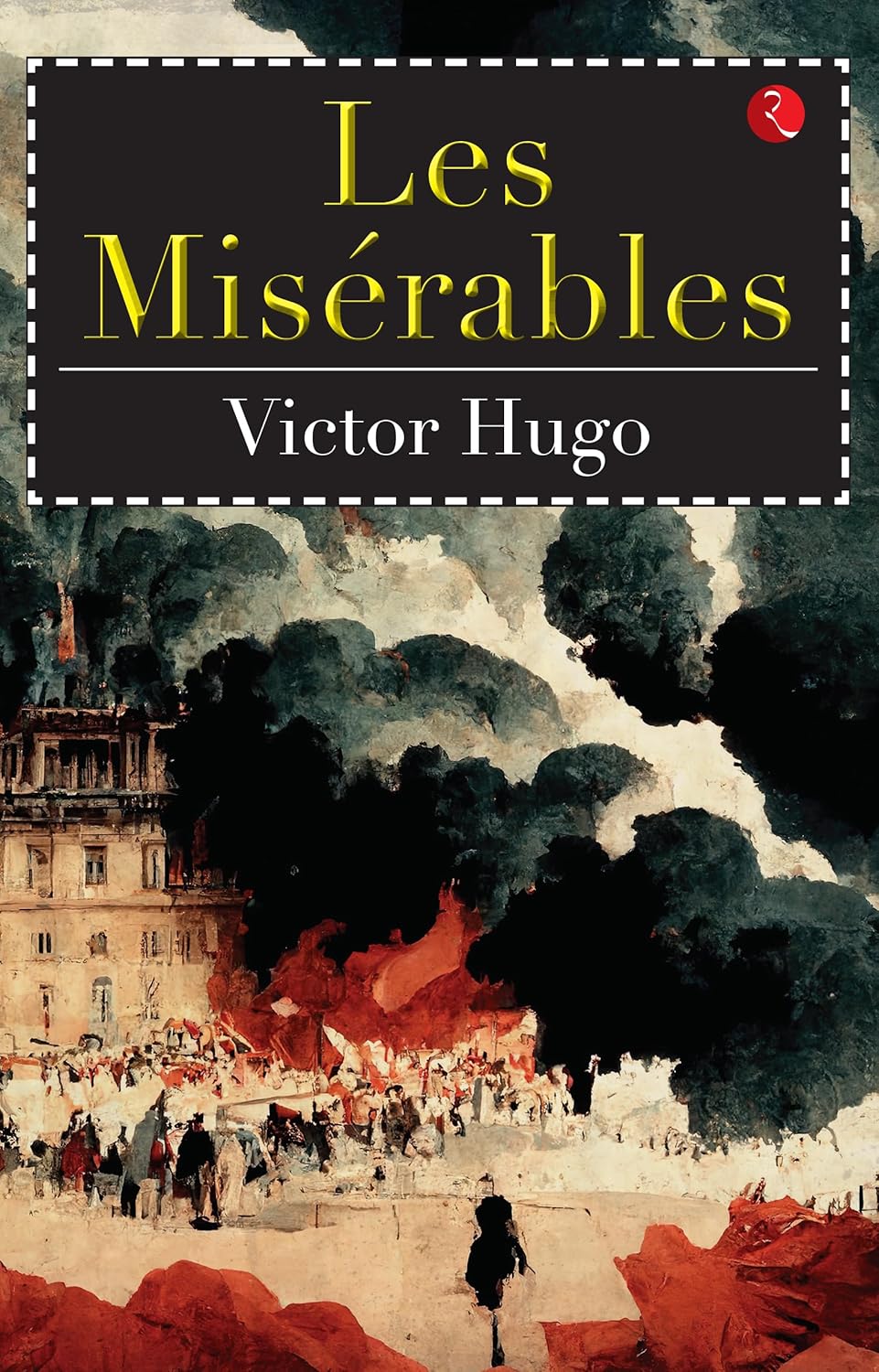
About Les Miserables by Victor Hugo – A Classic Novel About Justice, Poverty, Mercy, Love, and Redemption
Les Miserables by Victor Hugo is a major French novel first published in 1862. It follows Jean Valjean, a former prisoner who tries to rebuild his life after spending years in prison for stealing bread and for repeated escape attempts. When he leaves prison, he finds that society still treats him as a criminal.
A meeting with Bishop Myriel changes the direction of his life. The bishop responds to Valjean with mercy instead of punishment, and Valjean decides to become a better man. He later creates a new identity, builds a successful life, and becomes responsible for Cosette, the young daughter of Fantine.
At the same time, police inspector Javert continues to pursue him because he believes the law should be followed without exception.
Around this central conflict, Hugo tells stories about poverty, family, love, revolution, sacrifice, crime, childhood, and social injustice in nineteenth-century France.
Jean Valjean Begins With a Harsh Past
Jean Valjean enters the novel after serving a long prison sentence.
His original crime was stealing bread to feed his sister’s hungry children. His sentence becomes longer because of repeated escape attempts.
When he is released, he carries a yellow passport that marks him as a former convict. People refuse him food, shelter, and respect because of his record.
This makes him angry and suspicious.
Bishop Myriel is one of the first people to treat him with kindness. When Valjean steals the bishop’s silver and is caught, the bishop tells the police that the silver was a gift. He even gives Valjean more.
That act becomes the moral turning point of the novel.
Valjean begins trying to live by mercy rather than bitterness.
Javert Believes the Law Must Be Absolute
Inspector Javert stands on the other side of Valjean’s moral journey.
He believes strongly in rules, punishment, order, and legal authority.
To Javert, a convicted criminal remains a criminal.
He has little room for the idea that a person can change in a deep way.
This makes his pursuit of Valjean more than a simple chase between a policeman and a fugitive.
The two men represent different ideas about justice.
Valjean learns to believe in compassion, forgiveness, and personal change.
Javert believes that law gives society a clear structure and that breaking it must have consequences.
Their conflict becomes one of the strongest parts of the novel because both men are serious about the principles guiding their lives.
Fantine Shows the Cost of Poverty
Fantine is one of the novel’s most important characters.
She is a working-class woman and the mother of Cosette.
Because she is unmarried and poor, she faces judgment and limited choices. She leaves Cosette with the Thénardiers, believing they will care for her while she works.
Instead, they demand more and more money while treating Cosette badly.
Fantine loses her job and falls deeper into poverty.
Her story shows how quickly a person with little money or social protection can lose safety, health, and dignity.
Hugo does not present her hardship as a simple result of bad personal choices.
He uses her life to criticize a society that punishes vulnerable people while giving them very few ways to recover.
Cosette Gives Valjean a New Purpose
Before Fantine dies, Valjean promises to care for Cosette.
He eventually finds her living with the Thénardiers.
Cosette is still a child and has been treated more like a servant than a daughter.
Valjean takes her away and becomes her adoptive father.
This relationship changes him.
Until this point, much of his new life has been about proving that he can be honest and useful.
Caring for Cosette adds something more personal.
He now has someone whose safety and happiness matter to him every day.
The bond between Valjean and Cosette becomes one of the emotional centers of the novel.
It also creates new risks because Valjean must protect her while avoiding Javert.
Marius and Cosette Bring a Love Story Into the Novel
As Cosette grows older, she meets Marius Pontmercy.
Marius is a young student with his own family conflict and political ideas.
Their relationship adds a romantic story to the larger novel.
For Cosette, Marius represents a future beyond the protected life she has lived with Valjean.
For Valjean, their love is more difficult.
He wants Cosette to be happy, but he also fears losing the person who has become the center of his life.
This creates a quiet emotional conflict.
Valjean’s love for Cosette is generous, but it also includes fear and attachment.
He must learn that protecting someone does not mean keeping that person close forever.
The June Rebellion Brings the Characters Together
The later part of the novel moves toward the June Rebellion of 1832 in Paris.
A group of young republicans builds barricades and prepares to fight government forces.
Marius joins them.
Gavroche is also present, and Valjean eventually comes to the barricade for reasons tied to Cosette and Marius.
The rebellion gives the novel a larger political setting.
Hugo uses the barricades to explore courage, idealism, sacrifice, anger, and the distance between political hope and practical power.
The event was not the French Revolution of 1789.
It was a later uprising during the July Monarchy.
That distinction helps readers place the story more accurately in French history.
The Novel Covers More Than One Main Plot
Les Miserables is long because Hugo does not stay only with Jean Valjean’s personal story.
He often pauses the plot to discuss history, politics, religion, poverty, language, law, Paris, convents, sewers, and the Battle of Waterloo.
Some readers enjoy these sections because they make the novel feel large and historical.
Other readers may find them slower than the central story.
Knowing this before starting can make the reading experience easier.
The book is not written like a modern fast-paced thriller.
It mixes narrative with essays, social criticism, historical explanation, and moral reflection.
That wide structure is part of what makes the novel distinctive.
Justice and Mercy Are Central Questions
One of the clearest themes in Les Miserables is the difference between legal justice and moral mercy.
Javert trusts the law.
Valjean learns that human beings can be more complicated than a legal label.
Bishop Myriel’s mercy changes Valjean more effectively than punishment did.
Later, Valjean has chances to respond to other people with the same kind of compassion.
Hugo keeps asking whether people should be judged only by their worst act.
He also asks what society owes to people who are poor, hungry, uneducated, sick, abandoned, or trapped by earlier mistakes.
These questions help explain why the novel still feels relevant even though its setting belongs to nineteenth-century France.
The Original Novel Was Published in 1862
Les Miserables was first published in French in 1862.
The Bibliothèque nationale de France records the original work as a novel published in ten volumes, arranged into five major parts: Fantine, Cosette, Marius, The Idyll in the Rue Plumet and the Epic in the Rue Saint-Denis, and Jean Valjean.
Hugo had begun working on the novel many years earlier, paused the project, and later returned to it while living in exile.
The story begins in 1815 and reaches the June Rebellion of 1832.
Its long time span allows readers to watch characters age, change, lose people, form new relationships, and face the consequences of earlier decisions.
English Editions Can Be Very Different
There is no single page count for Les Miserables because many English editions use different translations, formats, and levels of abridgment.
A 2015 Penguin Classics paperback translated by Christine Donougher is 1,456 pages.
A 2013 Signet edition translated by Lee Fahnestock and Norman MacAfee is 1,488 pages.
A 2008 Modern Library edition translated by Julie Rose is 1,376 pages.
Penguin’s Clothbound Classics edition using Norman Denny’s translation is 1,232 pages.
There are also much shorter abridged editions.
Customers who want the complete novel should check whether an edition is unabridged and which translator it uses before ordering.
About Victor Hugo
Victor Hugo was born in Besançon, France, in 1802.
He became one of the major writers of French Romanticism and worked as a poet, novelist, dramatist, and political figure.
His best-known works include Les Miserables and The Hunchback of Notre-Dame.
Hugo was elected to the Académie Française in 1841.
He later became active in politics and went into exile after Napoleon III took power.
He returned to France in 1870.
Hugo died in 1885 and was buried in the Panthéon in Paris.
His writing often combines large historical events with personal stories about injustice, freedom, love, poverty, and human dignity.
Who Will Enjoy Les Miserables?
Les Miserables is a strong choice for readers who enjoy classic literature, historical fiction, social novels, moral questions, French history, political themes, family stories, and long character journeys.
It may especially appeal to readers who want a large novel with many connected characters rather than one narrow plot.
Readers should expect poverty, death, violence, imprisonment, child abuse, prostitution, political conflict, grief, and other difficult subjects.
It is also useful for students who want to study how fiction can combine character, history, politics, religion, and social criticism. Readers familiar with the musical may find characters, events, and ideas that adaptations shorten or remove.
The novel also contains compassion, friendship, parental love, romance, humor, and hope.
Because full editions are very long, readers may prefer to read the novel slowly rather than treating it like a short weekend book.
Book Quality at Bookish Wonderland
Bookish Wonderland offers this title with premium eye-soothing cream paper, crystal-clear printing, and high-quality stitched plus glue binding.
The cream paper supports comfortable reading during a long classic, while clear printing helps keep the dense text easy to follow. Strong binding is especially useful for a large book that may be read over many sessions.
The copy is suitable for personal reading, study, gifting, classic literature collections, or readers building a world classics shelf.
Why Order from Bookish Wonderland?
Bookish Wonderland delivers books across Bangladesh, including inside and outside Dhaka. Cash on Delivery is available nationwide.
Customers in Dhaka can also ask about fast or urgent delivery when available.
If you are checking Les Miserables by Victor Hugo Book price in Bangladesh, it is useful to compare the physical quality, translation, and whether the edition is complete or abridged along with the listed price.
Why Readers Continue to Choose Les Miserables
Les Miserables by Victor Hugo follows people who are judged by law, money, class, family history, and public opinion, then asks whether those judgments tell the whole truth.
Jean Valjean’s attempt to build a better life connects with Fantine’s struggle, Cosette’s childhood, Marius’s politics, Éponine’s loyalty, Gavroche’s street life, and Javert’s strict idea of justice.
The novel is long because Hugo wants to show both individual lives and the society around them.
For readers willing to spend time with a large nineteenth-century classic, it offers crime, family, history, politics, romance, moral conflict, and one of literature’s best-known stories of personal change.
Order your copy from Bookish Wonderland for nationwide delivery and Cash on Delivery.
If you require customization or have any questions, please inbox us via FB or Insta.
| Primary Specification | |
| Author | Victor Hugo |
| Translator | Christine Donougher |
| Narrator | Adeel Akhtar, Natalie Simpson, Adrian Scarborough, Emma Fielding, John Owen-Jones |
| Genre | Classic Fiction, Historical Fiction, Literary Fiction |
| ISBN-13/ISSN | 978-0241248744 |
| ISBN-10 | 0241248744 |
| Publisher | Penguin Classics |
| Publishing Date | March 8, 2016 |
| Language | English |
| Reading Age | 15+ |
| Format | Printed Book |
| Physical Specification & Quality | |
| Paper Quality | Premium eye-soothing cream paper |
| Binding Quality | High quality stitched and glue binding (for longevity) |
| Print Quality | Crystal-clear print |
| Pages | 1456 pages |
| Country | France |
| Logistics Information | |
| Weight | 1477 gm |
| Length | 8.5 inches |
| Width | 5.6 inches |
| Height | 2.36 inches |