

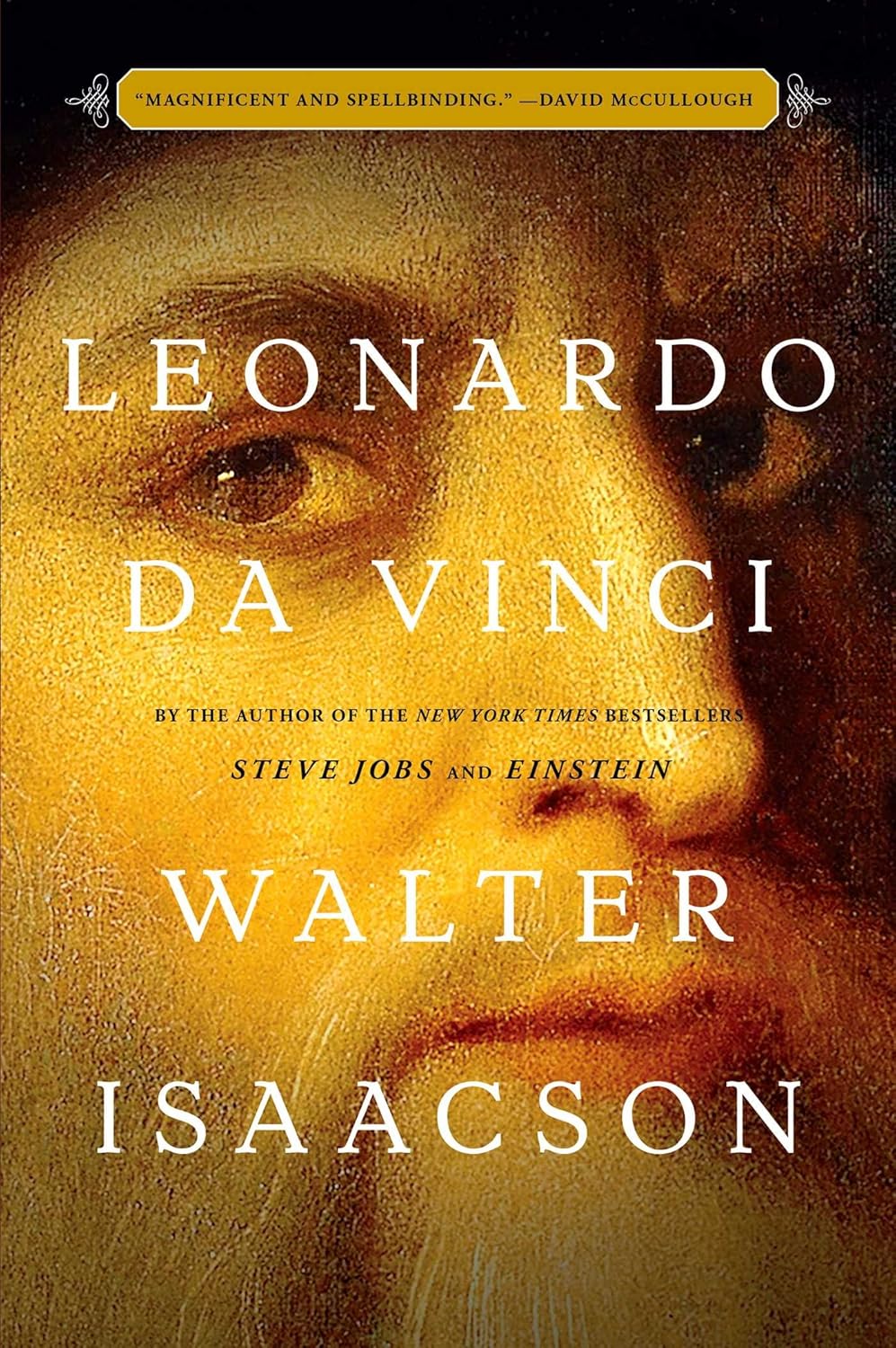
About Leonardo da Vinci by Walter Isaacson – A Biography of Art, Science, Curiosity, and the Renaissance Mind
Leonardo da Vinci by Walter Isaacson is a biography of the Renaissance artist, inventor, and thinker. Isaacson follows not only the Mona Lisa and The Last Supper but also Leonardo’s work in anatomy, engineering, water, flight, geology, optics, mathematics, architecture, and design.
The book draws on thousands of surviving notebook pages to show how Leonardo observed, questioned, sketched, tested ideas, and connected art with science. Curiosity becomes the main thread linking his paintings, experiments, machines, and unfinished plans.
Leonardo Begins in Vinci
Leonardo was born in 1452 near Vinci in Tuscany. He was the illegitimate son of the notary Piero da Vinci and a young woman named Caterina.
Because he was born outside marriage, he did not follow the usual professional path of a legitimate son in his father’s family. He also received less formal classical education than many scholars of his time.
Isaacson shows how Leonardo learned in another way. He watched closely, drew constantly, asked basic questions, studied patterns, and returned to problems that interested him. He wanted to know why water moved in certain shapes, how birds stayed in the air, how muscles worked, and how light reached the eye.
That habit of observation became one of the foundations of his work.
Verrocchio’s Workshop Gave Him Many Skills
As a young man, Leonardo trained in Florence in the workshop of Andrea del Verrocchio.
A Renaissance workshop involved more than painting. Artists and apprentices could work with sculpture, metal, mechanics, design, costumes, and other crafts. This suited Leonardo because his interests were already wide.
Drawing became one of his most important tools. He drew faces, hands, plants, water, machines, buildings, muscles, animals, and small details from everyday life.
For Leonardo, drawing was not only a way to make art. It was a way to investigate a question.
Isaacson uses this early training to explain why Leonardo later moved so naturally between painting, engineering, anatomy, and design.
The Notebooks Are Central to the Biography
Leonardo’s notebooks give Isaacson unusual access to the way he thought.
Thousands of pages survive, filled with sketches, diagrams, lists, calculations, observations, questions, and unfinished ideas. Leonardo often wrote in mirror script from right to left.
The pages do not follow a neat modern structure. A machine can appear beside an anatomical sketch. Notes about water can sit near a face. A question about birds can lead toward a flying device.
Isaacson sees this mixture as important. Leonardo did not keep art, science, and engineering inside separate boxes. He looked for connections between them.
That is one reason the book can appeal to readers interested in creativity as well as readers interested in Renaissance history.
Art and Science Work Together
One of Isaacson’s main ideas is that Leonardo’s scientific studies improved his art, while his ability to draw improved his scientific work.
Anatomy helped him understand muscles, bones, faces, and movement. Optics helped him study light, shadow, perspective, and vision. His attention to water, rocks, plants, and landscapes gave his paintings a stronger sense of natural form.
This approach helps explain why the biography spends so much time outside the studio.
Leonardo did not study the human body only because he wanted to become a doctor, and he did not study light only as a scientist. He wanted to understand what he saw so he could represent it more accurately and ask better questions about nature.
Vitruvian Man Shows His Mixed Interests
Vitruvian Man is one of Leonardo’s best-known drawings.
The image places a male figure inside a circle and a square and connects the human body with ideas about proportion described by the Roman architect Vitruvius.
Isaacson uses the drawing to discuss Leonardo’s interest in geometry, measurement, architecture, anatomy, and design.
The image is useful because it makes the book’s larger theme easy to see. Leonardo did not think he had to choose between art and mathematics. He could use both to explore the same question.
For readers interested in design or creative work, this part shows how different fields can strengthen each other when they are studied together.
Anatomy Became a Serious Study
Leonardo studied human anatomy in unusual depth for an artist of his time.
He dissected bodies and drew bones, muscles, organs, the skull, the spine, and the heart. He tried to understand not only what body parts looked like but how they worked together.
Isaacson discusses Leonardo’s studies of the muscles that move the lips, the heart, and other structures that later appeared in his art and notebooks.
Some of his observations were highly advanced for the period, while others were incomplete or mistaken.
That balance matters. The biography does not turn Leonardo into someone who was always correct. It shows a gifted observer working with the tools and knowledge available to him.
Birds, Flight, and Machines Kept His Attention
Leonardo watched birds carefully and studied how wings moved through air.
From those observations, he designed flying machines and explored the mechanics of flight. He also drew gears, bridges, weapons, mechanical devices, and stage equipment.
Many designs were never built, and some could not have worked exactly as drawn.
Isaacson treats these pages as evidence of a mind testing possibilities rather than as proof that Leonardo secretly invented every modern machine.
These sections show how sketching and observation helped Leonardo test difficult ideas.
Milan Expanded His Work
Leonardo spent an important period in Milan under Ludovico Sforza.
He offered his services as a painter, engineer, designer, military adviser, and creator of court entertainments. This range of skills helped him find work in a culture where artists depended heavily on patrons.
In Milan, Leonardo worked on paintings, performances, engineering ideas, and a huge horse monument planned for Francesco Sforza. The bronze monument was never completed.
Isaacson uses this period to show both Leonardo’s ambition and his difficulty finishing large projects.
It also shows that Renaissance creativity was tied to practical realities. Artists needed money, materials, access, and powerful patrons who were willing to support their plans.
The Last Supper Combines Observation and Design
The Last Supper receives close attention in the biography.
Isaacson explains how Leonardo organized the disciples into groups and used gesture, expression, perspective, and movement to show their reactions after Jesus says one of them will betray him.
The room’s lines guide the viewer toward Christ, while the figures remain active and individual.
Leonardo’s interest in perspective and optics helped shape the scene.
His experimental painting method also caused problems because the surface began deteriorating relatively early.
The work therefore shows both his careful planning and his willingness to test methods that did not always produce durable results.
The Mona Lisa Brings Many Studies Together
Isaacson also looks closely at the Mona Lisa.
He connects the portrait with Leonardo’s studies of anatomy, expression, light, shadow, optics, water, and landscape.
Leonardo used very soft transitions rather than hard outlines, a technique associated with sfumato. The effect helps create the uncertain expression that has made the painting so widely discussed.
Isaacson’s point is not simply that Leonardo knew many subjects.
It is that years of observation could meet inside one work. Scientific study helped him understand what he was painting, while artistic practice gave him new reasons to study nature.
The Mona Lisa becomes a clear example of how his interests supported each other.
His Final Years Were Spent in France
Late in life, Leonardo accepted an invitation from King Francis I of France.
He moved to France and lived at Clos Lucé near Amboise. He brought important papers and paintings with him, including the Mona Lisa.
Leonardo died in France in 1519.
Isaacson uses the final part of the biography to look back at both the completed works and the large number of questions Leonardo left open.
The notebooks make clear that he remained curious throughout his life.
His importance comes not only from a few famous paintings but from the way he joined observation, art, engineering, science, and imagination in one working process.
Publication and Edition Details
Simon & Schuster published Leonardo da Vinci on October 17, 2017. The US hardcover carries ISBN 9781501139154, while the ebook uses ISBN 9781501139178. Google Books lists the illustrated edition at 624 pages.
The book includes many reproductions of Leonardo’s drawings and artworks. Customers who need a specific cover, ISBN, format, or page count should check the exact edition before ordering their copy.
About Walter Isaacson
Walter Isaacson is a professor of history at Tulane University.
He has served as editor of Time magazine, chairman and CEO of CNN, and president and CEO of the Aspen Institute.
His books include biographies of Steve Jobs, Albert Einstein, Benjamin Franklin, Jennifer Doudna, Elon Musk, and Leonardo da Vinci, as well as The Innovators.
Isaacson often writes about people working at the meeting point of different fields.
His journalism background helps him explain technical subjects in language intended for general readers rather than only specialists.
Who Will Enjoy Leonardo da Vinci?
Leonardo da Vinci is a strong choice for readers interested in biography, Renaissance history, art, science, engineering, invention, anatomy, design, and creativity.
Artists may enjoy the close observation of drawings and paintings. Designers and engineers may be interested in Leonardo’s notebooks and machines. Students can see how persistent questions can lead across several subjects.
General readers do not need to be art historians or scientists to follow the book.
Its broad approach makes it useful for readers who want to understand Leonardo as a person, not only as the name behind a few famous artworks.
Book Quality at Bookish Wonderland
Bookish Wonderland offers this title with premium eye-soothing cream paper, crystal-clear printing, and high-quality stitched plus glue binding.
Clear printing is especially useful for a biography containing detailed text and visual references. Strong binding supports repeated reading and long-term shelf storage.
The book is suitable for personal reading, study, gifting, biography collections, art and design libraries, or readers building a shelf of history, science, and creativity books.
Why Order from Bookish Wonderland?
Bookish Wonderland delivers books across Bangladesh, including inside and outside Dhaka. Cash on Delivery is available nationwide.
Customers in Dhaka can also ask about fast or urgent delivery when available.
If you are checking Leonardo da Vinci by Walter Isaacson Book price in Bangladesh, it is useful to compare the physical quality, format, and printing of the illustrations along with the listed price.
Book customization is also available. For stock, edition, customization, or delivery questions, contact Bookish Wonderland through Facebook or Instagram.
Why Readers Choose This Biography
Leonardo da Vinci by Walter Isaacson gives readers a clear look at how Leonardo connected art, science, anatomy, engineering, nature, and imagination.
The notebooks let Isaacson follow Leonardo’s questions as closely as his finished works. That makes the biography useful for readers interested in creativity and history.
Leonardo changed direction often, left projects unfinished, and kept returning to problems. Isaacson shows how those habits could create difficulty while also supporting original work.
For readers who want a readable biography with visual material and clear explanations, this book offers an introduction to Leonardo’s life, ideas, methods, and influence.
Order your copy from Bookish Wonderland for nationwide delivery and Cash on Delivery.
If you require customization or have questions, please inbox us via FB or Insta.
| Primary Specification | |
| Author | Walter Isaacson |
| Narrator | Alfred Molina |
| Genre | Biography, History, Art History, Science, Nonfiction |
| ISBN-13/ISSN | 978-1501139161 |
| ISBN-10 | 1501139169 |
| Publisher | Simon & Schuster |
| Publishing Date | October 2, 2018 |
| Language | English |
| Reading Age | 16+ |
| Format | Printed Book |
| Physical Specification & Quality | |
| Paper Quality | Premium eye-soothing cream paper |
| Binding Quality | High quality stitched and glue binding (for longevity) |
| Print Quality | Crystal-clear print |
| Pages | 624 pages |
| Country | USA |
| Logistics Information | |
| Weight | 644 gm |
| Length | 8.5 inches |
| Width | 5.6 inches |
| Height | 1.5 inch |