

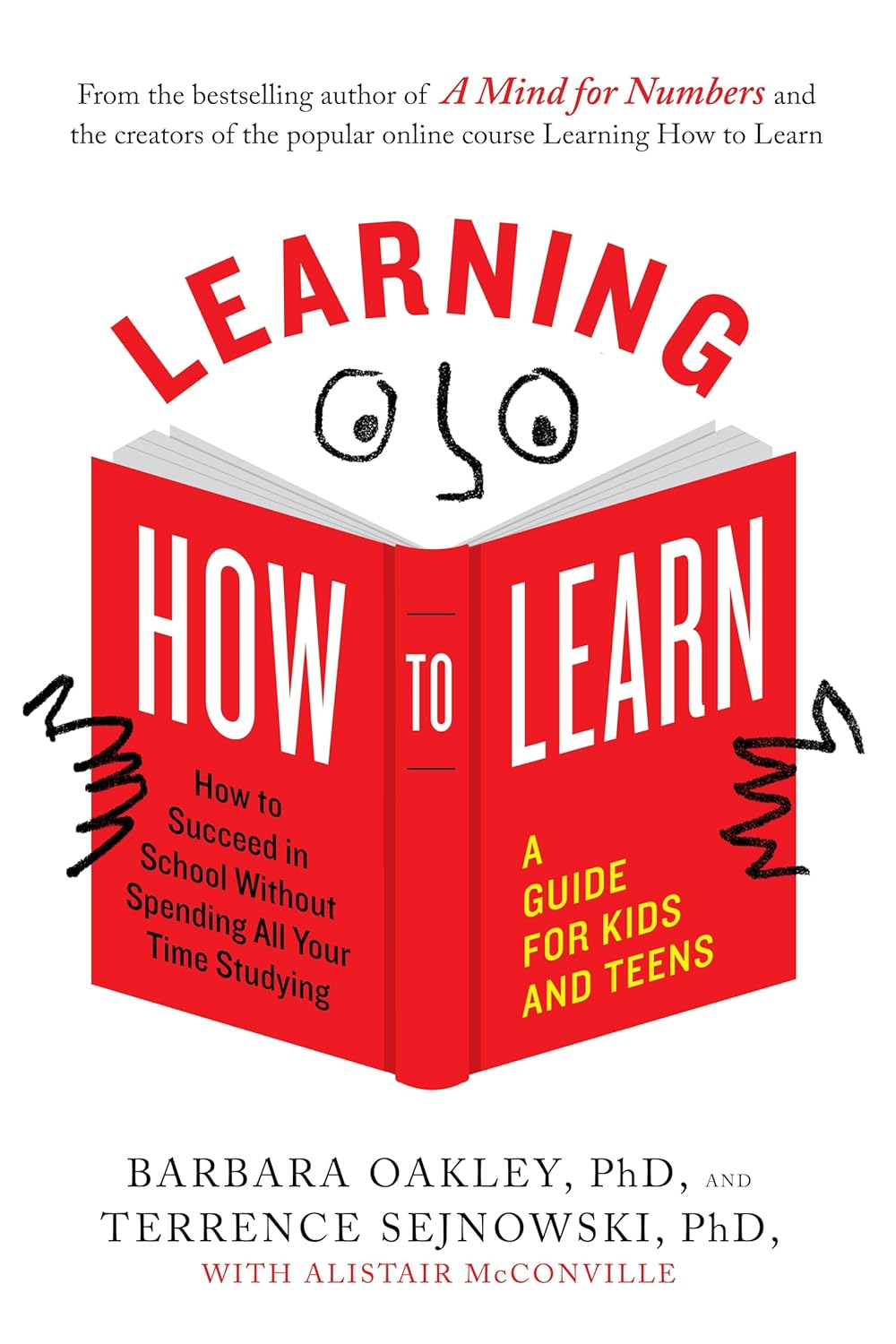
About Learning How to Learn by Barbara Oakley PhD & Terrence Sejnowski PhD – A Practical Guide to Smarter Study, Memory, Focus, and Better Learning
Learning How to Learn by Barbara Oakley PhD and Terrence Sejnowski PhD is a practical guide for students who want to understand how learning works and how to study more effectively. The full subtitle is How to Succeed in School Without Spending All Your Time Studying: A Guide for Kids and Teens. Alistair McConville is also credited as a contributing author.
The book is based on ideas from Barbara Oakley’s bestselling A Mind for Numbers and the popular Learning How to Learn online course created with neuroscientist Terrence Sejnowski. Instead of telling students simply to “study harder,” the book explains why some study habits work better than others.
It covers focused and diffuse thinking, memory, sleep, procrastination, practice, metaphors, mental chunks, testing yourself, and ways to avoid the illusion of learning. The goal is simple: help students use their study time better and feel less lost when a subject seems difficult.
The Book Starts With How the Brain Learns
One of the book’s main ideas is that learning is not only about intelligence.
A student may struggle with a subject because the method being used is not helping the brain build strong connections.
Oakley and Sejnowski explain learning with simple examples, drawings, and comparisons that younger readers can understand.
The book shows that the brain changes with practice.
A difficult idea can become easier when it is revisited, connected with something familiar, and used several times.
This is useful for students who think they are “bad” at math, science, languages, writing, or another subject.
The message is not that every subject becomes easy immediately. It is that improvement is possible when students understand how practice, attention, memory, and rest work together.
Focused and Diffuse Thinking Work Together
The book explains two broad ways of thinking: focused mode and diffuse mode.
Focused thinking happens when you give close attention to a problem.
You may be solving a math question, reading a difficult paragraph, or trying to remember a new rule.
Diffuse thinking is more relaxed.
It happens when attention is not locked tightly onto one problem. Walking, taking a shower, resting, or doing something simple can sometimes help the brain make new connections.
The authors explain that good learning often uses both modes.
A student can focus carefully, then take a break and allow the brain to work in a different way.
This is why staring at the same problem for hours is not always the best solution.
Taking Breaks Can Help Difficult Ideas Settle
Many students believe that a long study session is always better than a shorter one.
Learning How to Learn explains why breaks can be useful.
When the brain has worked hard on a problem, stepping away may allow ideas to connect in the background.
This does not mean avoiding work.
The focused effort still has to happen first.
The useful pattern is to study, pause, and return.
This can be especially helpful when a problem feels impossible.
A short break may make the next attempt clearer than another thirty minutes of frustrated staring.
The lesson is practical because students can use it immediately with homework, revision, and difficult assignments.
Memory Gets Stronger When You Practice Recall
One of the most useful ideas in the book is active recall.
Reading the same page many times can create a feeling of familiarity, but familiarity is not the same as being able to remember the information later.
A better method is to close the book and try to explain what you just learned.
You can ask yourself a question, write the answer from memory, or teach the idea to someone else.
This makes the brain work harder to retrieve the information.
That effort strengthens learning.
The book helps students understand why testing themselves before an exam can be more useful than simply rereading notes.
It also explains that making a mistake during practice can be helpful when the mistake is corrected.
Spacing Is Better Than Cramming
Another important lesson is that learning works better when practice is spread across time.
Trying to learn everything the night before a test may help with short-term memory, but much of that information can disappear quickly.
Spacing means returning to material across several days or weeks.
Each return gives the brain another chance to strengthen the memory.
This method can feel slower at first, but it usually creates stronger learning.
Students can use spacing with vocabulary, formulas, dates, definitions, science ideas, or almost any subject that requires memory.
The book encourages study routines that reduce last-minute panic and make revision more manageable.
Mental Chunks Make Complex Ideas Easier
The authors also explain the idea of chunking.
A chunk is a group of ideas or steps that the brain learns to treat as one useful unit.
When someone first learns to play a song, solve an equation, or use a grammar rule, every step may require attention.
With practice, several steps begin to feel connected.
The brain can then use that group more easily.
This frees attention for harder parts of the task.
Chunking is one reason experts can solve problems faster than beginners.
They have built many useful patterns through practice.
Students can build chunks by understanding the idea, practicing it, and using it in different situations.
Procrastination Is Treated as a Habit Problem
Many students know they should begin an assignment but still delay.
The book explains that procrastination often starts because thinking about a difficult task creates an uncomfortable feeling.
Avoiding the task gives short-term relief.
That relief makes the habit stronger.
The authors suggest simple ways to begin working without making the task feel enormous.
One useful idea connected with Oakley’s teaching is focusing on a short period of work rather than thinking about the entire project.
Starting can reduce the discomfort that made the student avoid the task.
Sleep Is Part of Learning
Learning How to Learn explains that sleep is not wasted study time.
Sleep helps the brain process information, strengthen memories, and clear away some of the waste created during normal brain activity.
A student who studies all night may gain extra hours with a book but lose some of the benefits that come from proper sleep.
This is especially important before exams.
Metaphors Can Make Hard Ideas Easier
A difficult idea is often easier to understand when it is connected with something familiar.
The authors encourage students to use metaphors and comparisons.
For example, a new scientific process might be compared with a road, a machine, or a set of doors.
The comparison does not have to be perfect.
Its job is to give the brain a starting structure for understanding.
Students can also draw a simple picture or make up a funny example.
The stranger or more memorable the connection is, the easier it may be to recall later.
Avoid the Illusion of Learning
One problem in studying is that students can feel prepared without actually being prepared.
Looking at a highlighted page may feel familiar.
Reading the answer while looking at the question may feel easy.
But the real test is whether you can produce the answer without help.
The book teaches readers to check their learning honestly.
Try a problem without looking at the solution.
Explain the idea without the notes.
Mix different types of questions.
Practice in conditions that require real retrieval.
These methods can reveal weak areas early, when there is still time to improve them.
The Book Is Written for Kids and Teens
Penguin Random House lists the book for Grade 5 and up.
The writing uses simple explanations, illustrations, questions, and exercises rather than academic language.
This makes it suitable for middle-school and secondary-school students, but older students and adults can also use the techniques.
Parents and teachers may find it useful because the book gives them a simple way to explain why certain study habits work.
The lessons can be applied to school subjects, music, sports, languages, creative skills, and other kinds of learning.
Publication and Edition Details
TarcherPerigee, part of Penguin Random House, published Learning How to Learn on August 7, 2018.
The paperback carries ISBN 9780143132547 and is listed at 256 pages.
The ebook was published on the same date and carries ISBN 9780525504467.
The full author credit is Barbara Oakley, PhD, Terrence Sejnowski, PhD, with Alistair McConville.
Customers who need a specific cover, ISBN, or format should check the exact edition before ordering.
About Barbara Oakley and Terrence Sejnowski
Barbara Oakley is a professor of engineering at Oakland University and a distinguished scholar of global digital learning at McMaster University.
Her research includes bioengineering, neuroscience, and cognitive psychology.
Terrence Sejnowski is a neuroscientist known for work on the brain and learning. He has taught the Learning How to Learn online course with Oakley.
Their online course has attracted millions of learners around the world.
Alistair McConville, also credited on the book, helped adapt the ideas for younger readers.
Together, the authors turn research about learning into practical explanations that students can use.
Who Will Benefit Most From This Book?
Learning How to Learn is a strong choice for students who struggle with homework, memory, concentration, procrastination, difficult subjects, or exam preparation.
It can also help students who already get good grades but spend too much time studying.
Parents, teachers, tutors, and homeschool families may also find useful ideas inside.
The book does not promise instant results.
Its value comes from giving readers methods they can practice repeatedly until better study habits become normal.
Book Quality at Bookish Wonderland
Bookish Wonderland offers this title with premium eye-soothing cream paper, crystal-clear printing, and high-quality stitched plus glue binding.
The clear print helps keep explanations, exercises, and illustrations easy to follow, while the cream paper supports comfortable study sessions. Strong binding makes the copy suitable for repeated reference during school terms.
The book works well for personal study, gifting, tutoring, classroom support, or a student learning library.
Why Order from Bookish Wonderland?
Bookish Wonderland delivers books across Bangladesh, including inside and outside Dhaka. Cash on Delivery is available nationwide.
Customers in Dhaka can also ask about fast or urgent delivery when available.
If you are checking Learning How to Learn by Barbara Oakley PhD & Terrence Sejnowski PhD Book price in Bangladesh, it is useful to compare the edition and physical quality along with the listed price.
Book customization is also available. For stock, edition, customization, or delivery questions, contact Bookish Wonderland through Facebook or Instagram.
Why Students Choose Learning How to Learn
Learning How to Learn by Barbara Oakley PhD and Terrence Sejnowski PhD gives students practical ways to study with less wasted effort.
The book explains why recall, spacing, focused attention, breaks, sleep, metaphors, and practice matter. It also shows why rereading and last-minute cramming can create the feeling of learning without strong memory.
For students who want a clear guide to studying smarter, remembering more, and handling difficult subjects with better methods, this book offers ideas that can be used immediately.
Order your copy from Bookish Wonderland for nationwide delivery and Cash on Delivery.
If you require customization or have questions, please inbox us via FB or Insta.
| Primary Specification | |
| Author | Barbara Oakley, PhD; Terrence Sejnowski, PhD; with Alistair McConville |
| Narrator | Laural Merlington |
| Editor | Sabrina Bowers |
| Genre | Education, Study Skills, Cognitive Psychology, Neuroscience, Juvenile Nonfiction |
| ISBN-13/ISSN | 978-0143132547 |
| ISBN-10 | 0143132547 |
| Publisher | Tarcher |
| Publishing Date | August 7, 2018 |
| Language | English |
| Reading Age | 10+ |
| Format | Printed Book |
| Physical Specification & Quality | |
| Paper Quality | Premium eye-soothing cream paper |
| Binding Quality | High quality stitched and glue binding (for longevity) |
| Print Quality | Crystal-clear print |
| Pages | 256 pages |
| Country | USA |
| Logistics Information | |
| Weight | 278 gm |
| Length | 8.5 inches |
| Width | 5.6 inches |
| Height | 0.67 inch |