

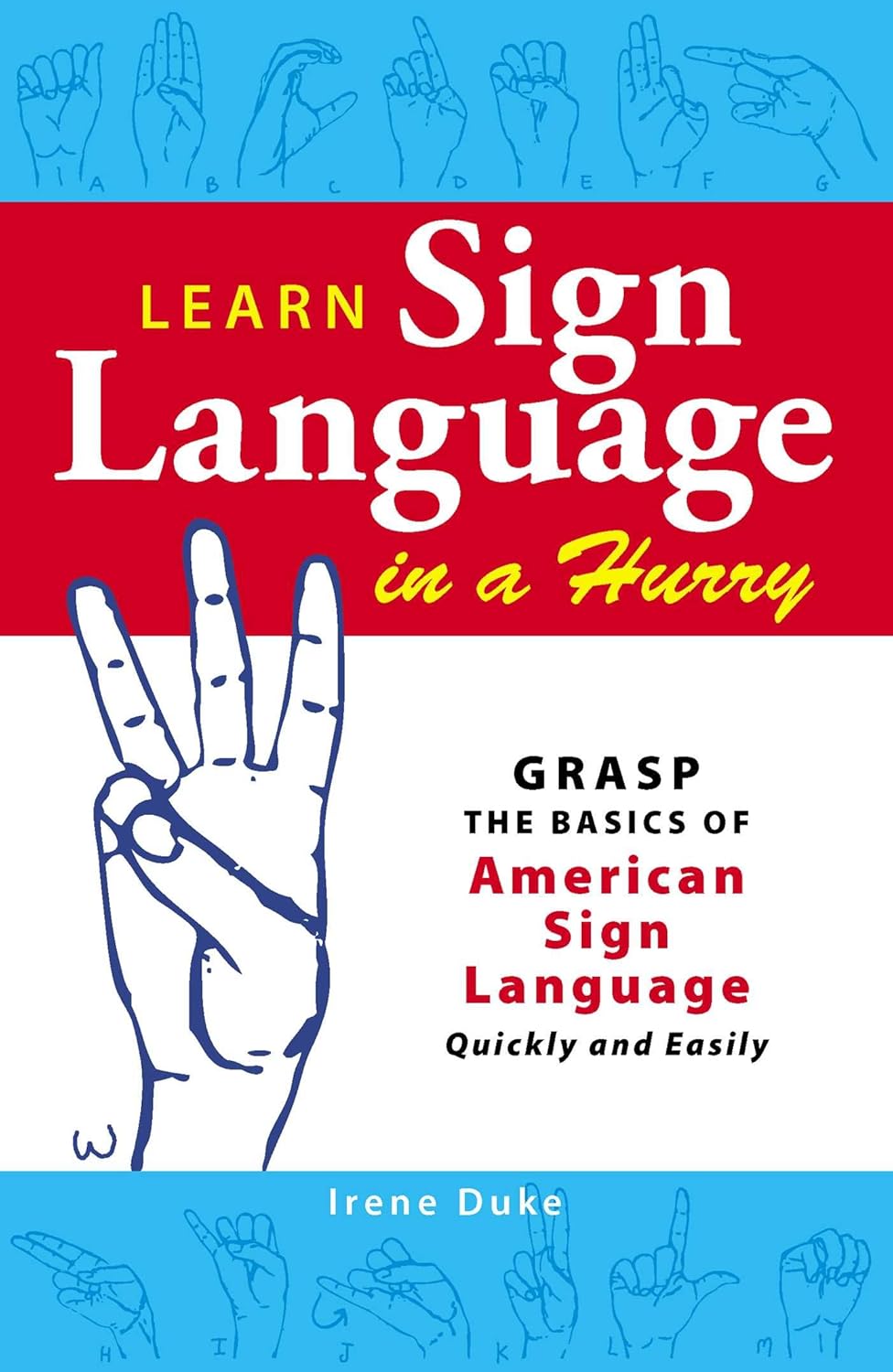
About Learn Sign Language in a Hurry by Irene Duke – A Practical Beginner Guide to American Sign Language, Everyday Signs, Questions, Numbers, and Daily Communication
Learn Sign Language in a Hurry by Irene Duke is a beginner-friendly guide to American Sign Language, commonly called ASL. It is written for people who want to learn useful signs quickly without starting with a large academic textbook. The book introduces the manual alphabet, fingerspelling, basic sentence patterns, questions, common vocabulary, numbers, time, home life, school, work, sports, travel, and everyday communication.
The full subtitle is Grasp the Basics of American Sign Language Quickly and Easily. The book uses photographs, examples, exercises, quizzes, and simple explanations to help readers understand how signs are formed and used.
Irene Duke does not treat ASL as a list of hand movements alone. She explains that facial expression, body movement, sign order, and context also matter. This makes the book useful for beginners who want a practical first step into signing rather than only memorizing isolated words.
The Book Begins With Sign Language Basics
The opening section explains what American Sign Language is and introduces several basic rules.
Readers learn that ASL is a visual language. Meaning comes from handshape, movement, location, direction, facial expression, and other nonmanual signals.
The book introduces the manual alphabet so beginners can start fingerspelling names and words that do not yet have a sign in their vocabulary.
Fingerspelling is useful, but the book also shows why communication becomes smoother when readers build a wider set of everyday signs.
For someone who has never studied ASL before, this early section gives a simple starting point without assuming prior knowledge.
The Manual Alphabet Gives Beginners a Useful First Skill
Learning the ASL alphabet is one of the easiest ways to begin.
Each letter has a handshape, and letters can be combined to spell names, places, or words.
This gives new learners a way to communicate even when they do not know the standard sign for something.
The book explains fingerspelling as a practical tool rather than as a replacement for learning ASL vocabulary.
A beginner can practice the alphabet alone, spell common names, and slowly improve hand control and recognition.
Because fingerspelling appears often in real ASL communication, this skill remains useful even after a learner builds a larger vocabulary.
Questions Need More Than Hand Signs
The second part of the book looks at asking and answering questions.
It explains “wh” questions and yes-no questions, along with the role of facial expression and other nonmanual behaviors.
This is important because ASL does not depend only on the hands.
Eyebrows, head position, facial expression, and body movement can change the meaning or function of a signed sentence.
The book helps beginners notice these features early instead of treating them as optional extras.
Readers also learn signs for common question words, relationships, people, pronouns, and possessives.
These topics are useful because simple conversations often depend on asking who, what, where, when, why, or whether something happened.
Vocabulary Expands Into Description
After basic questions, the book moves into vocabulary for describing people and things.
Readers learn signs connected with colors, clothing, appearance, and emotions.
This gives beginners more freedom than memorizing only greetings and introductions.
Being able to describe someone, explain what a person is wearing, or say how you feel makes communication more useful.
The book also introduces classifiers.
Classifiers are handshapes that can represent people, objects, movement, size, shape, or location depending on context.
They are an important part of ASL and can help a signer describe scenes more clearly.
For beginners, learning that classifiers exist is useful because it shows that ASL has its own visual ways of organizing information.
Sports and Outdoor Signs Add Everyday Language
One chapter focuses on sports, play, and outdoor activities.
Readers learn vocabulary connected with games, recreation, and movement.
This is useful for students, families, teachers, coaches, and anyone who wants to communicate about activities outside the home.
The chapter also returns to classifiers and compound signs.
Compound signs combine existing signs in ways that create another meaning.
Seeing how signs connect helps beginners understand that ASL vocabulary is not simply an English word matched with one hand gesture.
It has its own patterns and visual logic.
Numbers Are Needed in Many Daily Situations
The book gives a full section to numbers.
Readers practice counting from basic numbers into larger numbers and also learn how numbers appear in everyday situations.
This includes money, shopping, age, dates, times, and other common uses.
Number signs can change depending on context, so learning them as part of daily communication is more helpful than memorizing a number chart alone.
The book also covers fractions and higher numbers.
These skills can be useful in classrooms, shops, appointments, work, travel, and conversations about schedules.
Time and Calendar Signs Make Planning Easier
Communicating about time is a basic part of daily life.
The book covers past, present, and future, specific times, general times of day, calendar language, and celebrations.
These signs help readers move beyond basic introductions.
You can begin talking about when something happened, when an event will occur, or what day and time a meeting is planned.
For beginners who want ASL for work, family, education, or community service, time vocabulary is especially practical.
It allows conversations to become more useful in real situations.
Home Vocabulary Supports Daily Communication
The later chapters include signs connected with meals, home life, and routine.
Readers learn vocabulary for breakfast, lunch, snacks, dinner, dessert, and common activities around the house.
These subjects are especially useful for families learning ASL together.
A learner can practice while preparing food, talking about what someone wants, or discussing daily plans.
The book also includes computer signs and vocabulary for other common environments.
This practical focus makes it easier to use new signs soon after learning them.
School and Office Signs Add Professional Use
Learn Sign Language in a Hurry is not limited to home communication.
The book also includes vocabulary for classrooms and workplaces.
This can be useful for teachers, students, support staff, medical workers, community-service employees, and coworkers who regularly meet Deaf or hard-of-hearing people.
The guide does not replace formal interpreter training or advanced ASL study.
However, it can help someone build a basic vocabulary and become more comfortable with simple signed communication.
For professional settings where accurate communication is critical, especially healthcare, legal, or interpreting work, learners should continue with qualified training and Deaf-led resources.
Quizzes and Games Make Practice More Active
The book includes an appendix with quizzes and games.
These activities help readers check what they remember instead of only looking back at the page.
Active practice is useful when learning a visual language.
A learner can try to produce a sign from memory, recognize a sign without reading the answer first, or practice with another person.
Games can also make repeated practice less boring.
Families, classmates, or friends learning together may find this especially useful because they can test one another and build speed gradually.
Images Make a Visual Subject Easier to Follow
ASL is difficult to learn from text alone because handshape, position, and movement matter.
The publisher describes the book as complete with images and examples of common signs.
That visual support is one of the main practical features of the guide.
A learner can compare the written explanation with the image instead of trying to imagine the hand position from words alone.
Even so, a printed image cannot show every movement as clearly as live instruction or video.
For best results, readers can use the book as a foundation and add practice with Deaf signers, qualified teachers, or reliable video resources.
It Is Important to Know This Book Teaches ASL
Sign languages are not universal.
Learn Sign Language in a Hurry focuses on American Sign Language.
Someone using British Sign Language, Bangla Sign Language, or another national or regional sign language will encounter different vocabulary, grammar, alphabets, or conventions.
This distinction matters for readers in Bangladesh.
The book is useful if your goal is specifically to learn ASL, communicate with ASL users, study American sign-language resources, or build a foundation before interacting with ASL communities.
It should not be treated as a guide to every sign language used around the world.
Publication and Edition Details
Adams Media published the trade paperback on August 18, 2009.
Simon & Schuster lists the paperback at 192 pages with ISBN 9781598698688.
The ebook was released on July 18, 2009 and carries ISBN 9781440513831.
Google Books also lists the title at 192 pages.
Customers who need a particular format, ISBN, or cover should check the exact edition before ordering.
About Irene Duke
Irene Duke has worked as a professional American Sign Language instructor for more than twenty years.
Simon & Schuster identifies her as director of ASL programs at Massasoit College and in the Whitman-Hanson Regional School District in Massachusetts.
She has developed ASL courses, workshops, and lectures for educators, child-care providers, medical personnel, special-needs organizations, and community-service groups.
Google Books also describes her work in ADA advising, early education, special needs, and medical sign language.
She is the mother of a profoundly Deaf adult son and has worked to increase awareness of the uses and benefits of sign language.
Who Will Benefit From This Book?
Learn Sign Language in a Hurry is a strong choice for complete beginners who want a practical ASL introduction.
It may be useful for parents, students, teachers, caregivers, community workers, medical staff, families, and people learning ASL for personal interest.
The book covers enough topics to move a reader from the alphabet into simple everyday communication.
Book Quality at Bookish Wonderland
Bookish Wonderland offers this title with premium eye-soothing cream paper, crystal-clear printing, and high-quality stitched plus glue binding.
Clear printing is especially important in a sign-language guide because readers need to see hand positions and visual examples carefully. Strong binding supports repeated practice and reference.
The book is suitable for personal study, gifting, classroom support, family learning, or building a language-learning collection.
Why Order from Bookish Wonderland?
Bookish Wonderland delivers books across Bangladesh, including inside and outside Dhaka. Cash on Delivery is available nationwide.
Customers in Dhaka can also ask about fast or urgent delivery when available.
If you are checking Learn Sign Language in a Hurry by Irene Duke Book price in Bangladesh, it is useful to compare the physical quality, edition, and clarity of the visual material along with the listed price.
Book customization is also available. For stock, edition, customization, or delivery questions, contact Bookish Wonderland through Facebook or Instagram.
Why Beginners Choose Learn Sign Language in a Hurry
Learn Sign Language in a Hurry by Irene Duke gives beginners one compact place to start learning American Sign Language.
It moves from the alphabet and fingerspelling into questions, descriptions, emotions, sports, numbers, time, meals, home vocabulary, school, work, and travel. Quizzes and games give readers simple ways to review what they have learned.
For anyone who specifically wants an accessible introduction to ASL before moving to deeper study, this book provides a practical starting point with images, examples, and everyday vocabulary.
Order your copy from Bookish Wonderland for nationwide delivery and Cash on Delivery today.
If you require customization or have questions, please inbox us via FB or Insta.
| Primary Specification | |
| Author | Irene Duke |
| Genre | Language Learning, Education, Reference, Sign Language |
| ISBN-13/ISSN | 978-1598698688 |
| ISBN-10 | 1598698680 |
| Publisher | Adams Media |
| Publishing Date | August 18, 2009 |
| Language | English |
| Reading Age | 22+ |
| Format | Printed Book |
| Physical Specification & Quality | |
| Paper Quality | Premium eye-soothing cream paper |
| Binding Quality | High quality stitched and glue binding (for longevity) |
| Print Quality | Crystal-clear print |
| Pages | 192 pages |
| Country | USA |
| Logistics Information | |
| Weight | 214 gm |
| Length | 8.5 inches |
| Width | 5.6 inches |
| Height | 0.5 inch |