

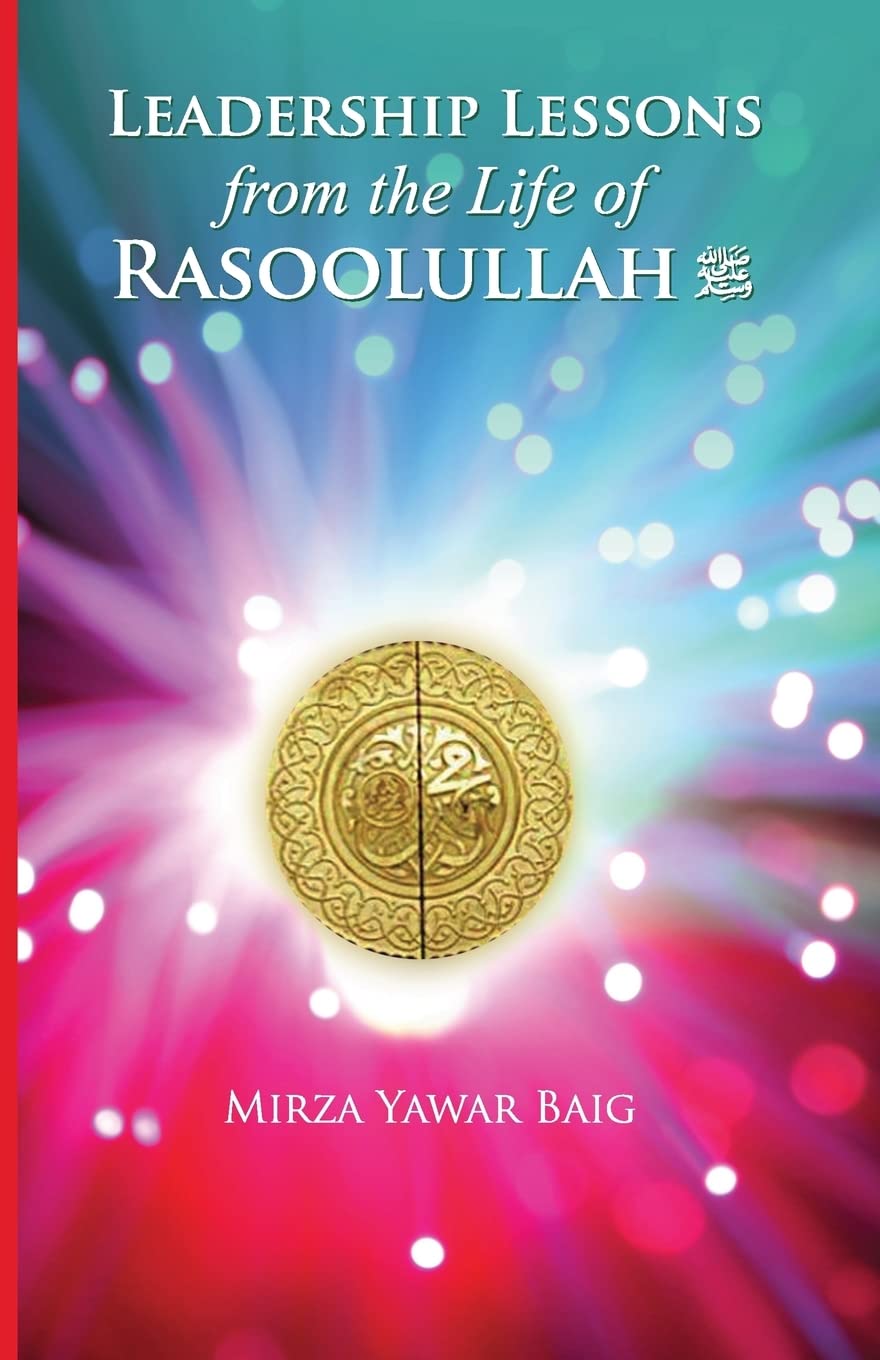
About Leadership Lessons from the Life of Rasoolullah by Mirza Yawar Baig – A Guide to Purpose, Character, Teamwork, and Lasting Leadership
Leadership Lessons from the Life of Rasoolullah by Mirza Yawar Baig studies the life of Prophet Muhammad, peace be upon him: what can readers learn about leading people? It is a book about faith and character, but it also addresses goals, teamwork, difficult decisions, risk, forgiveness, and preparing others to lead.
Baig writes from a Muslim perspective and explains his belief in the Prophet and his message. He also says his purpose is to make leadership lessons accessible to Muslim and non-Muslim readers and show how they might apply today. Rather than retelling every event of the seerah in order, he selects qualities and decisions that help explain leadership. Readers can use the chapters to reflect on work, family, education, community service, and their own conduct.
What Makes This Book Different From a Full Seerah?
A complete seerah normally follows the Prophet's life across its historical stages. This book takes a narrower approach. Baig selects leadership questions and explores them through the life of Rasoolullah, peace be upon him. Each theme gives readers something specific to consider, such as how to set a goal, build a team, or respond to hardship.
Start With an Extraordinary Goal
Baig gives an entire chapter to the importance of an extraordinary goal. A leader needs a purpose that can guide decisions when circumstances change. Without a clear goal, urgent problems can consume attention, and a group may work hard without moving in the same direction.
The practical question is simple: what are we trying to achieve, and why does it matter? A teacher could apply that question to a classroom. A business owner could use it when choosing between quick income and lasting trust. A community organizer could use it to decide which activities deserve limited resources. The book asks readers to connect daily effort with a larger purpose.
Faith Gives the Work Its Foundation
The chapter on extraordinary faith is central to Baig's approach. He writes as someone who believes that the Prophet's mission was guided by revelation. That religious commitment shapes his interpretation of leadership and should be understood as part of the book's viewpoint.
For readers, this section connects conviction with action. Believing in a purpose affects how a person responds to rejection, delay, and pressure. Baig does not present faith merely as a feeling. He asks what it changes in behavior. Muslim readers may appreciate the spiritual connection; other readers can still examine how strong convictions shape commitment and choices.
Commitment Must Show Up in Conduct
Another chapter looks at extraordinary commitment. Words can inspire a team for a moment, but repeated actions tell people whether a leader means what they say. A person who asks for sacrifice while avoiding inconvenience personally may lose credibility.
Baig draws attention to leadership that accepts effort and responsibility. In everyday life, the idea applies to a manager who shares difficult work, a parent who follows household rules, or a teacher who prepares carefully. Commitment becomes visible through what someone does when tasks are tiring or results are slow. This gives readers a practical way to examine their own habits instead of focusing only on a leader's speeches.
Build People, Not Just a Following
The book has chapters on extraordinary teams, brotherhood, friendship, succession planning, and leadership development. Together, these themes show that leadership depends on relationships and on helping others become capable. One person's energy is not enough to sustain a large mission indefinitely.
A team needs trust, shared expectations, and room for members to contribute different strengths. People also need chances to learn and accept responsibility. Readers can apply this idea to a school club, family business, charity, or workplace. The aim is not to make everyone behave exactly like the leader. It is to create a group that can continue serving its purpose when one person is absent.
Quality Is a Form of Responsibility
Baig discusses extraordinary quality as a separate leadership concern. Good intentions do not automatically produce good work. A service, lesson, product, or community project still needs care in planning and delivery. If people rely on a leader, careless work can harm them even when the stated mission sounds admirable.
Know What Must Not Be Compromised
The book distinguishes conviction in a message from flexibility in methods. Baig includes chapters on certainty and refusing to compromise the message, while also discussing decisions that should not become rigid. Those ideas belong together: a leader should understand which principles define the mission and which plans can change.
For example, an organization may be committed to honesty while changing its advertising approach. A teacher may protect fairness while trying a new classroom method. The book encourages readers to examine decisions against their stated principles, not merely against convenience or public approval. A firm purpose does not require repeating a failed method forever.
Face Hard Facts Without Giving Up
One chapter names resilience as facing brutal facts while maintaining faith in success. Baig treats hope and realism as connected responsibilities. A leader who ignores danger cannot make informed decisions. A leader who sees only danger may stop acting before a solution is possible.
A useful application is to describe a problem accurately, identify the resources available, and then decide on the next responsible step. A struggling business should look directly at its finances. A student should admit where understanding is weak. A community group should recognize what it cannot currently deliver. The book's lesson is to remain committed without hiding inconvenient information.
Put the Goal Ahead of Personal Preference
A leader's tastes and comfort can quietly become a group's priorities. Baig challenges that habit in a chapter about placing the goal before personal preferences. The mission may require listening to someone younger, changing a schedule, sharing credit, or taking on an unpleasant task.
Courage Includes Accepting Risk
Baig devotes attention to putting oneself on the line and taking risks. Leadership sometimes requires acting before every uncertainty disappears. Yet courage is not the same as recklessness. Risks should be considered in relation to the goal, the available information, and the people affected.
Think Beyond the Next Reward
The chapter on sacrificing short-term benefit for long-term success asks readers to look beyond immediate comfort. Some choices produce quick praise or money while weakening the future. Other choices take longer but build skills, trust, or stable systems.
Training a colleague, saving resources, correcting poor practices, and developing a successor may not provide instant results. They can still be important investments. Baig's theme invites readers to examine the time horizon of their decisions. What looks easy this month may create problems next year. The aim is to choose with the longer purpose in view while acknowledging present responsibilities.
Forgiveness Can Change What Happens Next
Magnanimity and forgiveness receive their own chapter. Baig examines how a leader responds after conflict, including moments when punishment or revenge may appear attractive. A generous response can sometimes create room for reconciliation and cooperation.
Forgiveness does not automatically erase responsibility or make every relationship safe. Readers still need to consider fairness and harm. The useful leadership question is what response will serve justice, people, and the future rather than only satisfy anger. The chapter may interest anyone managing disputes in a workplace, classroom, family, or volunteer group. It encourages restraint when a person has the power to retaliate.
Make the Work Bigger Than One Person
Baig's discussion of moving from person-led to process-driven leadership focuses on continuity. When every decision depends on one individual, a group can struggle whenever that person is unavailable. Clear responsibilities, useful procedures, shared knowledge, and trained team members make work less fragile.
This does not mean replacing human judgment with paperwork. It means preserving what the group has learned and helping other people act well. Succession planning follows naturally. Readers running small businesses or community organizations may find these closing chapters especially practical because they address what happens after the original leader steps aside.
Publication and Edition Information
The original Standard Bearers Academy record lists the book in 2012 at 300 pages, with ISBN 9781479284030. Bangladesh booksellers list a Sean Publication second edition from 2015 at 255 pages. Another Indian listing gives 299 pages and a different ISBN. These figures refer to different records and editions, so there is no single page count for every copy.
Check the actual publisher, binding, cover, and ISBN if you need a specific edition. The book is written in English, and its subject combines Islamic studies with leadership development. It is focused on ideas and applications, not a numbered fictional story.
About Mirza Yawar Baig
Mirza Yawar Baig is an author, leadership consultant, mentor, and founder of Yawar Baig and Associates. His official biography says he established the firm in 1994 and has worked with founders and family business leaders across several regions. His consulting interests include leadership development, conflict resolution, succession, and moving organizations from reliance on one person toward stronger processes.
That professional background helps explain the book's emphasis on applying lessons rather than only describing events. Baig explicitly asks readers to think about their public and private lives. He writes from his religious convictions while addressing practical questions faced by people responsible for others.
Who May Find This Book Useful?
Muslim readers interested in the seerah may appreciate a focused study of leadership themes. The book may also suit managers, entrepreneurs, teachers, students, parents, charity organizers, and study groups interested in purpose, character, teamwork, and responsibility.
Readers expecting a chronological biography should choose a general seerah alongside it. Readers seeking an academic comparison of leadership theories should know that Baig writes from a committed Islamic perspective. The value here lies in studying his selected lessons and deciding how to put them into practice. A notebook can help readers record one useful action after each chapter.
A Reading Copy Made for Regular Use
Bookish Wonderland offers premium eye-soothing cream paper, crystal-clear printing, and high-quality stitched plus glue binding. Comfortable pages support longer reading sessions, while clear text helps readers follow the detailed discussions. Durable binding is useful when returning to chapters during study or leadership training.
This book can be kept for personal reflection, given as a gift, or used in a group discussing leadership and Islamic history. It is suitable for readers who want to revisit ideas rather than finish a book once and forget it.
Ordering Through Bookish Wonderland
Bookish Wonderland delivers across Bangladesh, inside and outside Dhaka, with Cash on Delivery available nationwide. Customers in Dhaka can ask about fast or urgent delivery where available. Book customization is also offered; contact the store on Facebook or Instagram to discuss availability or requirements.
If you are checking Leadership Lessons from the Life of Rasoolullah by Mirza Yawar Baig Book price in Bangladesh, compare the stated edition and physical quality with the listed price. Page counts differ, so confirm the copy you want before ordering.
Bring These Lessons Into Daily Life
The book asks readers to turn admiration into conduct. Its chapters move from purpose and faith to commitment, teamwork, quality, resilience, forgiveness, and planning for the next generation. Each topic offers a question worth taking back to daily responsibilities.
Choose this book if you want a leadership study grounded in the author's reading of the Prophet's life, with applications for work, family, and community. Order your copy from Bookish Wonderland with nationwide delivery and Cash on Delivery.
For edition questions or customization, message the store through Facebook or Instagram.
| Primary Specification | |
| Author | Mirza Yawar Baig |
| Genre | Religion & Spirituality, Islamic Leadership, Biography, Self-Development, Nonfiction |
| ISBN-13/ISSN | 978-1479284030 |
| ISBN-10 | 1479284033 |
| Publisher | CreateSpace Independent Publishing Platform |
| Publishing Date | October 1, 2012 |
| Language | English |
| Reading Age | 16+ |
| Format | Printed Book |
| Physical Specification & Quality | |
| Paper Quality | Premium eye-soothing cream paper |
| Binding Quality | High quality stitched and glue binding (for longevity) |
| Print Quality | Crystal-clear print |
| Pages | 300 pages |
| Country | India |
| Logistics Information | |
| Weight | 323 gm |
| Length | 8.5 inches |
| Width | 5.6 inches |
| Height | 0.68 inch |