

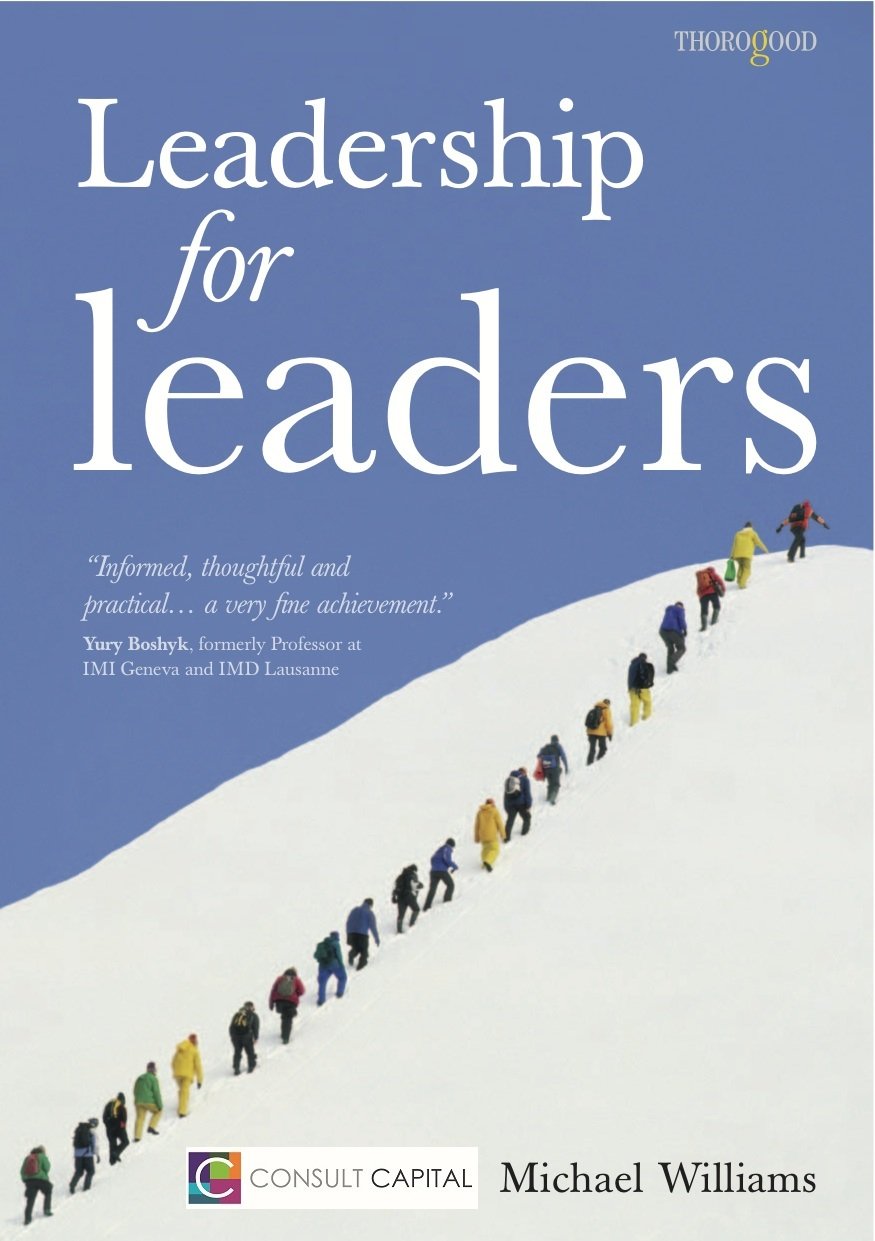
About Leadership for Leaders by Michael Williams – A Practical Guide to Leadership Skills, Team Development, Talent, Innovation, and Better Decisions
Leadership for Leaders by Michael Williams is a practical business and management book for people who already lead teams or are preparing to take greater responsibility. Instead of treating leadership as a vague idea, Williams builds the book around research with more than 2,500 senior managers in ten companies across the United States and Europe.
The book identifies seven leadership competency clusters: goal orientation, integrity, close engagement with others, helicopter perception, resilient resourcefulness, personal horsepower, and resonant communications. Williams explains how these qualities work together and why strong leadership requires more than technical knowledge or job authority.
The book also looks at emotional intelligence, trust, talent development, innovation, team engagement, communication, and the mindset needed to move an organization forward. Its main aim is practical: helping leaders understand what effective leadership looks like and how to develop it in daily work.
Goal Orientation Keeps Work Focused
The first major competency is goal orientation.
Leaders need to know what the team is trying to achieve and keep attention on important results.
This sounds simple, but teams can easily become busy without making meaningful progress.
Meetings, reports, emails, and urgent requests can fill the day while larger goals remain unclear.
Williams treats goal orientation as the ability to connect effort with a clear purpose.
A leader should help people understand what matters, what success looks like, and which tasks deserve priority.
For managers, this can improve planning, delegation, and performance discussions.
It also helps employees see how their work connects with wider business goals.
Integrity Builds Trust
Integrity is another central competency.
People watch whether leaders keep promises, apply rules fairly, admit mistakes, and behave consistently.
Trust becomes difficult when a manager says one thing and does another.
Williams links effective leadership with discipline, personal consistency, and a strong concern for mutual trust.
Integrity does not mean a leader will never make a bad decision.
It means the leader takes responsibility, behaves honestly, and gives people a reason to believe that standards will not change simply because a situation becomes uncomfortable.
For teams, this matters because people are more willing to speak, contribute, and accept difficult decisions when they trust the person leading them.
Close Engagement Means Staying Connected With People
Williams uses the idea of close engagement to describe leadership that stays connected with people rather than operating from a distance.
Leaders need information from the people doing the work.
They also need to understand motivation, concerns, skills, and pressure inside the team.
Close engagement does not mean controlling every small task.
It means paying enough attention to know what is happening and creating relationships where people can communicate openly.
The book connects this with emotional intelligence.
A leader who understands emotions, reactions, and relationships can often handle conflict and change more effectively.
This makes engagement especially useful when teams are under pressure or when a company is changing direction.
Helicopter Perception Helps Leaders See the Whole Picture
Another competency is what Williams calls helicopter perception.
The idea is simple: leaders sometimes need to move mentally above the immediate problem and look at the wider situation.
A manager can become so focused on one task, one customer, or one department that larger risks and opportunities are missed.
Helicopter perception means stepping back.
A leader looks at patterns, connections, business priorities, team needs, and possible future effects.
Then the leader can move back into the details with a clearer view.
This skill is useful for strategy, problem solving, planning, and change.
It helps leaders avoid making a decision that solves one local problem while creating another somewhere else.
Resilient Resourcefulness Matters When Plans Change
Leadership becomes easier when everything goes according to plan.
Real work rarely stays that simple.
Projects fail, people leave, customers change their minds, budgets move, and unexpected problems appear.
Williams includes resilient resourcefulness as a key competency because leaders need to keep working when conditions become difficult.
Resilience means recovering from setbacks.
Resourcefulness means finding workable options with the people, time, and information available.
Together, these skills help leaders avoid becoming stuck when the first plan fails.
A resourceful leader can ask different questions, use available talent, adjust priorities, and keep the team moving without pretending that the problem does not exist.
Personal Horsepower Is About Energy and Drive
Williams uses the term personal horsepower for the energy and drive a leader brings to work.
This does not mean being loud, aggressive, or constantly busy.
It refers more to the ability to keep moving important work forward and maintain effort over time.
Leaders often have to deal with uncertainty, resistance, difficult conversations, and competing priorities.
Without enough personal drive, decisions can be delayed and standards can slowly fall.
The book links leadership with focused passion and an intolerance of mediocrity.
The goal is not perfection in every small task.
The idea is to care enough about the work to keep standards clear and encourage the team to improve.
Resonant Communication Helps People Understand and Respond
A leader can have a good plan and still fail if nobody understands it.
Resonant communication is about making a message clear enough to connect with the people hearing it.
Different situations require different communication.
A team meeting, one-to-one conversation, strategy presentation, and difficult performance discussion cannot all be handled in exactly the same way.
Williams emphasizes communication that creates understanding and response.
Good leaders explain direction, listen carefully, ask useful questions, and adjust the message when necessary.
They also understand that tone and timing matter.
Clear communication reduces confusion and makes it easier for people to know what is expected from them.
Emotional Intelligence Supports Everyday Leadership
Emotional intelligence appears throughout the book because leadership is always connected with people.
A manager may understand finance, operations, or technology and still struggle to lead if that person cannot read situations or manage relationships.
Williams treats emotional intelligence as a cornerstone of the leadership mindset.
Leaders need self-awareness, control over their reactions, and an ability to understand other people.
These skills become especially important during conflict, poor performance, organizational change, or uncertainty.
Emotional intelligence does not mean avoiding hard decisions.
It helps leaders make difficult decisions while understanding how those decisions may affect the people who have to carry them out.
Leaders Should Develop More Leaders
One chapter focuses on the idea that great leaders develop other leaders.
This moves leadership away from personal control.
A manager who keeps every important decision, skill, and opportunity to themselves may appear useful, but the team becomes dependent on one person.
Williams looks at talent, leadership potential, and the danger of leaving ability unused inside organizations.
Developing leaders means noticing people with potential, giving them responsibility, coaching them, and creating opportunities to learn.
It also means understanding that a strength can become a weakness when overused.
The long-term goal is a team with more capable people, not a manager who remains the only person able to solve important problems.
Engagement Creates Buy-In During Change
The book gives attention to securing buy-in instead of simply pushing change past people.
Employees are more likely to support a new direction when they understand why it matters and how they are expected to contribute.
Williams discusses change strategy, knowledge and skill, team building, consolidation, and reward.
These areas show that change requires more than an announcement.
People may need information, training, time, feedback, and visible support from leaders.
A manager who ignores these needs may get compliance without real engagement.
For leaders managing change, this part of the book offers a practical way to think about how people move from hearing an idea to actually supporting it.
Innovation Needs Both Freedom and Direction
Leadership for Leaders also discusses innovation.
Organizations need new ideas, but innovation does not happen simply because a leader tells everyone to be creative.
Williams looks at conditions that can either support or block innovation.
He discusses imagination, creativity, risk, reward, and challenging objectives.
Leaders need to give people room to think while still connecting ideas with business needs.
Too much control can stop experimentation.
Too little direction can produce activity without useful results.
The book encourages leaders to create conditions where people can test ideas, learn, and contribute to improvement.
This makes the innovation section useful for managers working with products, services, operations, or organizational change.
Publication and Edition Details
Thorogood Publishing first published Leadership for Leaders in 2005.
The original paperback carries ISBN 1-85418-350-8, or 9781854183507 in ISBN-13 form. The hardback carries ISBN 1-85418-355-9.
The original Thorogood PDF is 192 pages including front matter, while Google Books lists a 169-page digitized record. A later ebook listing from IPI Academy is 234 pages with ISBN 9781854188557.
A Viva Books edition was also published in India and is listed at 224 pages.
Page counts therefore vary by edition and format, so buyers who need a specific version should check the ISBN and edition details.
About Michael Williams
Michael Williams is an international management consultant who established Michael Williams & Partners in 1979.
His professional work has focused on leadership, team development, organizational development, senior executive development, leadership potential, and corporate culture.
He has worked with companies in the United States and Europe, including IBM, ICI, British Alcan, AT&T/ISTEL, GUS, McCain’s, and Shroders.
His background also includes managerial experience across industries such as printing, iron and steel, engineering, automotive, and ceramics.
Williams has written and co-written several books on leadership, management practice, talent, and organizational behavior.
Book Quality at Bookish Wonderland
Bookish Wonderland offers this title with premium eye-soothing cream paper, crystal-clear printing, and high-quality stitched plus glue binding.
The clear print supports comfortable reading of the book’s models, explanations, and practical leadership ideas. Strong binding also makes the copy suitable for repeated reference at work, training sessions, or study.
The book can be useful for personal development, management training, team-leader preparation, business study, or an office leadership library.
Why Order from Bookish Wonderland?
Bookish Wonderland delivers books across Bangladesh, including inside and outside Dhaka. Cash on Delivery is available nationwide.
Customers in Dhaka can also ask about fast or urgent delivery when available.
If you are checking Leadership for Leaders by Michael Williams Book price in Bangladesh, it is useful to compare the physical quality of the copy along with the listed price.
Book customization is also available. For stock, customization, or delivery questions, contact Bookish Wonderland through Facebook or Instagram.
Why This Book Is Useful for Working Leaders
Leadership for Leaders by Michael Williams gives readers a structured way to examine leadership without reducing the subject to slogans.
Its seven competencies cover direction, integrity, relationships, perspective, resilience, drive, and communication. The later chapters connect those qualities with talent development, change, innovation, emotional intelligence, and daily management.
For readers who want practical leadership ideas supported by research with experienced managers, the book provides a focused guide that can be read individually or discussed with a management team.
It is especially useful for managers, supervisors, business owners, HR professionals, trainers, and team leaders who want a clear framework for improving everyday leadership practice.
Order your copy from Bookish Wonderland for nationwide delivery and Cash on Delivery.
If you require customization or have questions, please inbox us via FB or Insta.
| Primary Specification | |
| Author | Michael Williams |
| Editor | Driftdesign |
| Genre | Leadership, Business, Management, Personal Development |
| ISBN-13/ISSN | 978-1854183507 |
| ISBN-10 | 8130902230 |
| Publisher | THO |
| Publishing Date | June 1, 2005 |
| Language | English |
| Reading Age | 18+ |
| Format | Printed Book |
| Physical Specification & Quality | |
| Paper Quality | Premium eye-soothing cream paper |
| Binding Quality | High quality stitched and glue binding (for longevity) |
| Print Quality | Crystal-clear print |
| Pages | 224 pages |
| Country | UK |
| Logistics Information | |
| Weight | 245 gm |
| Length | 8.5 inches |
| Width | 5.6 inches |
| Height | 0.5 inch |