

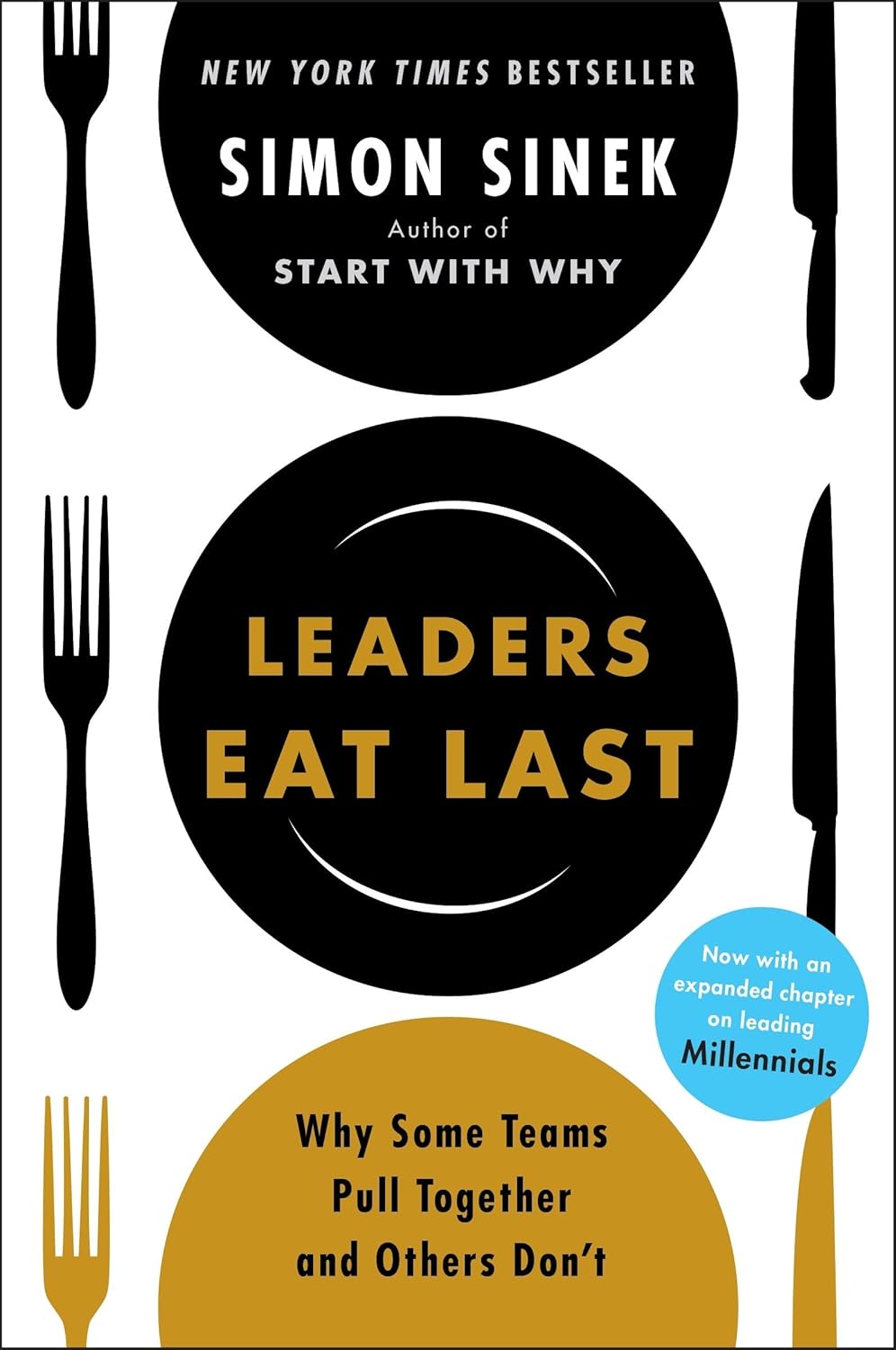
About Leaders Eat Last by Simon Sinek – A Practical Guide to Trust, Teamwork, Safety, Culture, and Responsible Leadership
Leaders Eat Last by Simon Sinek is a leadership and workplace culture book about why some teams work together with trust while others struggle with fear, rivalry, and low morale. The full subtitle is Why Some Teams Pull Together and Others Don’t.
Sinek’s central idea is that good leaders create an environment where people feel safe with one another. He calls this a Circle of Safety. When people trust the group and believe their leaders will protect them, they can spend more energy solving problems, helping customers, sharing ideas, and supporting each other.
The title comes from a practice Sinek observed in the United States Marine Corps, where junior Marines eat before senior leaders. He uses that example to explain leadership as responsibility and service rather than status.
The book combines stories from the military, business, government, manufacturing, and other organizations with ideas about biology, stress, trust, cooperation, and workplace culture.
The Circle of Safety Is the Main Idea
The Circle of Safety is the concept that holds the book together.
Every team faces problems from outside: competitors, market changes, deadlines, customer demands, economic pressure, and unexpected events.
Sinek argues that leaders should not add unnecessary fear inside the team.
When employees are worried that coworkers will undermine them or that managers will punish them unfairly, they spend energy protecting themselves.
That weakens cooperation.
A strong Circle of Safety does the opposite. People know they can ask questions, admit mistakes, share information, and help one another without constant fear.
The idea is simple, but it changes how leadership is measured.
The question is not only whether a manager gets results. It is also whether the environment helps people work together in a healthy and sustainable way.
The Title Comes From Marine Corps Leadership
Sinek explains that the phrase “leaders eat last” came from observing the United States Marine Corps.
At mealtime, junior Marines eat first while senior leaders wait.
The point is not the food itself.
The order represents a wider idea: leadership means taking responsibility for the people in your care.
A senior position brings more duty, not simply more privilege.
Sinek uses military examples because trust can become clear in dangerous situations. People have to believe that teammates will support them and that leaders will not sacrifice them for personal advantage.
In ordinary workplaces, the stakes are different, but the principle still applies.
Employees notice whether leaders protect the team when problems appear or protect only their own position.
Trust Cannot Be Ordered
A manager can tell people to cooperate, but trust does not appear because of an instruction.
It develops from repeated behavior.
People notice whether leaders keep promises, share information, admit mistakes, and treat employees fairly.
They also notice what happens when something goes wrong.
If every mistake leads to blame and fear, employees learn to hide problems.
If honest mistakes can be discussed and corrected, people are more likely to speak early.
That can help a team solve issues before they become larger.
Sinek presents trust as something leaders build through the environment they create.
It requires consistency over time.
Leadership Is About People, Not Only Numbers
One section of the book focuses on the danger of treating people as numbers.
Businesses need revenue, profit, productivity, budgets, and measurable performance.
Sinek does not argue that numbers are unimportant.
His concern is what happens when numbers become more important than the people doing the work.
A decision may improve a short-term financial result while damaging trust, loyalty, or long-term performance.
For example, sudden layoffs may reduce costs quickly but can also make remaining employees feel unsafe.
The book asks leaders to consider the human effect of business decisions.
Numbers help measure an organization. People make the organization function.
Sinek Uses Biology to Explain Cooperation
The book discusses several chemicals connected with human behavior, including endorphins, dopamine, serotonin, oxytocin, and cortisol.
Sinek uses them to explain why people respond strongly to reward, status, belonging, trust, and stress.
Dopamine can support goal-focused behavior and the satisfaction of completing tasks.
Serotonin and oxytocin are discussed in connection with social bonds, pride, trust, and relationships.
Cortisol is connected with stress and threat.
The wider leadership point is that workplace culture affects how people feel every day.
A team built around constant fear can keep people under stress.
A team built around trust can make cooperation easier.
The biological discussion is written for general readers rather than as a neuroscience textbook.
Stress Becomes Dangerous When It Never Stops
Temporary stress can help people respond to urgent problems.
The problem is constant stress without enough safety or recovery.
Sinek discusses workplaces where fear becomes normal.
Employees may worry about layoffs, internal competition, unrealistic targets, or managers who use pressure as their main tool.
Over time, this can damage morale, cooperation, and health.
A leader cannot remove every source of stress.
Competition and uncertainty are part of business.
The book argues that leaders can reduce avoidable internal stress by creating fairness, support, clear expectations, and trust.
That gives people more energy to deal with real external challenges.
Empathy Is a Practical Leadership Skill
Sinek treats empathy as an important part of leadership.
Empathy means trying to understand what another person is experiencing before judging the result.
This does not mean lowering every standard.
A leader can still expect good work, accountability, and improvement.
The difference is in how problems are handled.
If an employee’s performance changes, a manager can immediately assume laziness or ask what has changed.
Sometimes the answer is a skill problem. Sometimes it is unclear instruction. Sometimes it is a personal difficulty.
Understanding the cause makes it easier to choose the right response.
Empathy helps leaders manage people as people rather than as replaceable parts.
Strong Culture Reduces Internal Competition
Competition can motivate people, but too much internal competition can damage teamwork.
If employees believe coworkers are threats, they may hide information, avoid helping, or try to protect credit.
That can make the organization weaker even when individual numbers look good.
Sinek prefers cultures where people direct their competitive energy toward external challenges instead of fighting each other.
Inside the Circle of Safety, teammates should know that success is shared.
This allows people to ask for help and offer help without worrying that cooperation will harm their career.
Leaders Set the Tone Through Their Behavior
Culture is not created only by HR policies or company slogans.
If leaders reward selfish behavior while talking about teamwork, employees learn that the real rule is selfishness.
If leaders admit mistakes, share credit, and protect people fairly, those actions also spread.
Sinek uses the phrase “so goes the leader, so goes the culture” to explain this connection.
People watch what leaders tolerate.
They notice who gets promoted.
They notice what happens when someone behaves badly but produces strong numbers.
Those decisions teach the organization what actually matters.
Integrity Matters Most When It Costs Something
Integrity is easy when honesty has no cost.
The harder test comes when doing the right thing creates inconvenience, embarrassment, or financial pressure.
The book argues that trust grows when leaders stay consistent in those moments.
Employees are more likely to believe stated values when they see leaders accept consequences rather than quietly changing the rules for themselves.
This does not require leaders to be perfect.
It requires them to take responsibility when they get something wrong.
An admission can sometimes protect trust better than an elaborate excuse.
Good Leaders Develop Other People
Leadership is not only about making personal decisions.
Strong leaders also help other people become more capable.
That means giving responsibility, coaching, sharing information, and allowing people to learn.
A team becomes fragile when every important decision depends on one person.
A better system develops people who can think, solve problems, and lead when necessary.
This is useful for managers, business owners, team leaders, teachers, and community leaders.
The goal is not to remain the smartest or most powerful person in the room.
The goal is to create a team that can function well together.
The 2017 Edition Adds Material on Millennials
Portfolio first published the hardcover edition of Leaders Eat Last on January 7, 2014.
Penguin Random House lists that edition at 368 pages.
A revised paperback was published on May 23, 2017, also at 368 pages, with ISBN 9781591848011.
The paperback includes an expanded chapter and appendix on leading millennials.
An audiobook edition released in 2020 runs 9 hours and 24 minutes.
Different international editions may use different ISBNs or page counts, so customers who need a specific version should check the edition before ordering.
About Simon Sinek
Simon Sinek is an author, speaker, and leadership educator known for writing about purpose, trust, workplace culture, and human-centered leadership.
His books include Start With Why, Leaders Eat Last, Together Is Better, Find Your Why, and The Infinite Game.
His TED talk How Great Leaders Inspire Action became one of TED’s most widely viewed talks.
His work often asks why some organizations inspire loyalty while others rely mainly on authority, incentives, or pressure.
Who Will Benefit From Leaders Eat Last?
Leaders Eat Last is useful for managers, supervisors, business owners, founders, HR professionals, team leaders, teachers, nonprofit leaders, and people preparing for leadership roles.
It may also help employees understand why some workplaces feel supportive while others feel unsafe even when salaries or job titles look attractive.
The book is especially relevant for readers interested in trust, workplace culture, employee engagement, leadership psychology, team performance, and long-term organizational health.
It is written for general readers, so no formal business education is required.
Book Quality at Bookish Wonderland
Bookish Wonderland offers this title with premium eye-soothing cream paper, crystal-clear printing, and high-quality stitched plus glue binding.
The clear print supports comfortable reading of longer explanations, case examples, and leadership ideas. Strong binding makes the copy suitable for repeated reading, workplace reference, training sessions, or study.
The book works well for personal development, gifting, management training, business study, or building a leadership library.
Why Order from Bookish Wonderland?
Bookish Wonderland delivers books across Bangladesh, including inside and outside Dhaka. Cash on Delivery is available nationwide.
Customers in Dhaka can also ask about fast or urgent delivery when available.
If you are checking Leaders Eat Last by Simon Sinek Book price in Bangladesh, it is useful to compare the edition, page count, and physical quality along with the listed price.
Book customization is also available. For stock, edition, customization, or delivery questions, contact Bookish Wonderland through Facebook or Instagram.
Why Readers Choose Leaders Eat Last
Leaders Eat Last by Simon Sinek gives readers a clear framework for thinking about trust, culture, responsibility, and team behavior.
The Circle of Safety explains why employees work differently when they feel supported instead of threatened. The book then connects that idea with stress, incentives, empathy, integrity, long-term thinking, and leadership behavior.
For readers who want practical ideas about building stronger teams and healthier workplace cultures, the book provides examples that can be discussed with managers or applied to daily leadership decisions.
Order your copy from Bookish Wonderland for nationwide delivery and Cash on Delivery.
If you require customization or have questions, please inbox us via FB or Insta.
| Primary Specification | |
| Author | Simon Sinek |
| Narrator | Simon Sinek |
| Genre | Business & Economics, Leadership, Management, Workplace Culture, Social Psychology |
| ISBN-13/ISSN | 978-1591848011 |
| ISBN-10 | 1591848016 |
| Publisher | Portfolio |
| Publishing Date | May 23, 2017 |
| Language | English |
| Reading Age | 16+ |
| Format | Printed Book |
| Physical Specification & Quality | |
| Paper Quality | Premium eye-soothing cream paper |
| Binding Quality | High quality stitched and glue binding (for longevity) |
| Print Quality | Crystal-clear print |
| Pages | 368 pages |
| Country | USA |
| Logistics Information | |
| Weight | 392 gm |
| Length | 8.5 inches |
| Width | 5.6 inches |
| Height | 0.78 inch |