

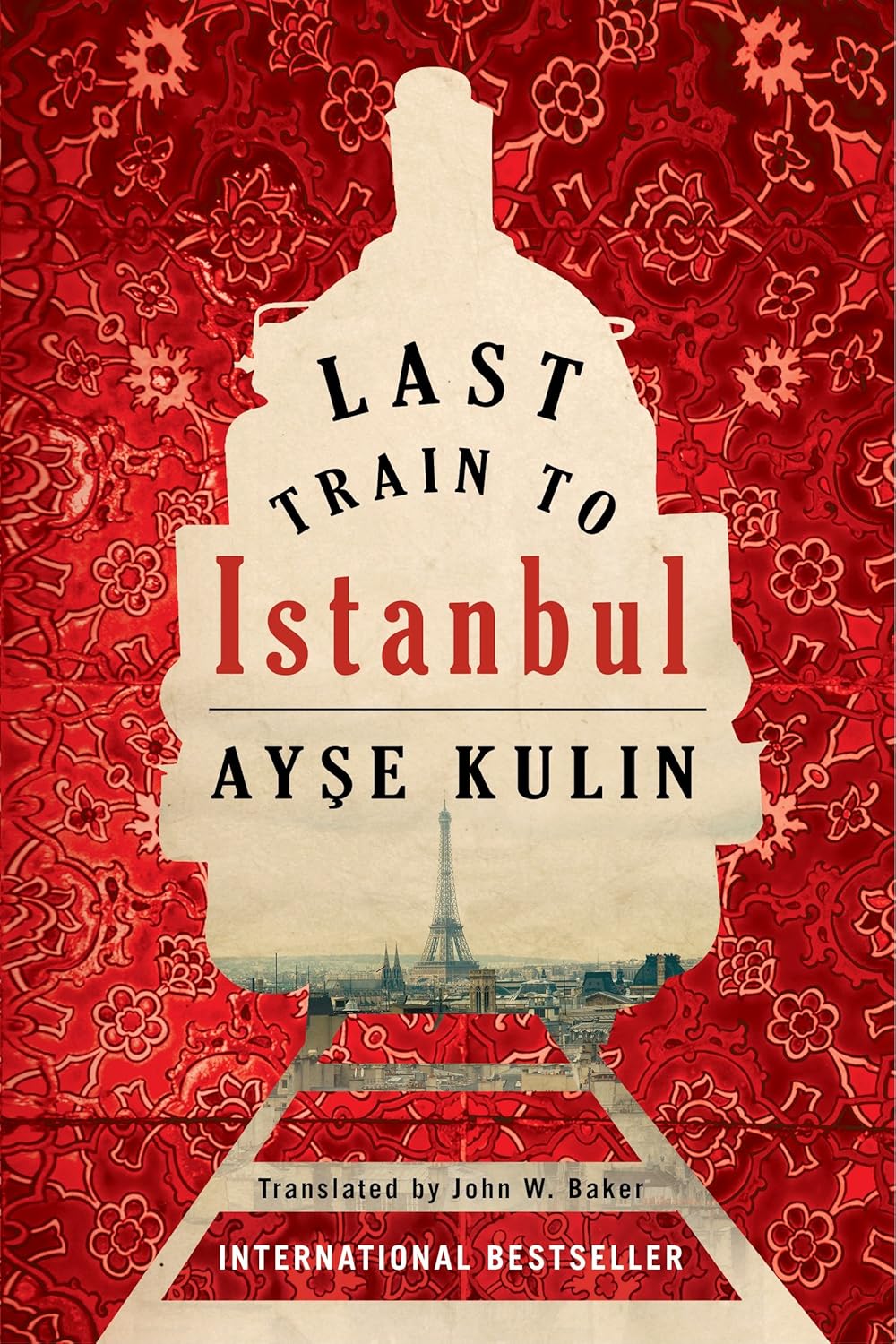
About Last Train to Istanbul by Ayse Kulin – A Historical Novel About Love, Family, War, Identity, and a Dangerous Journey Home
Last Train to Istanbul by Ayse Kulin is a historical novel set during the Second World War. It follows Selva, the Muslim daughter of an Ottoman pasha, and Rafael Alfandari, a Jewish man from a respected Turkish family. Their love is rejected by both families, so they marry and leave Turkey for France, hoping distance will give them a quieter life.
War changes everything. Nazi Germany occupies France, Jews face arrest and deportation, and Rafael’s identity places the couple in growing danger. At the same time, Selva’s family in Turkey begins to understand how serious the situation has become.
The story moves between Turkey and wartime Europe, combining family conflict, romance, diplomacy, fear, and escape. A group of Turkish diplomats becomes involved in efforts to help citizens and Jewish families leave occupied France. The journey that follows gives the novel its title and turns a family story into a wider story about survival, courage, and belonging.
Selva Chooses Love Over Family Approval
Selva grows up in a privileged Muslim household.
Her father is one of the last Ottoman pashas, and her family expects her to marry within the social and religious world they know.
Instead, she falls in love with Rafael, often called Rafo, the Jewish son of an esteemed court physician.
Their relationship creates immediate conflict.
Both families object to the marriage, not because Selva and Rafael do not care for each other, but because religion, tradition, and family expectations stand between them.
Selva chooses Rafael anyway.
That choice gives the novel its first major conflict and continues to affect her long after she leaves Turkey.
The book asks what happens when personal love challenges the rules a family believes should never be crossed.
France Does Not Give Them the Safety They Expected
Selva and Rafael leave Turkey and settle in France.
They hope that living away from their families will allow them to build a life without constant judgment.
For a while, distance gives them more freedom.
Then Europe moves deeper into war.
When German forces occupy France and anti-Jewish policies become more dangerous, Rafael is no longer simply a husband trying to build a new life. His Jewish identity places him at risk of arrest, detention, and deportation.
Selva is forced to see that leaving Turkey solved one problem but placed them inside another, much larger crisis.
The novel uses this change to move from a family conflict into wartime historical fiction.
Sabiha Gives the Story Another Family View
Selva’s older sister Sabiha remains in Turkey.
Her life looks more acceptable to the family because she has married Macit, a man connected with the Turkish Foreign Ministry.
Yet Sabiha is not simply the sister who made the safer choice.
She carries her own emotional struggles and complicated feelings about Selva.
As news from Europe becomes worse, family tension changes into fear.
The distance between the sisters no longer feels like an ordinary family disagreement when Selva may be in real danger.
Through Sabiha, the novel shows how war affects people who are not standing directly inside a battlefield.
Fear can travel through letters, government reports, rumors, delayed news, and the knowledge that someone you love is trapped far away.
Macit Connects Family Life With Diplomacy
Macit’s work in the Turkish Foreign Ministry gives the novel access to the political side of the war.
Turkey is trying to remain outside the fighting for most of the Second World War while facing pressure from powerful countries on different sides.
That creates a difficult diplomatic setting.
Macit and other officials must think about national policy while individual families are asking for help.
Kulin uses this tension to show that government decisions are not abstract when real people are waiting for passports, permissions, transportation, and protection.
The novel moves between private conversations and larger political problems, allowing readers to see how war enters homes even when the country itself is not yet fighting.
The Novel Moves Across Several Cities
The story does not stay in one place.
It moves through Ankara, Istanbul, Paris, Marseilles, Cairo, Berlin, and other locations connected with the war and diplomatic work.
This wider setting helps the novel show how European conflict affects people across borders.
Travel becomes harder.
Documents become more important.
A passport, train route, official letter, or checkpoint can decide whether someone moves forward or is stopped.
The changing locations also give the story a broader historical feel.
Readers see both the relative distance of Turkey from the main fighting and the immediate danger faced by Jewish people in occupied France.
Turkish Diplomats Become Important to the Plot
A major part of the novel follows Turkish diplomats who try to help people caught in occupied Europe.
Kulin presents officials who use diplomatic channels, documents, negotiation to protect citizens and help Jewish families escape.
These sections are one reason the novel has attracted readers interested in less familiar perspectives on World War II fiction.
The book portrays diplomacy as practical work carried out under pressure rather than as formal meetings alone.
A decision about a passport can become a decision about life and death.
Because Last Train to Istanbul is historical fiction, readers should treat its characters and scenes as a literary interpretation rather than a complete documentary record of Turkey’s wartime history.
The Train Becomes a Symbol of Escape
The planned train journey gives the novel its title.
For the passengers, the train represents more than transportation.
It is a possible route out of Nazi-controlled Europe and toward safety.
But leaving is not simple.
The route crosses a continent shaped by war, military control, suspicion, and changing borders.
Every stop can bring another inspection or delay.
Documents must survive close attention.
Passengers have to remain calm even when they know that discovery could have severe consequences.
Kulin builds much of the later suspense around this movement from France toward Istanbul.
The closer the train gets to safety, the more clearly the reader understands how much is at risk.
Religion Is Part of the Story From the Beginning
Selva is Muslim and Rafael is Jewish.
Their marriage places religious difference at the center of the novel before the war begins.
At first, religion creates conflict through family expectations.
Later, under Nazi occupation, Jewish identity becomes connected with persecution and survival.
This change gives the book a wider question.
What does identity mean when society treats it as a reason to separate, reject, or punish people?
Kulin uses the marriage to connect private prejudice with a much larger historical system of persecution.
The novel repeatedly returns to the idea that family bonds and human responsibility can cross religious boundaries.
The Story Mixes Romance, History, and Suspense
Readers may see the book described as historical fiction, wartime fiction, romance, or adventure.
All of those elements are present.
The romance begins the story because Selva and Rafael’s decision to marry changes their lives.
Historical events then create the main danger.
Diplomatic efforts and the train journey bring suspense.
Family relationships connect the different parts.
This combination makes the book suitable for readers who want historical fiction with personal relationships at its center rather than a military story focused mainly on battles.
The English Edition Is a Translation
Ayse Kulin originally published the novel in Turkish as Nefes Nefese in 2002.
John W. Baker translated the novel into English.
Everest Publications released an English edition in 2006. Google Books lists that edition at 414 pages with ISBN 9789752893276.
AmazonCrossing later published an English edition in 2013. Google Books lists that edition at 382 pages with ISBN 9781477807613.
Some catalogues list slightly different page totals for the AmazonCrossing edition, so customers who need a specific page count, cover, or ISBN should check the exact copy before ordering.
The Book Received International Recognition
The AmazonCrossing edition describes Last Train to Istanbul as an international bestseller.
Its publisher biography also notes that the novel received the European Council Jewish Community Best Novel Award and later the Premio Roma in Italy.
Turkish literary reference sources list Nefes Nefese as receiving a European Council of Jewish Communities novel award in 2008 and the Premio Roma award for Best Foreign Novel in 2016.
These recognitions helped the book reach readers far beyond Turkey, and the novel has appeared in many translated editions.
About Ayse Kulin
Ayse Kulin is a Turkish novelist, short-story writer, columnist, screenwriter, and former television and film professional.
She was born in Istanbul in 1941 and studied at the American College for Girls.
Before becoming widely known for her novels, she worked in television, film, production, and screenwriting.
Her books include Aylin, Sevdalinka, Farewell, and many other works of fiction and biographical writing.
Kulin is known for writing accessible stories that connect private lives with larger historical and social events.
Last Train to Istanbul became one of her best-known books internationally.
Who Will Enjoy Last Train to Istanbul?
This book is a strong choice for readers who enjoy World War II historical fiction, family sagas, interfaith relationships, wartime romance, diplomatic history, escape stories, and novels set across several countries.
It may especially appeal to readers looking for WWII fiction told partly from a Turkish perspective.
The book includes antisemitic persecution, Nazi occupation, arrest, fear of deportation, family conflict, war, and emotional distress.
Readers should also remember that it is a novel, not a history textbook.
For a detailed understanding of Turkey, Jewish communities, and the Holocaust, it is best read alongside reliable historical sources.
Book Quality at Bookish Wonderland
Bookish Wonderland offers this title with premium eye-soothing cream paper, crystal-clear printing, and high-quality stitched plus glue binding.
The comfortable paper and clear text support longer reading sessions, while the strong binding makes the book suitable for repeated reading and shelf storage.
The copy works well for personal reading, gifting, historical-fiction collections, book clubs, or readers building a World War II literature shelf.
Why Order from Bookish Wonderland?
Bookish Wonderland delivers books across Bangladesh, including inside and outside Dhaka. Cash on Delivery is available nationwide.
Customers in Dhaka can also ask about fast or urgent delivery when available.
If you are checking Last Train to Istanbul by Ayse Kulin Book price in Bangladesh, it is useful to compare the edition, translation, page count, and physical quality along with the listed price.
Book customization is also available. For stock, edition, customization, or delivery questions, contact Bookish Wonderland through Facebook or Instagram.
Why Readers Choose Last Train to Istanbul
Last Train to Istanbul by Ayse Kulin combines a family divided by an interfaith marriage with the danger of Nazi-occupied France.
Selva and Rafael’s private decision to build a life together becomes connected with war, diplomacy, Jewish persecution, and a risky route toward Turkey.
The novel gives readers romance and family conflict while also showing how passports, borders, officials, and political choices can shape ordinary lives during war.
For readers who enjoy historical fiction with family relationships, international settings, and a journey toward safety at its center, this standalone novel offers a different angle on familiar World War II history.
Order your copy from Bookish Wonderland for nationwide delivery and Cash on Delivery.
If you require customization or have questions, please inbox us via FB or Insta.
| Primary Specification | |
| Author | Ayşe Kulin John |
| Translator | John W. Baker |
| Narrator | Sanjiv Jhaveri |
| Genre | Historical Fiction, World War II Fiction, Historical Romance, War Fiction |
| ISBN-13/ISSN | 978-1477807613 |
| ISBN-10 | 1477807616 |
| Publisher | Amazon Crossing |
| Publishing Date | October 8, 2013 |
| Language | English |
| Reading Age | 18+ |
| Format | Printed Book |
| Physical Specification & Quality | |
| Paper Quality | Premium eye-soothing cream paper |
| Binding Quality | High quality stitched and glue binding (for longevity) |
| Print Quality | Crystal-clear print |
| Pages | 396 pages |
| Country | Turkey |
| Logistics Information | |
| Weight | 421 gm |
| Length | 8.5 inches |
| Width | 5.6 inches |
| Height | 1 inch |