

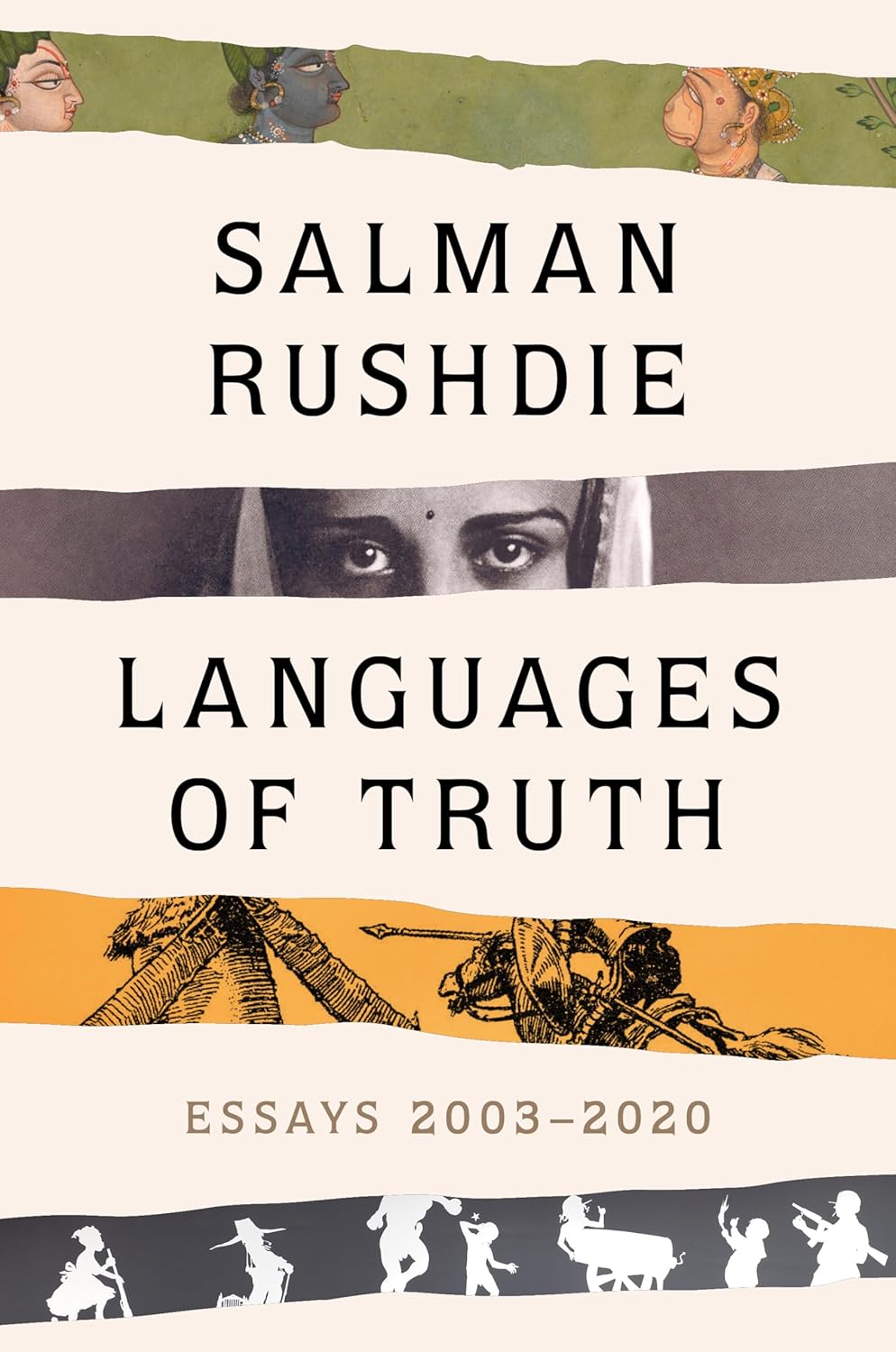
About Languages of Truth Book by Salman Rushdie – Essays on Storytelling, Literature, Freedom, Art, and the Search for Meaning
Languages of Truth by Salman Rushdie is a collection of essays, criticism, and speeches written between 2003 and 2020. Its full subtitle is Essays 2003–2020. Rushdie looks at why people tell stories, what fiction can reveal about real life, and how language changes the way we understand ourselves and others. He also writes about fellow authors, visual artists, public debate, migration, and the freedom to create.
This is nonfiction, not a novel with one plot. Readers move between literary reflections, personal memories, public addresses, and essays on art. Some pieces explore familiar books; others discuss people Rushdie has known or events that shaped his thinking. Together, they offer a clear view of the questions behind his fiction and the writers and artists who interest him.
Why Do Stories Matter?
Rushdie begins by thinking about storytelling as an activity older than printed books. People have always shared accounts of adventures, danger, love, and strange events. Stories can entertain, preserve memories, question accepted ideas, and help us imagine lives different from our own.
He is especially interested in the truth that fiction can carry without being a factual report. A made-up character may reveal something recognizable about fear or hope. A fantastic event can help a writer explore a real social problem. Readers do not have to believe that every event literally happened to understand the feelings or ideas behind it.
Wonder Tales Open the Discussion
In the essay Wonder Tales, Rushdie examines the power of stories that move beyond ordinary reality. Myths, fairy tales, and fantastic fiction can give writers freedom to approach difficult questions from an unexpected direction.
For readers familiar with Midnight's Children, this offers useful context for Rushdie's own methods. His interest in unusual events and playful storytelling is connected to a larger belief that literature should not be limited to plain realism.
The essay also invites readers to reconsider books they once dismissed as simple entertainment. Stories about impossible things can still ask serious questions.
Ideas About Change and Identity
The early essays include Proteus and Heraclitus, titles drawn from figures associated with transformation and change. Rushdie considers the movement of stories and the changing nature of the world around them.
His own writing often crosses borders between countries, cultures, languages, and literary forms. These reflections help explain why he resists narrow rules about what fiction must look like.
It offers arguments to consider, supported by examples from literature and the author's experience. Readers who enjoy thinking about identity, migration, and cultural change will find these subjects appearing throughout the book.
A Writer Looks Back at His Beginnings
Another Writer's Beginnings offers a more personal perspective. Instead of treating a successful author as someone who always knew what to do, Rushdie reflects on the work and uncertainty involved in becoming a writer.
This matters for aspiring authors. Published books can seem complete and inevitable, but their creation involves choices, false starts, reading, and revision. A writer develops a voice by discovering what can be expressed and finding a form that suits it.
These personal passages also provide a connection between Rushdie's essays and his novels.
Conversations With Other Writers
A large part of the collection examines writers Rushdie admires, questions, or has known personally. The contents include essays on Philip Roth, Kurt Vonnegut, Samuel Beckett, Cervantes, Shakespeare, Gabriel García Márquez, Harold Pinter, and Hans Christian Andersen.
Rather than offering a simple list of famous names, Rushdie explains what particular writers do with story, form, voice, and humor. These pieces give readers several routes into books they may want to discover next.
You do not need to have read every author discussed. Familiarity helps with particular references, but the essays can also serve as introductions to different styles of fiction and drama.
Shakespeare and Cervantes Share the Page
One essay brings Cervantes and Shakespeare together. Rushdie considers how their work allows different voices and possibilities to exist within a story. Their writing remains influential because characters and situations can resist a single neat interpretation.
This comparison will interest readers of classic literature and students looking for fresh ways to think about old texts. It also shows why Rushdie reads beyond one national tradition. Literary ideas travel, and authors can learn from work created in another language or century.
Remembering García Márquez and Pinter
The essay Gabo and I considers Gabriel García Márquez, whose fiction is closely associated with magical realism. Rushdie also writes about playwright Harold Pinter, a friend who publicly supported him during a difficult period.
These pieces combine literary appreciation with personal memory. Rushdie looks at what writers produce and how relationships can shape a creative life. They show that literary history is made not only through books but also through conversations, friendships, arguments, and acts of solidarity.
Writing About Adaptation and Autobiography
Rushdie examines what happens when a story changes form and how novels may draw on an author's life. Adaptation raises practical questions: what can a film preserve from a book, and what must change when words become images and performances?
Autobiography raises another problem. Fiction may borrow real experiences without becoming an exact record of them. The person telling the story can select, reshape, and imagine.
These subjects are useful to readers who compare books with screen versions, study narrative techniques, or write stories of their own.
Literature and the Freedom to Speak
Rushdie draws on his involvement with PEN, an organization that defends literature and freedom of expression. The collection includes addresses and reflections associated with that work.
He argues for the importance of allowing difficult, challenging, or unpopular art to exist. These are Rushdie's positions, presented through his own speeches and essays. Readers can examine his reasoning and consider the responsibilities and tensions involved in public expression.
The discussion will interest anyone studying censorship, literary freedom, culture, or the place of writers in public life. It also explains why questions about imagination matter to Rushdie outside the pages of fiction.
Public Life Enters the Collection
Rushdie's subjects are not limited to novels and poetry. The contents include essays connected with Christopher Hitchens, Ai Weiwei, Osama bin Laden, and public addresses delivered at universities.
These writings respond to particular people, events, and debates from the years covered by the book. They should be read as the author's arguments within their historical contexts, not as a neutral account of every issue.
Their presence gives the collection variety. A reader may begin with a discussion of fairy tales and later encounter the difficult choices that arise when artists and public figures speak about society.
Visual Art Gets Serious Attention
The final part turns toward artists and images. Rushdie discusses the Hamzanama, a richly illustrated storytelling tradition associated with the Mughal emperor Akbar, alongside works by Amrita Sher-Gil, Bhupen Khakhar, Francesco Clemente, Taryn Simon, Kara Walker, and Sebastião Salgado.
These pieces show an author responding to art beyond the written page. Paintings, photographs, and visual projects can tell stories, challenge expectations, and raise questions about identity and history.
Others can use the essays as starting points for discovering unfamiliar artists. The section broadens the collection without losing its concern with how people make meaning.
Personal Pieces Close the Book
The later contents include writing about Carrie Fisher and a personal engagement with the coronavirus pandemic. A Proust questionnaire also appears near the end.
These pieces vary in form and subject. They show a writer moving from broad literary questions to the experiences and people that shaped a particular moment. The pandemic essay belongs to the collection's stated ending period, 2020, and should be understood in that context.
A reader can approach these sections independently without needing to work through every earlier essay first.
A Collection You Can Read in Any Order
The four main parts give the book a clear structure, but most pieces can stand on their own. Start with Wonder Tales if you want the central idea. Try an essay on an author you already know, or open the visual art section if paintings interest you more than novels.
Some essays refer to books and events that will be unfamiliar. That is normal for a wide-ranging literary collection. Read the argument, note any title that interests you, and return later if you want more context.
Publication and Edition Details
Random House published the US hardcover on May 25, 2021, with ISBN 9780593133170. The US paperback appeared on July 12, 2022, with ISBN 9780593133194 and 368 pages. Penguin Random House India lists a 2021 hardback at 416 pages with ISBN 9780670092802.
An audiobook is also available, narrated by Raj Ghatak and Salman Rushdie, with a running time of 13 hours and 20 minutes. Formats and regional editions can have different page counts, covers, and ISBNs.
About Salman Rushdie
Salman Rushdie is a British American novelist and essayist whose books include Midnight's Children, The Satanic Verses, The Moor's Last Sigh, Quichotte, and the memoir Joseph Anton. Midnight's Children won the Booker Prize and later received the Best of the Booker distinction.
He has also served as president of PEN America and has taught as a distinguished writer in residence at New York University. His career across fiction and nonfiction helps explain the range of this collection. He writes as a novelist who thinks carefully about literature and as a public figure who has participated in debates about artistic freedom.
Who Will Enjoy Languages of Truth?
This is a suitable choice for readers of literary essays, nonfiction, book criticism, creative writing, cultural studies, and contemporary literature. Fans of Rushdie's novels can discover more about his influences and the ideas behind his storytelling.
Writers and students may enjoy the discussions of form, adaptation, imagination, and other authors. Readers interested in art and free expression will find relevant material in the later parts.
Expect thoughtful arguments and references, not a plot-driven story or a step-by-step writing manual. Some sections are demanding, but the varied subjects allow readers to choose where to begin.
Book Quality at Bookish Wonderland
Bookish Wonderland offers this title with premium eye-soothing cream paper, crystal-clear printing, and high-quality stitched plus glue binding. Comfortable pages support longer reading, while clear text makes it easier to follow detailed arguments and return to favorite passages. Strong binding helps the copy remain useful for repeated reference and shelf storage.
Ordering and Delivery in Bangladesh
Bookish Wonderland delivers inside and outside Dhaka, with Cash on Delivery available nationwide. Customers in Dhaka can ask whether fast or urgent delivery is available. Book customization is offered, and the store can answer stock and edition questions through Facebook or Instagram.
Check the Book price in Bangladesh for Languages of Truth by Salman Rushdie alongside the listed edition, page count, and physical quality. Confirm your preferred format if you need a particular ISBN or cover.
Add a Book of Ideas to Your Shelf
Languages of Truth brings together Rushdie's thinking about stories, other writers, art, culture, and freedom across nearly two decades. It invites readers to ask why imagination matters and how books can reveal truths without simply reporting facts.
Choose it if you want nonfiction that opens paths toward new authors and ideas. Order your copy from Bookish Wonderland with nationwide delivery and Cash on Delivery.
For customization or other questions, message the store through Facebook or Instagram.
| Primary Specification | |
| Author | Salman Rushdie |
| Narrator | Salman Rushdie, Raj Ghatak |
| Editor | Barbara M. Bachman |
| Genre | Nonfiction, Literary Criticism, Essays, Cultural Commentary |
| ISBN-13/ISSN | 978-0593133194 |
| ISBN-10 | 0593133196 |
| Publisher | Random House Trade Paperbacks |
| Publishing Date | July 12, 2022 |
| Language | English |
| Reading Age | 18+ |
| Format | Printed Book |
| Physical Specification & Quality | |
| Paper Quality | Premium eye-soothing cream paper |
| Binding Quality | High quality stitched and glue binding (for longevity) |
| Print Quality | Crystal-clear print |
| Pages | 368 pages |
| Country | USA |
| Logistics Information | |
| Weight | 392 gm |
| Length | 8.5 inches |
| Width | 5.6 inches |
| Height | 0.75 inch |