

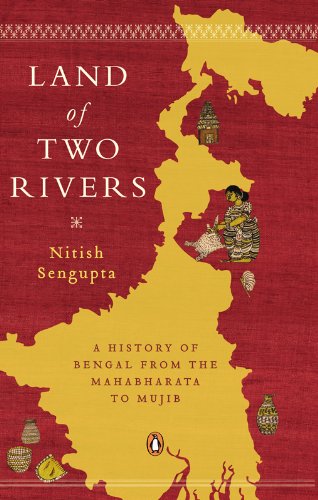
About Land of Two Rivers by Nitish Sengupta – A Wide History of Bengal From Ancient Times to the Birth of Bangladesh
Land of Two Rivers by Nitish Sengupta is a broad history of Bengal, the region shaped by the Ganga and Brahmaputra river systems. The book begins with the earliest recorded periods and moves through ancient kingdoms, medieval dynasties, Mughal rule, European expansion, British colonial rule, the Bengal Renaissance, nationalist politics, Partition in 1947, East Pakistan, and the creation of Bangladesh in 1971.
Its full subtitle is A History of Bengal from the Mahabharata to Mujib. That subtitle explains the scale of the book. Sengupta tries to connect many centuries of political change with the development of Bengali identity, language, religion, culture, and regional power.
For readers in Bangladesh, the later chapters are especially relevant because they trace the history of East Bengal, the political relationship with West Pakistan, the language and autonomy struggles, and the events that led to independence under Sheikh Mujibur Rahman. The book is dense in subject, but its one-volume structure makes it useful for readers who want a long historical overview in one place.
The Rivers Help Explain the Region
The title points to two great river systems: the Ganga and the Brahmaputra. Their waters helped create the fertile Bengal delta and shaped settlement, trade, agriculture, transport, and political life.
Bengal's geography has always mattered to its history. Rivers could connect places, but they could also divide them. Floods changed land. Ports opened routes to trade. Fertile soil supported dense populations and valuable crops.
Ancient Bengal Comes Before the Familiar Modern Story
The early chapters move into prehistoric and ancient Bengal before most of the modern borders readers know today existed.
Sengupta discusses early references to Bengal, the rise of Gaur, Sasanka, the Pala rulers, and the Sena dynasty. These sections show that Bengal had important political centers long before British rule.
The Pala period receives attention because the dynasty controlled large territories and supported Buddhist institutions and learning. The Sena period reflects another stage in political and religious change.
Muslim Rule Changes Bengal's Political Landscape
The medieval chapters trace the arrival of Turkish rulers and the growth of Muslim political power in Bengal.
Sengupta covers the Ilyas Shahi dynasty, Raja Ganesh and later rulers, the spread of Islam, and the emergence of Bengal under independent sultans.
The book gives particular attention to the period of Alauddin Hussain Shah, often remembered as an important ruler in Bengal's history.
Bengali Language and Culture Receive Their Own Attention
Political history is central to the book, but Sengupta also discusses the growth of the Bengali language and major religious and cultural movements.
The Mughals Bring Bengal Into a Larger Empire
The book then follows conflict between Afghan and Mughal power and Bengal's eventual incorporation into the Mughal Empire.
Under Mughal rule, Bengal became one of the empire's richest provinces. Agriculture, textiles, trade, and river transport supported large economic activity.
Sengupta also discusses the appearance of European trading companies and the gradual growth of their influence.
The Nawabs and the Battle of Plassey Mark a Turning Point
The chapters on the independent nawabs lead toward one of the best-known events in Bengal's history: the Battle of Plassey in 1757.
Sengupta discusses Siraj ud-Daulah, Mir Jafar, Mir Qasim, and the political struggles surrounding the East India Company.
Plassey is important because it helped the Company move from commercial influence toward political control in Bengal.
The consequences went far beyond one battle. Revenue collection, administration, trade, and the balance of power all changed.
The book continues into the era of Warren Hastings and the growth of colonial government.
Colonial Rule Changes Economy and Society
British rule transformed Bengal's political and economic structure.
Sengupta examines agrarian change, industry, administration, and popular disturbances against government authority.
The colonial economy created new opportunities for some groups while placing heavy pressure on others. Land revenue systems changed relationships between landlords and cultivators. Trade patterns shifted. Calcutta grew into a major imperial city.
The book also discusses the long-term effects of these changes on Bengali society.
The Bengal Renaissance Creates New Debates
The Bengal Renaissance is one of the major themes of the modern section.
Sengupta looks at intellectual, social, educational, and religious reform during the nineteenth century.
Figures connected with reform movements challenged older practices, debated religion, promoted education, and responded to new ideas coming through colonial institutions.
The book also covers Hindu religious reform movements and the growth of a new educated middle class.
These changes helped create a public culture in which newspapers, schools, literature, associations, and political debate became increasingly important.
Nationalism Grows Alongside Communal Politics
As British rule faced stronger opposition, political organization expanded.
Sengupta traces the beginnings of nationalist politics, the Swadeshi movement, revolutionary activity, the Indian National Congress, and the growing role of Muslim political organizations.
The book also examines the growth of Muslim separatism and the increasing tension between ideas of a united Bengali identity and separate political interests.
The First Partition of Bengal Becomes a Major Political Moment
The 1905 partition of Bengal by the British government produced strong political reaction.
The Swadeshi movement encouraged boycotts of British goods and became a major force in nationalist politics.
Sengupta discusses the different responses among Hindu and Muslim communities and the way the partition debate changed political organization.
The decision was later reversed, but the political effects remained.
Readers can also see how Bengal became one of the main centers of anti-colonial activity in the early twentieth century.
Subhas Bose and the Final Years Before Partition
The book gives attention to revolutionary politics and to Subhas Chandra Bose, one of Bengal's most important nationalist leaders.
Sengupta follows the growing crisis of British rule, debates within nationalist movements, and the changing relationship between Congress, the Muslim League, and regional political leaders.
He also covers attempts to imagine a united Bengal even as Partition became increasingly likely.
These chapters lead toward 1947, when British India was divided and Bengal itself was partitioned.
West Bengal became part of India, while East Bengal became part of Pakistan.
The division separated a region that had shared language, culture, economy, and history for centuries.
East Bengal Enters Pakistan
The later part of the book is especially important for Bangladeshi readers.
Sengupta follows East Bengal after 1947 as it became the eastern wing of Pakistan, geographically separated from West Pakistan by a large part of India.
The political arrangement created major problems.
East Pakistan had a large population but faced disputes over political representation, language, economic policy, and the distribution of power.
The book covers the growth of Bengali political demands and the increasing belief that the eastern wing was being treated unfairly.
Language and culture became major political issues, especially because Bengali was central to the identity of the majority population in the east.
The Road to Bangladesh Becomes the Final Major Story
Sengupta traces the political developments that moved East Pakistan toward independence.
The book discusses the growing demand for autonomy, the leadership of Sheikh Mujibur Rahman, political conflict with West Pakistan, military rule, elections, and the crisis that followed.
Economic inequality and cultural pressure are presented as important parts of the growing divide.
The final chapters move into the 1971 war and the emergence of Bangladesh as an independent country.
The Book Is Broad Rather Than Narrow
Land of Two Rivers covers a very long period, so it cannot examine every event with the depth of a specialist book devoted to one century or movement.
Its strength is breadth.
Readers can see connections between ancient dynasties, medieval rule, colonial transformation, nationalism, Partition, Pakistan, and Bangladesh inside one continuous narrative.
The book is especially useful as an overview before moving to more specialized histories.
Because historical interpretation can differ between scholars, readers studying disputed events should compare Sengupta's account with other academic sources and perspectives.
That is particularly important for politically sensitive topics such as communal relations, Partition, Pakistan, and the 1971 war.
Publication and Edition Details
Penguin published Land of Two Rivers in July 2011.
Penguin Random House India lists the paperback ISBN as 9780143416784 and gives a length of 656 pages.
Google Books also records a 2011 Penguin edition at 656 pages with ebook ISBN 9788184755305, while another catalogue record for an illustrated Penguin Books India edition lists 639 pages.
These differences come from separate editions and catalogue records.
The full subtitle is A History of Bengal from the Mahabharata to Mujib.
Customers who need a specific cover, ISBN, or page count should check the exact edition before ordering.
About Nitish Sengupta
Nitish Sengupta was an Indian civil servant, scholar, and author.
Google Books records that he joined the Indian Administrative Service in 1957 and later served as Revenue Secretary to the Government of India.
He also served as chairman of the United Nations Commission on Transnational Corporations and completed a doctorate in management from Delhi University.
His books include History of the Bengali-Speaking People and My Times.
His administrative experience and interest in Bengal's political history shaped a body of writing that connected government, economics, and historical development.
Who Will Benefit From This Book?
This book is suitable for students, history readers, researchers, teachers, and anyone interested in Bengal, Bangladesh, West Bengal, colonial India, Partition, or South Asian politics.
It is especially useful for readers who want one volume that connects early Bengal with the events of 1971.
The language is more accessible than many highly specialized academic histories, but the book is still detailed and long.
Readers may find it easier to study one period at a time rather than read all 600-plus pages quickly.
Book Quality at Bookish Wonderland
Bookish Wonderland offers this title with premium eye-soothing cream paper, crystal-clear printing, and high-quality stitched plus glue binding.
The comfortable paper supports long reading sessions, while clear printing helps with names, dates, and detailed historical discussion. Strong binding is useful for a large reference book that readers may return to many times.
The copy suits personal reading, university study, gifting, research, or building a South Asian history collection.
Ordering Land of Two Rivers in Bangladesh
Bookish Wonderland delivers across Bangladesh, including inside and outside Dhaka. Cash on Delivery is available nationwide, and customers in Dhaka can ask about fast or urgent delivery when available.
If you are comparing Land of Two Rivers by Nitish Sengupta Book price in Bangladesh, check the edition, page count, and physical quality along with the listed price.
Book customization is also available. Contact Bookish Wonderland through Facebook or Instagram for stock, edition, delivery, or customization questions.
Why Readers Choose Land of Two Rivers
Land of Two Rivers gives readers one continuous account of Bengal across a remarkable span of time.
It connects ancient kingdoms, Muslim dynasties, Mughal administration, colonial expansion, the Bengal Renaissance, nationalism, the 1947 Partition, East Pakistan, and the birth of Bangladesh in 1971.
For Bangladeshi readers, the book offers historical context for many events that shaped the country while also placing those events inside the much longer history of Bengal.
Choose it if you want a detailed one-volume introduction to the political development of Bengal and the forces that shaped Bengali identity over centuries.
Order your copy from Bookish Wonderland for nationwide delivery and Cash on Delivery.
For customization or other questions, message Bookish Wonderland through Facebook or Instagram.
| Primary Specification | |
| Author | Nitish Sengupta |
| Genre | History, South Asian History, Cultural History, Political History |
| ISBN-13/ISSN | 978-0143416784 |
| ISBN-10 | 0143416782 |
| Publisher | India Penguin |
| Publishing Date | January 1, 2011 |
| Language | English |
| Reading Age | 16+ |
| Format | Printed Book |
| Physical Specification & Quality | |
| Paper Quality | Premium eye-soothing cream paper |
| Binding Quality | High quality stitched and glue binding (for longevity) |
| Print Quality | Crystal-clear print |
| Pages | 656 pages |
| Country | India |
| Logistics Information | |
| Weight | 678 gm |
| Length | 8.5 inches |
| Width | 5.6 inches |
| Height | 1.7 inch |