

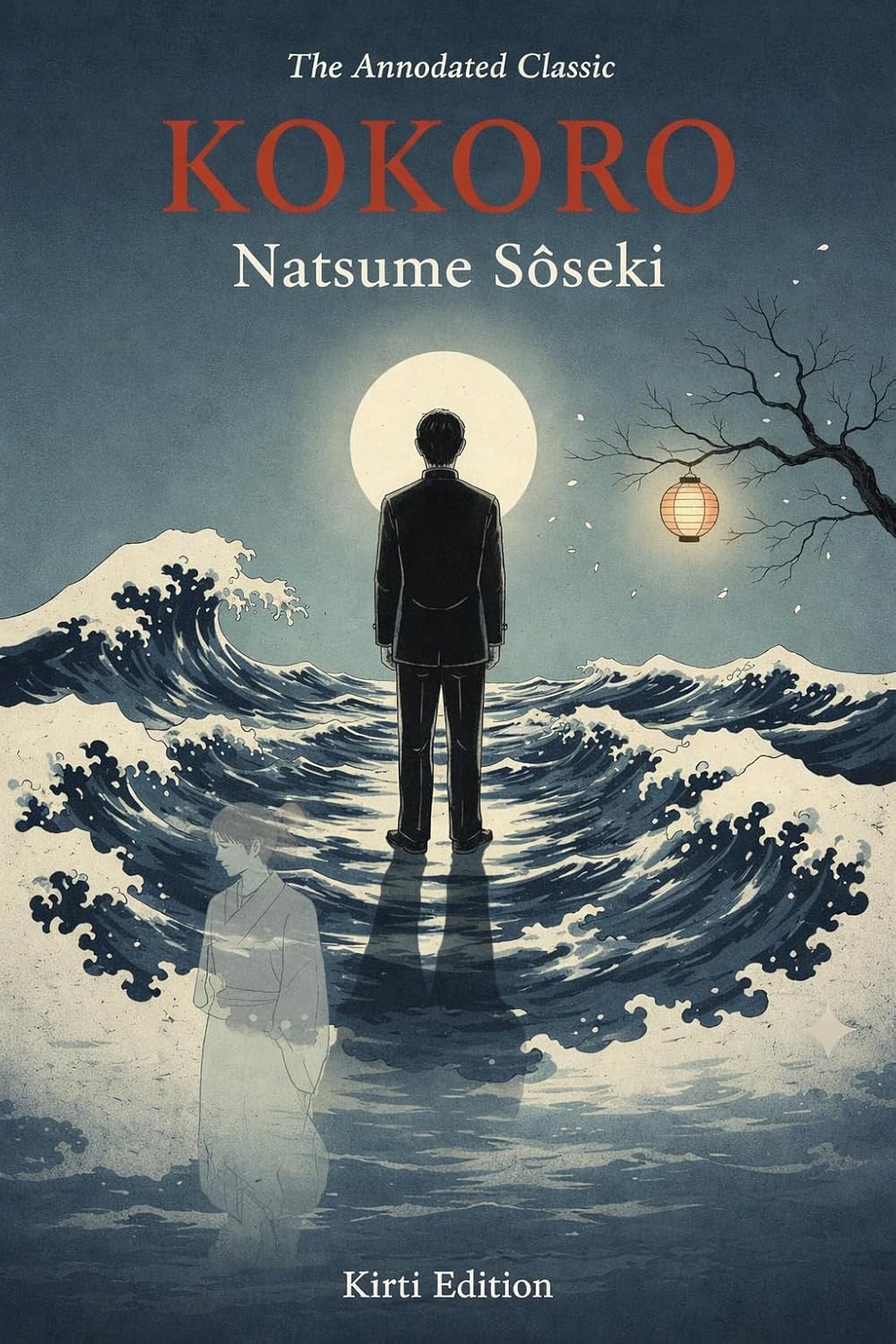
About Kokoro by Natsume Soseki – A Quiet Japanese Classic About Friendship, Guilt, and the Human Heart
Some books move fast. Some books try to shock you. Kokoro by Natsume Soseki does something different. It speaks in a calm voice and slowly takes you inside the mind of a young man and the mysterious older man he calls Sensei. The story may look simple at first, but every meeting, silence, question, and memory carries weight. As the student becomes closer to Sensei, he begins to feel that the older man is hiding pain from his past. That hidden pain becomes the heart of the novel.
First published in 1914, Kokoro is one of the best-known works of modern Japanese literature. The title can be linked with ideas such as heart, feeling, or the inner self. That fits the story well because the novel is less about big action and more about what people carry inside. It looks at friendship, trust, loneliness, love, guilt, family, change, and the fear of being truly known.
A Simple Story That Becomes Deep Very Fast
The narrator is a young student. While spending time near the sea, he notices an older man. The young man feels curious about him and slowly begins a friendship with him. He calls the man Sensei, a Japanese word that can mean teacher or master. Sensei is polite, thoughtful, and often kind, but he also keeps a distance from other people.
The student wants to understand him.
Why does Sensei seem lonely even though he has a wife? Why does he visit a grave? Why does he speak with such little trust in people? Why does he sometimes warn the student not to come too close?
These questions pull the reader forward.
The power of Kokoro comes from the fact that the answers do not arrive quickly. Soseki lets the mystery grow in a quiet way. The student keeps learning small things, yet the full truth remains hidden. Later, a long and deeply personal letter changes how the student understands Sensei, his past, and the pain he has carried for years.
This slow reveal gives the novel its strong emotional force.
When You Want More Than a Fast Story
If you often feel that modern stories move too quickly, this book gives you room to think. The language and structure allow the feelings to build step by step. Instead of giving you a simple hero and villain, the story shows people who are weak, proud, loving, afraid, selfish, and sincere at the same time.
That makes the characters feel human.
Sensei is not easy to judge. The student is not always easy to understand. Their bond is warm, but it also has distance. You may agree with them in one chapter and question them in the next. This is part of what makes the novel useful for readers who enjoy psychology, philosophy, human nature, or serious literary fiction.
Why Sensei Is So Hard to Forget
Sensei is one of the main reasons people remember Kokoro. He is quiet, private, and full of conflict. He wants connection, but he also pulls away from it. He cares about the young narrator, yet he is slow to trust him. His past has shaped how he sees friendship, love, loyalty, and himself.
This creates a strong question at the center of the novel: what happens when a person cannot forgive his own past?
Kokoro does not answer that question with a simple lesson. Instead, it shows how guilt can shape daily life. A person may look calm from the outside while carrying a heavy inner burden. A happy home can still contain silence. A friendship can be real even when one person keeps part of himself hidden.
A Book About Friendship, Trust, and Distance
The friendship between the student and Sensei is not a normal friendship. There is respect between them, but also a gap in age, life experience, and belief. The student looks to Sensei for answers. Sensei often gives him warnings instead.
This makes their talks feel important.
The student wants to believe that knowing another person is possible. Sensei has learned to doubt people. Their difference creates tension without needing loud fights or fast action. Each conversation becomes a small test of trust.
The book also asks a difficult question: can we ever fully know another person?
A friend may smile and still hide pain. A teacher may give advice because of a mistake he once made. A person may love someone and still act out of fear. Kokoro keeps returning to these kinds of ideas in a clear but thoughtful way.
Japan Is Changing, and the Characters Feel It
Kokoro is also a book about change. The story is set around the end of Japan's Meiji era, a time when the country had been changing quickly. Old ideas and new ideas existed side by side. Younger people were growing up in a different world from the one their elders knew.
This background matters because Sensei and the student do not only belong to different ages. They also stand near two different moments in Japanese life.
Sensei carries the weight of an older world. The student belongs more to the new one. Their relationship lets the novel show how large changes in society can enter private life. History is not only something that happens in books or government. It can change how people think about duty, family, success, loyalty, and the future.
A Strong Choice for Readers of Japanese Classics
If you want to start reading classic Japanese literature, Kokoro is a strong place to begin. The story is focused, the main characters are easy to keep track of, and the main ideas are clear even when they are deep.
Readers who like No Longer Human, The Setting Sun, Snow Country, or other reflective Japanese works may also connect with Kokoro. It has a different voice and a different time period, but it shares an interest in loneliness, identity, society, and the private thoughts people do not always say aloud.
This is not a book to choose mainly for action. It is a book to choose for feeling, thought, character, and meaning.
Made for Slow Reading, Notes, and Re-Reading
Kokoro can be read once for the story, then again for the small details you missed.
On a first read, you may focus on the mystery around Sensei. On a second read, you may notice how early conversations prepare you for later truths. You may also see more clearly how the student changes as he learns about the older man's past.
This makes the book useful for many kinds of readers.
A student can read it for class or literary study. A serious reader can use it for quiet personal reading. A book club can discuss trust, guilt, friendship, duty, and social change. A new reader of Japanese literature can use it as a doorway into one of Japan's most important literary traditions.
A Premium Reading Copy from Bookish Wonderland
At Bookish Wonderland, this edition is prepared for readers who want a clean, comfortable printed book that can handle regular reading. The book uses premium eye-soothing cream paper, which gives the pages a soft look and helps make long reading sessions more comfortable. The crystal-clear print keeps the text sharp and easy to follow. High-quality stitched and glue binding is used for better strength and longer life.
These details matter with a classic like Kokoro because this is the kind of book many readers may want to keep, revisit, study, or lend to someone else later.
The aim is simple: give you a reading copy that feels good in the hand, looks neat on the page, and stays useful after more than one read.
What You Gain from Reading Kokoro
Kokoro gives you more than a plot. It gives you a chance to think about people.
You may begin to notice how silence can say as much as speech. You may think about how trust is built and how quickly it can be damaged. You may ask whether guilt can change a person for life. You may also think about the difference between being alone and feeling alone.
The book can help readers understand that people often carry stories we cannot see.
It also shows how personal choices can connect with larger changes in society. A private regret may belong to one person, but the way that person understands duty, honor, friendship, or success may come from the world around him.
For readers who enjoy books with ideas that can be discussed long after reading, this is one of the main benefits of Kokoro.
Who Will Enjoy This Book Most?
Kokoro is a good choice for readers who enjoy calm but deep novels, Japanese literature, classic fiction, psychological stories, and books about human behavior. It can also suit students, book-club readers, literature lovers, and anyone who prefers strong characters over fast action.
It may be especially meaningful for readers who have ever wondered why someone becomes distant, why regret lasts, or why a person may find it hard to trust again.
Because the story is built around memory and confession, it can feel very personal. You are not simply watching events happen. You are slowly being allowed into a private part of another person's life.
A Book for Quiet Evenings and Thoughtful Readers
This is the kind of novel that fits a quiet evening, a weekend reading session, or a slow chapter before sleep. It does not need noise around it. In fact, the more attention you give it, the more it gives back.
You can read it when you want a break from fast thrillers, loud romance, or highly complex fantasy worlds. Kokoro uses a small group of people and simple settings to explore very large feelings.
That simplicity is one of its strengths.
For anyone checking Book price in Bangladesh, Kokoro by Natsume Soseki is a meaningful choice if you want a respected Japanese classic in a durable printed format from Bookish Wonderland.
Why Buy Kokoro from Bookish Wonderland?
Bookish Wonderland is a practical choice for readers who want English books with clear print, durable binding, comfortable paper, and easy ordering. You can order from inside or outside Dhaka, and nationwide delivery is available across Bangladesh. Cash on Delivery is also available, while customers in Dhaka can ask about fast or urgent delivery options when needed.
That means you can focus on choosing the book instead of worrying about how to get it.
Kokoro is also a strong addition to a personal library because it is a book you may want to read again as your own life changes. A line that feels simple today may feel very different years later.
Read the Story Behind the Silence
Kokoro by Natsume Soseki is quiet, but it is not empty. It is full of questions about trust, love, guilt, friendship, loneliness, and change. It asks what happens when a person carries one painful truth for too long, and what another person can learn by hearing that truth.
If you want a classic that is easy to enter but hard to forget, this book deserves your attention.
Order Kokoro by Natsume Soseki from Bookish Wonderland and discover why this Japanese classic continues to speak to readers who care about the hidden parts of the human heart.
If you require any customization or have any questions, please inbox us via FB or Insta.
| Primary Specification | |
| Author | Natsume Soseki |
| Translator | Edwin McClellan |
| Narrator | Matt Shea |
| Genre | Literary Fiction, Classics, Japanese Literature / World Literature |
| ISBN-13/ISSN | 978-0895267153 |
| ISBN-10 | 0895267152 |
| Publisher | Gateway Editions |
| Publishing Date | July 1, 1996 |
| Edition | Seventh |
| Language | English |
| Reading Age | 18+ years |
| Format | Printed book |
| Physical Specification & Quality | |
| Paper Quality | Premium eye-soothing cream paper |
| Binding Quality | High quality stitched and glue binding (for longevity) |
| Print Quality | Crystal-clear print |
| Pages | 256 pages |
| Country | Japan |
| Logistics Information | |
| Weight | 273 gm |
| Length | 8.5 inches |
| Width | 5.6 inches |
| Height | 0.7 inch |