

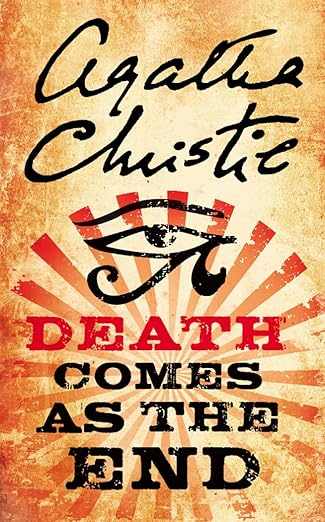
About Death Comes as the End by Agatha Christie – An Ancient Egypt Murder Mystery About Family, Jealousy, Greed, and Hidden Violence
Death Comes as the End by Agatha Christie is a historical murder mystery set in Egypt around 2000 BC. The story follows Renisenb, a young widow who returns to her father Imhotep’s household after the death of her husband. She expects familiar routines, familiar faces, and the comfort of home. Instead, she finds a family already carrying old tensions beneath the surface.
The situation becomes worse when Imhotep, a Ka-priest and landowner, returns with a beautiful young concubine named Nofret. Nofret quickly creates conflict inside the household. She is sharp, proud, and willing to use her influence over Imhotep. The family dislikes her, and resentment grows.
When Nofret is later found dead at the foot of a cliff, many people are willing to believe that fate has removed a difficult woman. Renisenb is not convinced. She begins to suspect murder, and the household soon becomes a place where nobody feels completely safe.
Renisenb Returns Home Looking for Stability
Renisenb has already experienced loss before the murder begins. Her husband, Khay, has died, and she returns to her father’s home with the hope that familiar surroundings will make life feel steady again.
At first, she wants to believe that nothing important has changed. Her brothers are still there. Their wives are still there. Her grandmother Esa remains sharp and observant. Hori, the family’s quiet and thoughtful man of business, is still part of the household.
But Renisenb slowly realises that people do change, even when a house looks the same.
Old jealousy, fear, frustration, and ambition have been growing while she was away. Nofret does not create every problem. Her arrival exposes problems that were already present.
That idea gives the novel more depth than a simple murder puzzle.
Nofret Changes the Balance of the Household
Nofret is younger than Imhotep and arrives as his concubine from the north.
Her presence immediately affects the family.
Imhotep’s sons worry about money, inheritance, authority, and their position in the household. Their wives see Nofret as a threat. Nofret understands that Imhotep is attracted to her and knows that this gives her influence.
She does not try hard to make peace.
Instead, arguments become sharper and private resentments become more open.
Agatha Christie uses Nofret as the person who disturbs a family system that was already unstable. Her behaviour makes people angry, but the novel keeps asking whether anger alone can explain what follows.
The First Death Looks Like an Accident
Because so many people disliked her, some members of the household are willing to accept the death quickly. It is easier to believe that an unpleasant problem has simply disappeared.
Renisenb feels differently.
Something about Nofret’s death does not sit right with her. She begins to wonder whether somebody in the family wanted Nofret dead badly enough to act.
A complaint can become a motive. A frightened look can become evidence. A family disagreement can become part of a murder investigation.
More Deaths Make the Household Afraid
Nofret’s death is not the end.
Other people begin to die, and the family becomes increasingly frightened.
Because the story takes place in ancient Egypt, some characters wonder whether Nofret’s spirit has returned for revenge. The possibility of a curse gives the murders another layer of fear.
Renisenb has to decide whether the danger is supernatural or human.
Christie uses that uncertainty carefully. The setting allows beliefs about death, spirits, burial, and the afterlife to become part of the household’s response without turning the novel into fantasy.
Hori Helps Renisenb Look Beneath Appearances
He works closely with Imhotep and has known the family for years. He is practical, intelligent, and much less interested in drama than many of the people around him.
Renisenb values his way of thinking.
Hori encourages her to look beyond what people say about themselves and consider what their behaviour reveals.
This becomes important because many members of the household have built roles around themselves: the obedient son, the strong wife, the loyal servant, the difficult younger brother, the respectable father.
Esa Sees More Than People Expect
Esa, Imhotep’s elderly mother, is nearly blind, but she is one of the sharpest observers in the household.
Esa is not easily impressed by appearances, and she has little patience for foolish behaviour. Her age gives her a long view of the family’s habits, grudges, and failures.
She becomes important because the investigation is not driven by one official detective.
Instead, Renisenb, Hori, Esa, and others notice different parts of the problem.
That makes the mystery feel rooted in family life rather than in formal police work.
Imhotep Is Powerful but Often Blind to His Own Family
He has money, property, authority, and adult sons who depend on decisions he makes.
Yet he often understands his family less clearly than the people around him do.
His relationship with Nofret makes this worse because he gives her influence while failing to understand how much resentment that creates.
Christie uses Imhotep to show how authority does not always bring insight.
A person can control property and still misunderstand the people living under the same roof.
Money and Inheritance Add Pressure
Money and inheritance matter.
Imhotep’s sons depend on their father’s property and decisions. Their future status can change depending on what he chooses to give, withhold, or reorganise.
Nofret’s influence therefore feels dangerous in practical terms.
If she can change Imhotep’s mind, she may affect the financial future of the entire household.
Christie often wrote mysteries where money, wills, inheritance, and family resentment sit close together, and this ancient setting allows her to use the same human motives in a very different world.
Ancient Egypt Feels Like a Working Household, Not a Museum
One of the most interesting parts of Death Comes as the End is the way ancient Egypt is presented through daily life.
The characters deal with family meals, household work, servants, business, property, clothing, travel, marriage, religion, and social expectations.
Christie does not write the setting only as temples, pharaohs, and monuments.
The story focuses on a family household where people complain, argue, worry about money, fall in love, become jealous, and misunderstand one another.
That makes the historical setting easier to enter.
Real Ancient Letters Helped Inspire the Story
The novel has an unusual historical source.
Agatha Christie’s official site explains that the premise was partly inspired by real Egyptian letters written by a man named Heqanakhte to his family.
The letters discuss household behaviour and the family’s unhappy reaction to his concubine.
Christie’s friend, Egyptologist Stephen Glanville, suggested the idea of writing a detective story set in ancient Egypt and helped her with historical detail.
Christie then used her own experience writing murder mysteries to turn that domestic situation into a fictional chain of deaths.
Christie Knew Archaeology Through Her Own Life
Agatha Christie had direct experience with archaeology through her husband, archaeologist Max Mallowan.
She travelled with him on expeditions in the Middle East and learned about excavation, ancient objects, daily life, and the practical work behind archaeological research.
Her official site says that she drew on that experience and extensive research while writing Death Comes as the End.
This helps explain why the book feels different from a modern mystery simply moved into an old setting.
The social rules, household structure, beliefs, and material world matter to the plot.
This Is Christie’s Only Novel Set Entirely in the Ancient Past
It is her only novel set entirely in the ancient past rather than the twentieth century.
There is no Hercule Poirot, Miss Marple, Tommy and Tuppence, or modern police detective.
That makes it a useful choice for readers who already know Christie’s famous detectives and want to see her use the murder-mystery form in a completely different setting.
The core skills remain familiar: suspicious deaths, family secrets, motives, misdirection, fear, and a final explanation.
The world around those elements is completely different.
The Original Ending Was Changed
Christie changed the ending after suggestions from Stephen Glanville and her publishers.
She later regretted making that change and believed her original ending would have been more effective.
That history is interesting because it shows how closely Glanville was involved with the book’s development.
It also gives longtime Christie readers another reason to discuss the final solution and whether the published ending feels like the strongest possible choice.
Publication and Edition Details
Death Comes as the End was first published in the United States by Dodd, Mead and Company in October 1944.
The first US edition is listed at 223 pages.
The UK edition followed through the Collins Crime Club in March 1945 and was listed at 160 pages.
Later editions vary considerably in length. A HarperCollins edition published in 2010 is listed at 272 pages, while other paperback editions have different pagination.
Customers who need a specific ISBN, page count, or cover should therefore check the exact edition before ordering.
Who Will Enjoy Death Comes as the End?
This book is a strong choice for readers who enjoy Agatha Christie, historical mysteries, ancient Egypt, family murder stories, closed-circle suspects, inheritance conflicts, psychological tension, and unusual settings.
It may especially appeal to readers who want a Christie novel without Poirot or Miss Marple.
The book contains multiple deaths, poisoning, murder, family conflict, fear, and references to bodies and violence.
The language is not especially graphic by modern thriller standards, but the death count is high.
Readers who enjoy mysteries where the suspects are trapped inside one family system will find plenty to follow.
Book Quality at Bookish Wonderland
Bookish Wonderland offers this title with premium eye-soothing cream paper, crystal-clear printing, and high-quality stitched plus glue binding.
The cream paper gives the pages a softer tone for comfortable reading. Clear printing keeps the names, dialogue, and mystery details easy to follow, while the stronger binding supports repeated reading and shelf storage.
The copy is suitable for personal reading, gifting, book clubs, classic mystery collections, or readers building an Agatha Christie shelf.
Why Order from Bookish Wonderland?
Bookish Wonderland delivers books across Bangladesh, including inside and outside Dhaka. Cash on Delivery is available nationwide.
Customers in Dhaka can also ask about fast or urgent delivery when available.
If you are checking Death Comes as the End by Agatha Christie Book price in Bangladesh, it is useful to compare the physical quality of the copy along with the listed price.
Book customization is also available. For stock, customization, or delivery questions, you can contact Bookish Wonderland through Facebook or Instagram.
A Different Kind of Agatha Christie Mystery
Death Comes as the End by Agatha Christie gives readers the familiar pleasure of a Christie family mystery in a setting thousands of years away from her usual England.
Renisenb returns home hoping for stability and instead watches old family tensions become deadly after Nofret enters the household.
The mystery grows through jealousy, money, fear, resentment, and hidden motives rather than through modern forensic evidence.
For readers who enjoy classic whodunits but want something different from Poirot or Miss Marple, this novel offers one of the most unusual settings in Christie’s career.
Order your copy from Bookish Wonderland for nationwide delivery, Cash on Delivery, premium cream paper, clear printing, and strong stitched plus glue binding.
If you require any customization or have any questions, please inbox us via FB or Insta.
| Primary Specification | |
| Author | Agatha Christie |
| Narrator | Emilia Fox |
| Editor | Michael P. Correy |
| Genre | Historical Mystery, Crime Fiction, Detective Fiction |
| ISBN-13/ISSN | 978-0062074133 |
| ISBN-10 | 006207413X |
| Publisher | William Morrow Paperbacks |
| Publishing Date | March 13, 2012 |
| Language | English |
| Reading Age | 16+ |
| Format | Printed Book |
| Physical Specification & Quality | |
| Paper Quality | Premium eye-soothing cream paper |
| Binding Quality | High quality stitched and glue binding (for longevity) |
| Print Quality | Crystal-clear print |
| Pages | 272 pages |
| Country | UK |
| Logistics Information | |
| Weight | 293 gm |
| Length | 8.5 inches |
| Width | 5.6 inches |
| Height | 0.61 inch |