

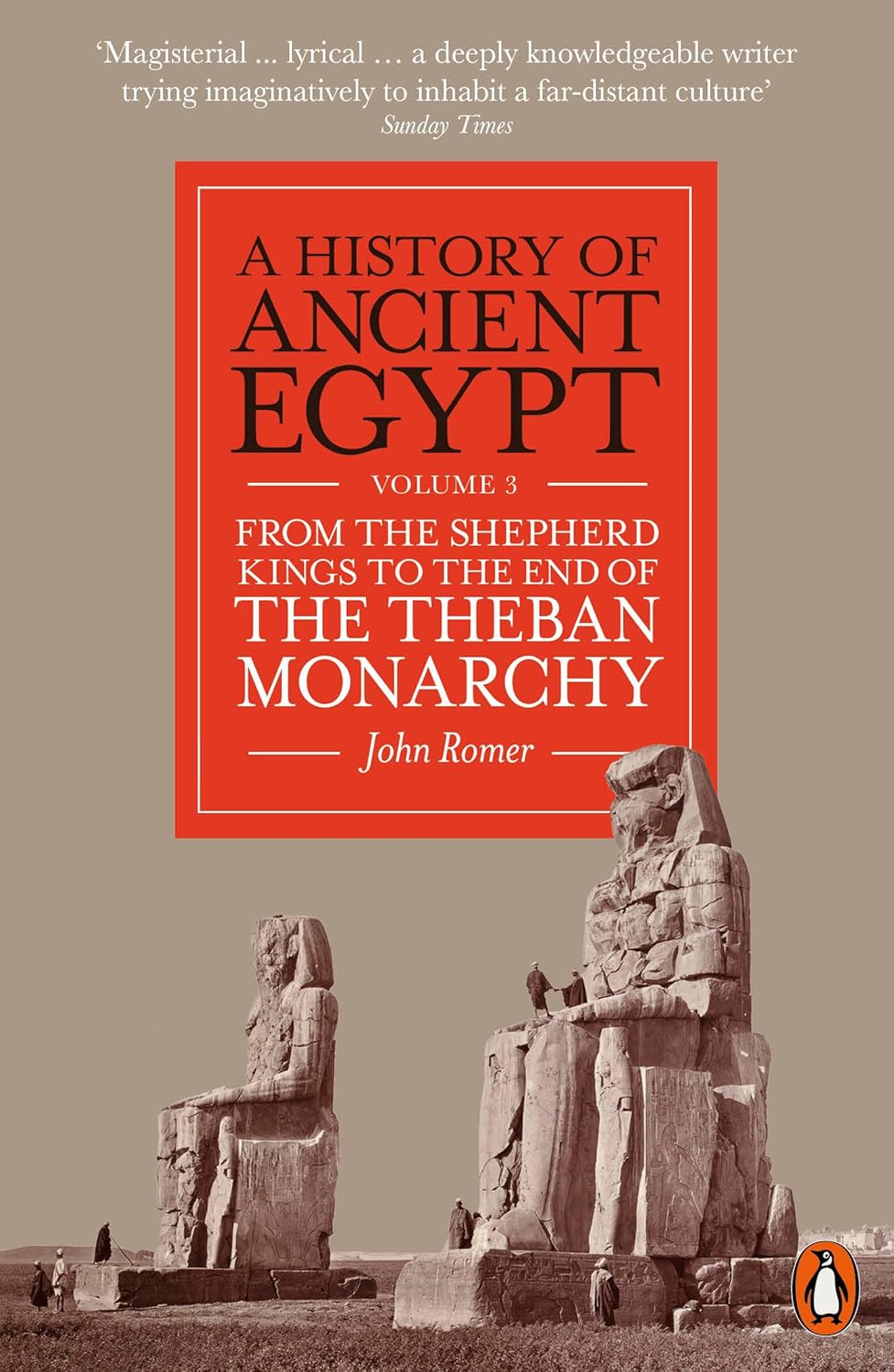
About A History of Ancient Egypt by John Romer (Volume 3 of 3): The Final Journey Through Egypt’s New Kingdom
Some history books give you a list of kings, wars, and dates. This book gives you something deeper. A History of Ancient Egypt by John Romer (Volume 3 of 3) takes you into one of the most famous times in Egypt’s long story. It begins with the Shepherd Kings and moves through the New Kingdom to the last years of the Theban monarchy. Along the way, you meet names that still catch the world’s eye: Hatshepsut, Akhenaten, Tutankhamun, and Ramesses II.
Yet this is not only their story. John Romer looks past crowns and grand statues. He studies the people who built tombs, made art, wrote letters, traded goods, and kept temples alive. He asks what the objects left in the ground can truly tell us. The result is a wide, careful, and very human view of ancient Egypt. If you want more than old myths, this final volume can change how you see the world of the pharaohs.
See the real Egypt behind the famous names
Ancient Egypt can feel hard to understand. Many books move fast through long lists of rulers. Some tell simple stories about good kings, bad kings, sudden wars, and great wins. That may be easy to follow, but it can hide how life truly worked. Modern ideas are often placed on a world that thought in a very different way.
John Romer offers a better path. He starts with the evidence. A damaged object, a wall image, a work area, or a letter may show more than a later tale. He looks at how people lived, worked, shared ideas, and made meaning. This helps the past feel less like a school chart and more like a living place.
The book does not remove the wonder. It makes the wonder stronger. You still enter temples, royal courts, tombs, and growing cities. But now you can ask better questions. Who made these things? Why were they made? What can we know, and what must stay uncertain? That honest method gives readers a history they can trust and think about.
A rich story of the New Kingdom
Volume 3 starts in a time of division, when the rulers known as the Shepherd Kings, or Hyksos, held power in part of Egypt. It follows the changes that led to a new royal age based strongly around Thebes. Egypt then became part of a busy world linked by travel, trade, gifts, craft, and conflict.
The story moves through the rise of the New Kingdom and its great building age. It looks at Hatshepsut and the unusual form of her rule. It reaches the time of Akhenaten, whose religious changes still lead to debate. It also places Tutankhamun inside his own time, beyond the gold mask that made him famous today. Later, the book explores the age linked with Ramesses II and continues toward the end of Theban royal power.
Romer does not treat these rulers as lone heroes who made everything happen. He shows a larger world around them. Artists, builders, officials, families, traders, and temple workers all had a part. This makes the book feel full. Egypt is not a stage with one king in the light. It is a whole society, moving and changing across many lives.
History made from things people left behind
One of the book’s greatest strengths is the way it uses physical proof. Romer has spent a lifetime working with ancient Egypt. He understands that a broken item can matter. A ruined workshop can matter. A short note between family members can matter. These small traces often bring us closer to real lives than a grand royal claim.
Royal writing was made for a purpose. It could praise a ruler, honour a god, mark a gift, or show order after danger. It was not a modern news report. Romer reads such records with care. He also looks at the place, object, and human work around the words. That allows him to test old ideas instead of simply repeating them.
This approach is helpful for new readers and serious history lovers. You do not need to agree with every view to enjoy the book. The value is in seeing how history is built. You watch the author move from evidence to meaning. You also learn why some popular stories may be too neat. Reading becomes an act of discovery, not just memory.
Written for curious readers who want depth
This is a large work of history, so it suits a reader who enjoys a slow and thoughtful journey. It is a strong choice for ancient history fans, Egyptology readers, university students, teachers, researchers, museum lovers, and anyone who enjoyed the first two volumes. It can also suit a new reader who is ready for detail and does not mind meeting unfamiliar names.
Use it for quiet reading at home. Keep it near you while watching a film about Egypt, visiting a museum, or planning a study project. Read one part at a time and mark the ideas you want to explore later. It also makes a meaningful gift for someone who loves archaeology, old cultures, temples, tombs, or serious non-fiction.
The language and ideas ask for attention. This is not a tiny fact book for very young children. It is a full history for older teens and adults. Still, Romer’s focus on objects and people gives readers clear points to hold. You can see the past through things that were made, used, broken, saved, and found.
The ending your three-volume journey deserves
If you have read Volumes 1 and 2, this book completes a long path. The first volume begins with early farmers and moves toward the Great Pyramid. The second continues from the pyramid age to the fall of the Middle Kingdom. The third carries the history into the celebrated yet often misunderstood New Kingdom and closes the trilogy at the end of the Theban monarchy.
That wide reach is one reason the set feels special. Across three books, Romer does more than move along a timeline. He keeps asking how we know the past. He studies the gap between ancient evidence and modern stories. By the final volume, this method becomes especially powerful because the period contains so many famous faces and fixed ideas.
You may read Volume 3 on its own if the New Kingdom is your main interest. The book explains its own era and has a complete focus. However, reading the full series gives more context. You can follow changes in work, belief, rule, building, and society over a much longer time. Together, the books form a lasting home reference for readers who want Egypt in depth.
A premium copy made for long reading
Bookish Wonderland prepares this printed book for readers who care about comfort and strength. The pages use premium, eye-soothing cream paper. The soft cream colour is calm under normal light, which helps during long reading sessions. Crystal-clear printing keeps letters sharp, maps and details easy to follow, and each page pleasant to study.
The book also uses high-quality stitched and glue binding. The stitches add support, while the glue helps keep the page block secure. This is useful for a large history book that may be opened many times for reading, study, or reference. With normal care, it can remain a strong part of your shelf for years.
These choices match the kind of reading this work invites. You may want to pause, return to an earlier point, compare names, or revisit a favourite period. A comfortable page and firm binding make that easier. The result is a premium edition made for real use, not only for display.
What you gain from this book
- A complete account of the final period covered by John Romer’s three-volume history.
- A careful view of the Shepherd Kings, the New Kingdom, and the end of Theban royal rule.
- Fresh context for Hatshepsut, Akhenaten, Tutankhamun, Ramesses II, and their times.
- A wider picture that includes workers, artists, families, trade, faith, and cultural exchange.
- A clear example of how historians use objects, writing, ruins, and other clues.
- A thoughtful challenge to simple modern stories placed on the ancient world.
- A useful reference for personal reading, class work, teaching, and later research.
- A handsome shelf book for readers building an English ancient-history collection.
The main benefit is simple: you begin to see ancient Egypt with more care. The book can help you move from “I know the famous names” to “I understand the world around them.” That is a much more rewarding place for any history reader to reach.
Easy ordering from Bookish Wonderland
Finding a serious English history title locally can take time. Bookish Wonderland brings together a large collection of premium and durable English books for readers across the country. You can order A History of Ancient Egypt by John Romer (Volume 3 of 3) without having to search shop after shop.
Cash on Delivery is available nationwide. Delivery is offered inside Dhaka and outside Dhaka, so readers in many areas can place an order with ease. If you live in Dhaka and need the book quickly, ask about the fast or urgent delivery option before confirming your order.
If you are checking A History of Ancient Egypt by John Romer Volume 3 price in Bangladesh, contact Bookish Wonderland for the current price and stock status. The final cost may depend on the available copy and delivery place. The team can also answer questions about your order through Facebook or Instagram.
What books are in the A History of Ancient Egypt series by John Romer?:
The A History of Ancient Egypt has 3 volumes. They are:
-
A History of Ancient Egypt: From the First Farmers to the Great Pyramid by John Romer (A History of Ancient Egypt, Volume 1 of 3)
-
A History of Ancient Egypt: From the Great Pyramid to the Fall of the Middle Kingdom by John Romer (A History of Ancient Egypt, Volume 2 of 3)
- A History of Ancient Egypt: From the Shepherd Kings to the End of the Theban Monarchy by John Romer (A History of Ancient Egypt, Volume 3 of 3)
Best Sellers Rank of This Book
- #675,602 in Kindle Store
- #67 in History of Egypt
- #102 in Ancient African History (Kindle Store)
- #154 in Architecture History & Periods
These ranks are shown exactly as supplied for this product listing. Online sales ranks can change over time and may differ by marketplace or format.
Open the final volume and enter a changing world
This is the part of Egypt’s story many people think they already know. The golden mask is familiar. The huge statues are familiar. The names of Akhenaten and Ramesses II are familiar. John Romer shows why familiarity is only the start.
Behind every grand image are hands that cut stone, mixed colour, carried goods, wrote notes, and built a life beside the Nile. Behind every royal claim is a real piece of evidence that must be read with care. Behind every simple legend is a culture that was more complex, connected, and surprising than a short tale can show.
It is also a fine choice for a reader who wants a careful guide to the New Kingdom without losing the people, places, and objects behind its history.
Bring this final volume home if you want history that respects both evidence and wonder. Read it to complete the trilogy, support your studies, deepen your knowledge, or spend many quiet hours in one of the ancient world’s most powerful cultures. Order from Bookish Wonderland today, choose the delivery option that suits you, and ask about Cash on Delivery. Your journey from the Shepherd Kings to the end of the Theban monarchy can begin with the first page.
If you require any customization or have any questions, please inbox us via FB or Insta.
| Primary Specification | |
| Author | John Romer |
| Genre | History, Ancient History, Egyptology, Archaeology and African History |
| ISBN-13/ISSN | 978-0141993355 |
| ISBN-10 | 0141993359 |
| Publisher | PENGUIN UK |
| Publishing Date | May 22, 2024 |
| Language | English |
| Format | Printed Book |
| Physical Specification & Quality | |
| Paper Quality | Premium eye-soothing cream paper |
| Binding Quality | High quality stitched and glue binding (for longevity) |
| Print Quality | Crystal-clear print |
| Pages | 704 pages |
| Country | UK |
| Logistics Information | |
| Weight | 723 gm |
| Length | 8.5 inches |
| Width | 5.6 inches |
| Height | 1.34 inch |