

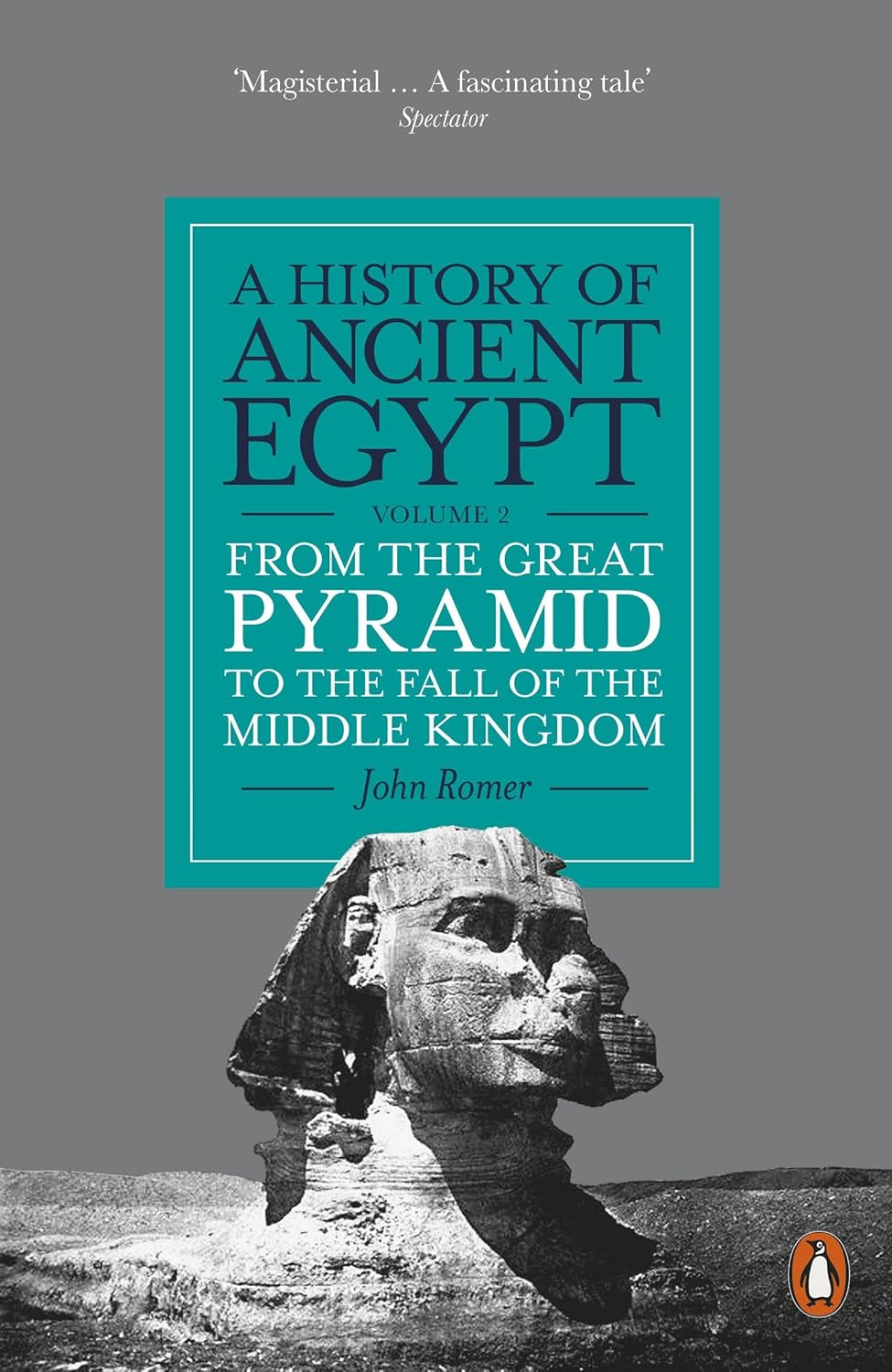
About A History of Ancient Egypt by John Romer (Volume 2 of 3): Life Beyond the Great Pyramid
The Great Pyramid may look like the end of a great story. In this book, it is the beginning. John Romer starts with the world that built this huge monument and follows Egypt through the rise and fall of the Middle Kingdom. It is a long journey filled with buildings, objects, written words, changing ideas, and the lives of people who lived thousands of years ago.
This volume gives you the middle part of Romer’s three-book history. It connects the early world of Volume 1 with the later age explored in Volume 3. You can also read it as a deep study of one important period in its own right.
The story continues after the Great Pyramid
Many people know the names of the pyramids at Giza, but they know less about the centuries that came next. That can leave a large gap in the story of Egypt. A monument may survive, while the people, choices, work, and changes behind it are harder to see.
Romer helps fill that gap. He begins around the building of the Great Pyramid and moves through the Old Kingdom and into the Middle Kingdom. The book shows how Egypt changed after its most famous monument was complete. Royal power did not stay still. Ways of organising work changed. Written records grew. Buildings, objects, and places began to tell new parts of the story.
This makes Volume 2 useful for anyone who has finished a basic guide and wants a fuller view. It takes a part of Egyptian history that can feel unclear and turns it into a connected account.
Understand history without memorising endless lists
Ancient history can be hard when every page gives the reader another name, date, or dynasty. It is easy to remember a fact for a day and then forget why it mattered. Romer offers another way to learn.
He builds the history around things that remain. A wall can show how a space was used. An object can point to work, trade, skill, or belief. A written text can show what people valued, but it must still be read with care. By joining many kinds of clues, Romer gives the reader a stronger picture than a royal list can provide.
This method helps each detail find a place. Names and dates are still important, but they support the story instead of taking it over. The reader sees change taking place in real homes, workshops, temples, tombs, and public spaces.
See what the evidence can really tell us
One of the book’s main ideas is simple: history should begin with evidence. Old books often described ancient Egypt as a land ruled only by cruel kings and damaged by constant war. Romer checks such claims against the architecture, objects, and writing that have survived.
He also explains that evidence has limits. A broken object cannot answer every question. A royal text may show what a ruler wanted people to believe, not every part of daily life. A grand tomb can tell us much about wealth and belief, yet it cannot speak for every person in Egypt.
By showing these limits, the book becomes more trustworthy. Romer does not need to turn every missing fact into a dramatic tale. He lets the remains lead the discussion and shows why experts may change their minds when new finds appear.
Readers gain more than information about Egypt. They learn how careful history is made.
Follow Egypt through a major age of change
The book covers the time from the Great Pyramid to the end of the Middle Kingdom. During this wide period, Egypt saw strong royal projects, times of change, new forms of order, and a rich growth in written culture.
The journey includes:
- The world connected with the building of the Great Pyramid
- Life and power during the later Old Kingdom
- The use of buildings, objects, and writing as historical evidence
- Changes in rule, work, belief, and social order
- The rise of the Middle Kingdom
- A period when Egyptian writing flourished
- The decline and fall of the Middle Kingdom
- Questions raised by older views of Egyptian kings and warfare
These subjects are not presented as separate boxes. Romer looks for links between them. A change in building may connect with a change in work. A new kind of writing may reveal a new way of seeing life. A damaged site may still hold a clear sign of how people used it.
The book therefore feels like a journey through a changing society, not a set of loose facts.
Meet ancient Egypt through ordinary things
The most famous remains of Egypt are huge, but small objects can carry just as much meaning. Romer pays attention to the things people made, touched, used, and left behind. These details bring daily life closer.
A tool may show the skill needed for a task. A room may reveal how people moved or worked together. A line of writing can point to duty, memory, belief, or fear. Even the place where an object was found may change what it means.
This close view gives the book a human side. Kings and large buildings remain part of the story, but they are not the whole story. The reader also thinks about makers, writers, planners, builders, farmers, officials, and families.
That balance is one reason the book can stay in the mind. It shows that a great culture was formed by many hands over many years.
Read a historian who knows Egypt closely
John Romer has worked in Egypt since 1966. His experience includes important sites such as Karnak, Medinet Habu, and the Valley of the Kings. He also led the Brooklyn Museum expedition that excavated the tomb of Ramesses XI.
His field experience shapes the way he writes. Buildings are not flat names on a page. They have size, shape, material, and place. Objects are not used only as decoration. They are part of the record of past lives.
Romer is also willing to question older ideas. He looks at how early Egyptologists built large stories and asks whether the surviving evidence truly supports them. This does not make the past less exciting. It makes the picture clearer and more honest.
Readers who enjoy archaeology will value this care. Readers new to the subject will learn to ask better questions as they move through the book.
A detailed book that remains open to general readers
Volume 2 is a serious history, but it is not written only for experts. Romer explains the larger picture and guides the reader through difficult periods. No degree in archaeology or Egyptology is required.
The book is best for someone who enjoys slow, thoughtful reading. It is not a short collection of fun facts. Some chapters contain complex ideas, long periods, and close discussion of evidence. Taking notes or reading one section at a time may help.
A practical reading age is 16 and above, although the publisher does not give an official age rating. Older teens, university students, teachers, adult readers, and history lovers can all find value here.
If you already know the famous pharaohs, this book can show you the deeper world around them. If you are a beginner, it can build a solid base for future reading.
Reasons to add Volume 2 to your shelf
This book can serve more than one purpose. You can read it from start to finish, use it beside a course, or return to selected chapters when another book raises a question.
It is a strong choice for:
- Readers continuing from Volume 1
- Students studying ancient history or archaeology
- Teachers seeking clear background for lessons
- Museum visitors who want better context for Egyptian objects
- Travellers interested in the history behind ancient sites
- Readers who question simple stories about kings and war
- Collectors completing John Romer’s three-volume work
The main benefit is context. The book helps you see why the Old and Middle Kingdoms matter, how evidence shapes our knowledge, and how one period leads into another. Instead of learning only isolated facts, you gain a framework that makes later reading easier to understand.
A copy made for long reading sessions
Bookish Wonderland offers this edition with premium, eye-soothing cream paper. The softer colour is comfortable during long reading and produces less harsh glare than bright white pages. Crystal-clear printing keeps the letters clean, sharp, and easy to follow.
The pages are held with high-quality stitched and glue binding. Stitching supports groups of pages, while glue adds strength along the spine. This combination is designed for regular use and longer book life.
Keep the copy upright in a cool and dry place. Protect it from water, strong sunlight, and heavy pressure. Use a bookmark instead of folding corners, and avoid forcing the spine flat. With simple care, the book can remain useful for study, rereading, and display for years.
What books are in the A History of Ancient Egypt series by John Romer?:
The A History of Ancient Egypt has 3 volumes. They are:
-
A History of Ancient Egypt: From the First Farmers to the Great Pyramid by John Romer (A History of Ancient Egypt, Volume 1 of 3)
-
A History of Ancient Egypt: From the Great Pyramid to the Fall of the Middle Kingdom by John Romer (A History of Ancient Egypt, Volume 2 of 3)
- A History of Ancient Egypt: From the Shepherd Kings to the End of the Theban Monarchy by John Romer (A History of Ancient Egypt, Volume 3 of 3)
Best Sellers Rank of This Book
- #2,201,092 in Books
- #685 in Ancient Egyptians History
These are the marketplace rankings supplied for this product listing. Sales ranks can move when purchases and category positions change, so they may not remain fixed.
Price, payment, and delivery made simple
If you are checking A History of Ancient Egypt by John Romer price in Bangladesh, visit the product page for the current amount. Stock, print costs, and special offers can affect the displayed price. When comparing the book price in Bangladesh, also consider print clarity, paper comfort, binding, and delivery service.
Bookish Wonderland delivers inside Dhaka, outside Dhaka, and across the country. Cash on Delivery is available nationwide, allowing you to pay when the order reaches you. Customers in Dhaka can ask about fast or urgent delivery when that service is available for their location and order time.
You can also contact Bookish Wonderland through Facebook or Instagram before ordering. Ask about stock, the current price, expected delivery time, or available custom options.
Continue the story beyond the pyramids
The Great Pyramid is one of the world’s best-known buildings, yet Egypt did not stop changing when it was finished. New rulers came, old systems changed, writing grew, and the Middle Kingdom formed its own rich culture.
This volume lets you follow that less familiar part of the journey. It takes you beyond the image of Egypt found on posters and into the evidence left by real people. You will see not only what survived, but how historians use those remains to rebuild a lost world.
Order A History of Ancient Egypt by John Romer (Volume 2 of 3) from Bookish Wonderland and continue your study from the Great Pyramid to the fall of the Middle Kingdom. Add it to your history shelf, read it beside Volume 1, or choose it as the next step in a deeper study of ancient Egypt.
Open Volume 2 and discover what came after the age everyone remembers.
If you require any customization or have any questions, please inbox us via FB or Insta.
| Primary Specification | |
| Volume | 2 of 3 |
| Author | John Romer |
| Genre | Ancient History, Egyptology, Archaeology, Nonfiction |
| ISBN-13/ISSN | 978-0141399720 |
| ISBN-10 | 0141399724 |
| Publisher | Penguin UK |
| Publishing Date | December 26, 2017 |
| Language | English |
| Reading Age | 16+ |
| Format | Printed Book |
| Physical Specification & Quality | |
| Paper Quality | Premium eye-soothing cream paper |
| Binding Quality | High quality stitched and glue binding (for longevity) |
| Print Quality | Crystal-clear print |
| Pages | 500 pages |
| Country | UK |
| Logistics Information | |
| Weight | 523 gm |
| Length | 8.5 inches |
| Width | 5.6 inches |
| Height | 1.18 inch |