

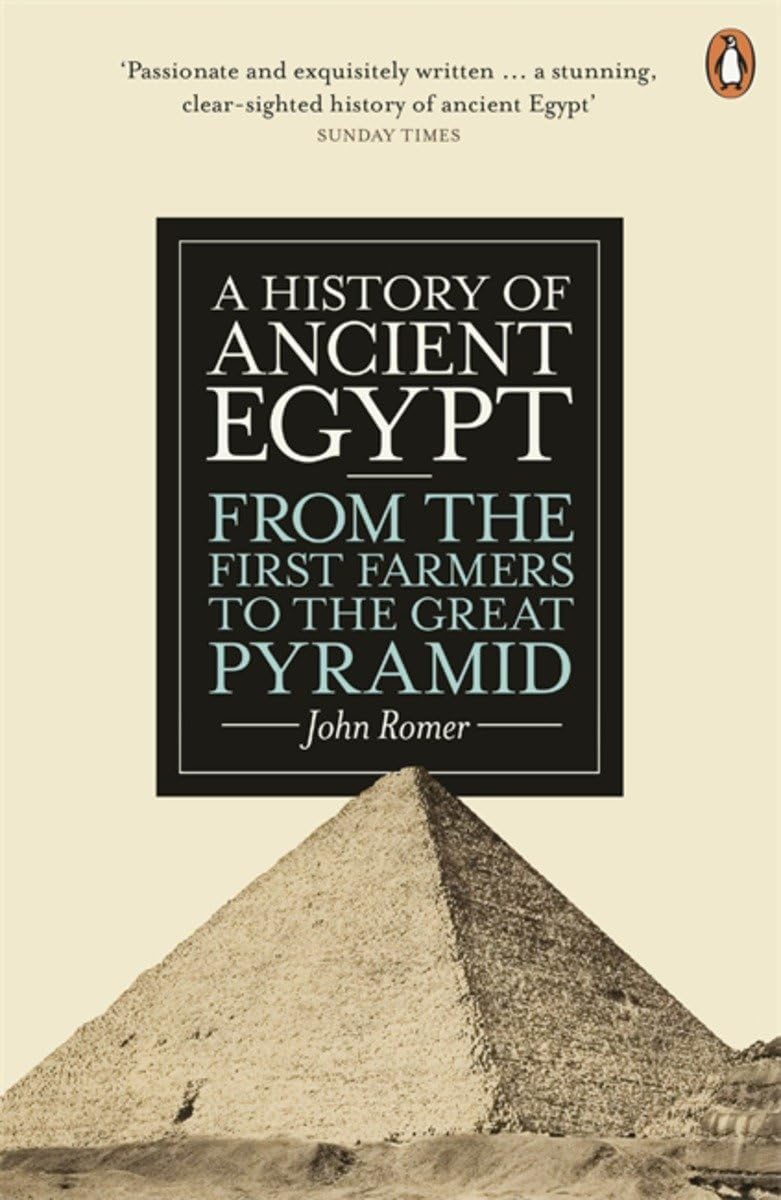
About A History of Ancient Egypt by John Romer (Volume 1 of 3): See How a Great World Began
Long before the gold masks, great kings, and tall stone temples, people lived beside the Nile in small groups. They fished, farmed, made tools, buried their dead, and learned how to work with the land. From those quiet beginnings came one of the most famous cultures in human history.
A History of Ancient Egypt by John Romer (Volume 1 of 3) tells that early story. It starts before Egypt became a kingdom and follows the long path to the Great Pyramid. This is not only a book about rulers. It is about people, places, objects, homes, graves, art, work, and the small signs left behind in the earth.
If you have ever looked at a pyramid and asked, “How did people reach this point?” this book gives you a clear and rich answer. It helps you see ancient Egypt as a living world that grew over time, not as a land that appeared all at once.
Begin before the age of the pharaohs
Many books open with famous kings and ready-made dynasties. John Romer begins much earlier. He takes the reader to the Nile Valley when early groups were learning to settle, grow food, make useful goods, and form larger communities. This early part matters because the Great Pyramid makes more sense when we know what came before it.
The story moves from the first farmers to the rise of royal power. Along the way, the book looks at how daily life changed. Small villages grew. Skills became stronger. Beliefs took shape. Ways of making and moving goods improved. Signs of rank and rule began to appear. Step by step, Egypt became able to plan and build on a huge scale.
The Great Pyramid is not treated as a strange wonder with no past. It becomes the result of a very long human journey. That makes the final part of this volume feel earned, clear, and exciting.
Find the answer behind the famous monuments
A common problem for new readers is that ancient Egypt can feel like a list of hard names, dates, and kings. Another problem is that popular shows often begin with mystery. They may tell us what looks amazing without showing how historians know it.
This book offers a better path. Romer uses real remains to build the story. A bead, a grave, a tool, a wall, or the plan of a building may hold an important clue. He explains how experts read these clues and why their ideas can change when new facts appear.
The result is a history that feels close to the ground. It answers not only “What happened?” but also “How can we know?”
Walk through a world made from real clues
Romer’s main strength is his close look at physical things. He can move from a small necklace bead to a royal tomb and show why both matter. This gives the book a wide view without losing the human side of the past.
The pages explain how land, water, work, craft, and belief joined together. The Nile was not simply a pretty background. It shaped food, travel, settlement, and time. The desert also mattered. It helped protect some remains, yet it placed hard limits on life. By looking at the whole setting, the book shows why Egypt grew in its own special way.
Readers will meet people whose names are lost as well as rulers whose names still live. Farmers, fishers, makers, builders, and workers all have a place in this account. Their tools and living spaces help tell a story that royal lists cannot tell alone.
This makes the book useful for readers who want more than quick facts. It shows culture growing through many small acts across many years.
Learn from a writer who knows the sites
John Romer is not writing about Egypt only from a desk. He has worked in Egypt since 1966. His field experience includes major sites such as Karnak, Medinet Habu, and the Valley of the Kings. He also led work connected with the tomb of Ramesses XI.
That long contact with ancient places can be felt in his writing. Buildings have shape, weight, light, and space. Objects are not just names in a list. They are things made and used by people. Ruins become records that must be read with patience.
Romer also knows that old remains do not explain themselves. Every claim needs thought. Some clues are clear, while others allow more than one answer. He often shows where a common story came from and why a different reading may fit the evidence better.
This careful style gives the reader room to think. The author is a guide, but he does not hide the limits of what can be known.
Discover what Volume 1 covers
This first volume has a clear path and a strong end point. It begins with the earliest roots of settled life in the Nile Valley and continues through the growth of the Egyptian state. It then reaches the Old Kingdom and the building of Khufu’s Great Pyramid at Giza.
Key areas include:
- Early farmers, fishers, and settled communities beside the Nile
- The growth of craft, trade, burial customs, and shared belief
- The rise of larger centres and organised royal rule
- The evidence used to study Egypt before full written records
- The making of early monuments and new forms of building
- The people, work, skill, and planning behind the Great Pyramid
- The way old ideas about Egyptian history have changed
These parts are joined as one story. The reader can see links between a small early settlement and a huge later monument. Nothing stands alone.
Enjoy history that rewards slow reading
This is a detailed history book, not a short fact guide. That is one of its best points. It gives ideas time to grow and lets the reader see how one change leads to another. You can read a chapter at a time, stop to think, and return when ready.
The book can help a new reader build a strong base in ancient Egyptian history. It can also help a reader who already knows famous names but wants to understand the deeper roots of the culture. Students may use it to gain context before reading narrow books about pyramids, art, religion, or kingship.
The writing is made for general readers, yet the subject is rich. Some parts ask for focus because they deal with long periods and limited evidence. A reader does not need a degree or past study. Interest and patience are enough.
For most readers, age 16 and above is a useful guide, though the publisher does not give an official reading age.
See the past without easy myths
Ancient Egypt is often sold through simple claims: one ruler changed everything, one secret explains a pyramid, or every grand building was made by fear. Real history is more complex and more interesting.
Romer shows that a culture is not built by one person. It grows through shared work, skill, memory, and change. He pays close attention to what survives and avoids turning missing facts into drama. This helps readers separate good history from a pleasing but weak story.
The benefit is lasting. After reading, you may look at museums, films, photos, and news about Egypt with sharper eyes. You will be more ready to ask where a claim came from, what object supports it, and what other answer may be possible.
The book does not remove wonder. It gives wonder a stronger base.
A good choice for many kinds of readers
Choose this volume if you enjoy ancient history, archaeology, early cities, human culture, or the story of great buildings. It is also a thoughtful gift for someone who watches shows about Egypt and wants to go deeper.
It works well for:
- General readers starting a serious study of ancient Egypt
- University and college students seeking broad background
- History teachers looking for a rich outside reading choice
- Museum lovers who want to understand objects in context
- Travellers planning to visit Egyptian sites
- Readers interested in how archaeology creates knowledge
- Collectors building a full three-volume history set
Volume 1 can be read on its own because it has a complete period and end point. Readers who want the later story can continue with Volumes 2 and 3.
Made for comfortable reading and a longer shelf life
Bookish Wonderland offers this copy with premium, eye-soothing cream paper. The softer page colour helps reduce the hard glare that bright white paper can cause during a long reading session. Crystal-clear print keeps the text sharp and easy to follow.
The book uses high-quality stitched and glue binding. The stitched support helps hold groups of pages together, while glue gives the spine added strength. This design is made for regular reading and better life on the shelf.
To care for your copy, keep it in a cool, dry place. Store it upright, away from water and direct sun. Use a bookmark instead of folding page corners, and do not press the open spine flat. Simple care can help the pages and binding stay in good shape for years.
What books are in the A History of Ancient Egypt series by John Romer?:
The A History of Ancient Egypt has 3 volumes. They are:
-
A History of Ancient Egypt: From the First Farmers to the Great Pyramid by John Romer (A History of Ancient Egypt, Volume 1 of 3)
-
A History of Ancient Egypt: From the Great Pyramid to the Fall of the Middle Kingdom by John Romer (A History of Ancient Egypt, Volume 2 of 3)
- A History of Ancient Egypt: From the Shepherd Kings to the End of the Theban Monarchy by John Romer (A History of Ancient Egypt, Volume 3 of 3)
Best Sellers Rank of This Book
- #212,095 in Books
- #32 in Egyptian History (Books)
- #61 in Ancient Egyptians History
- #327 in History of Civilization & Culture
These are the supplied marketplace ranks for this listing. Sales ranks can change over time as books are bought and category positions move.
Check the current price and delivery choice
If you are searching for A History of Ancient Egypt by John Romer price in Bangladesh, check the product page for the latest amount before ordering. The displayed price may change with stock, print cost, or offers. When comparing the book price in Bangladesh, also look at paper, print, binding, and delivery so you know what you will receive.
Bookish Wonderland provides delivery inside Dhaka and outside Dhaka, with nationwide service across the country. Cash on Delivery is available across Bangladesh, so you can pay when the order arrives. Customers in Dhaka may also ask about fast or urgent delivery when the option is available for their area and order time.
If you need help before buying, message Bookish Wonderland through Facebook or Instagram. You can ask about the current price, stock, delivery time, or any available custom choice.
Start Egypt’s story from the beginning
Most people know about the Great Pyramid, but the story of Egypt started thousands of years before it was built. Small groups settled beside the Nile, grew food, made tools, formed communities, and slowly created the culture we now call ancient Egypt.
A History of Ancient Egypt by John Romer (Volume 1 of 3) explains how those early communities grew into a powerful kingdom. Using archaeological evidence, Romer takes readers from the first farmers to the building of the Great Pyramid.
Order your copy from Bookish Wonderland if you want to learn about more than famous pharaohs and monuments. Open Volume 1 and discover how one of the world’s greatest civilizations truly began.
If you require any customization or have any questions, please inbox us via FB or Insta.
| Primary Specification | |
| Volume | 1 of 3 |
| Author | John Romer |
| Genre | Ancient History, Egyptology, Archaeology and Nonfiction |
| ISBN-13/ISSN | 978-1250030115 |
| ISBN-10 | 1250030110 |
| Publisher | Penguin |
| Publishing Date | 28 Mar. 2013 |
| Language | English |
| Reading Age | 16+ |
| Format | Printed Book |
| Physical Specification & Quality | |
| Paper Quality | Premium eye-soothing cream paper |
| Binding Quality | High quality stitched and glue binding (for longevity) |
| Print Quality | Crystal-clear print |
| Pages | 512 pages |
| Country | UK |
| Logistics Information | |
| Weight | 532 gm |
| Length | 8.5 inches |
| Width | 5.6 inches |
| Height | 1.31 inch |